


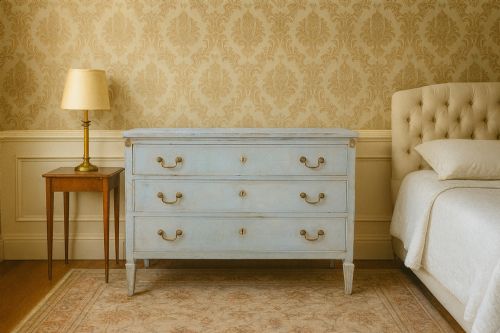

Swedish Neoclassical Chest
These Swedish neoclassical chest examples bring restrained elegance and crisp symmetry to a room, offering practical storage wrapped in continental refinement.
Swedish Neoclassical Chest
A swedish neoclassical chest typically presents clean lines and classical restraint, appearing primarily as painted commodes or birch drawer units from the eighteenth and nineteenth centuries. Buyers searching for this phrase encounter pieces spanning from the mid-eighteenth century through the nineteenth century, including Gustavian examples and later revival forms.
The selection ranges from eighteenth-century painted commodes bearing circa dates to nineteenth-century Empire revival and Biedermeier secretaire variations. Alongside standard chests of drawers, one finds pairs of commodes and oak or ebonised wood versions.
Materials and Construction
Carpenters utilised native softwoods and hardwoods like pine, birch, and oak, often applying birch veneer or paint finishes to the exterior surfaces. Metal and brass hardware provides functional contrast to the wooden carcases.
Surfaces frequently show hand-applied paint, sometimes in black or lighter Gustavian palettes, alongside ebonised wood details and inlaid woodwork.
Swedish Neoclassical Chest Retail Price Guide 2026
Typical asking prices for swedish neoclassical chest among the pieces listed under this phrase on Sellingantiques today, from the lower quarter to the upper quarter. They describe what is for sale here now, not the wider market.
The inventory spans the eighteenth century and the nineteenth century, covering Gustavian and Biedermeier styles.
Assessing Quality and Execution
Quality reveals itself in the crispness of the carving, the selection of figured birch veneer, and the fidelity of the neoclassical proportions. Finer examples display meticulous hand-painted surfaces and well-fitted drawer construction that endure across centuries.
Revival pieces and later nineteenth-century interpretations vary in how closely they adhere to eighteenth-century prototypes, with superior specimens maintaining sharp architectural details and balanced hardware placement.
The Swedish Neoclassical Chest Glossary
- Gustavian
- The Swedish interpretation of neoclassical style, characterised by lighter proportions and classical restraint. It developed during the reign of King Gustav III.
- Commode
- A low chest of drawers or cabinet originating in France and adopted across Europe. In Scandinavian contexts, it often serves as a principal decorative storage piece.
- Biedermeier
- A Central European style popular during the nineteenth century, focusing on utility and clean lines. Pieces from this movement often showcase rich wood grains without excessive ornamentation.
- Secretaire
- A desk or chest featuring a writing surface concealed within a drawer or fall-front compartment. This form combines storage with practical writing capabilities.
Swedish Neoclassical Chest: Frequently Asked Questions
How do I spot a Gustavian chest?
Look for pale painted finishes, fluted columns, and subtle neoclassical carvings derived from French and Italian models.
These pieces usually feature straight tapering legs and restrained symmetrical facades rather than heavy baroque curves.
What is birch veneer?
Birch veneer involves thin slices of birch wood applied over a secondary timber carcase like pine.
This technique creates striking grain patterns on the drawer fronts while maintaining structural stability.
Where were these chests used?
They served primarily in domestic bedrooms, grand halls, and reception rooms for storing linens and garments.
Their decorative surfaces also allowed them to function as display surfaces for mirrors and lamps.
How do nineteenth-century revivals differ?
Nineteenth-century revival pieces reinterpret earlier eighteenth-century motifs through the lens of later Victorian or Empire tastes.
They often incorporate bolder wood grains, ebonised details, or denser construction methods.