


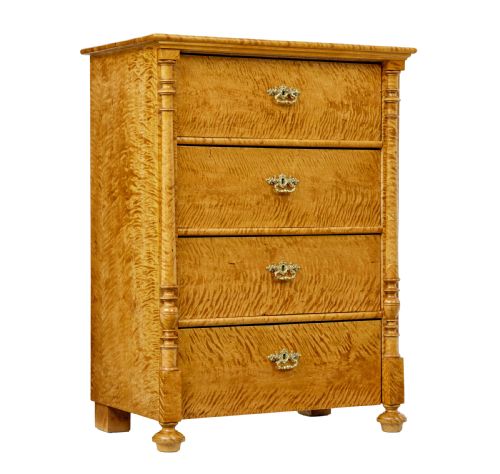


Biedermeier Style Commode
These pieces of biedermeier style commode bring restrained form and striking wood grains into a room, offering practical storage with distinct continental character.

Biedermeier Style Commode
A biedermeier style commode serves primarily as a chest of drawers or a secretaire commode, providing deep storage behind flat or serpentine fronts. Buyers searching this phrase encounter nineteenth-century examples originating from Sweden, France, and Britain.
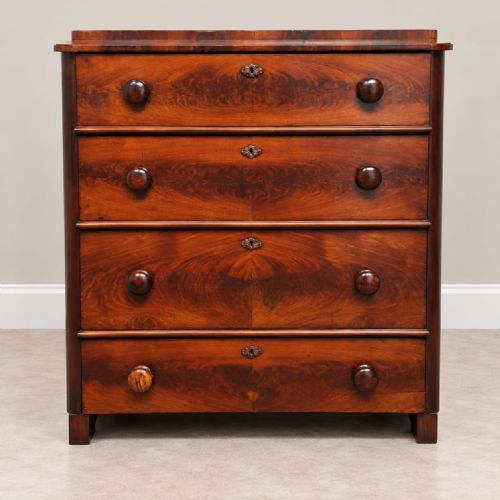
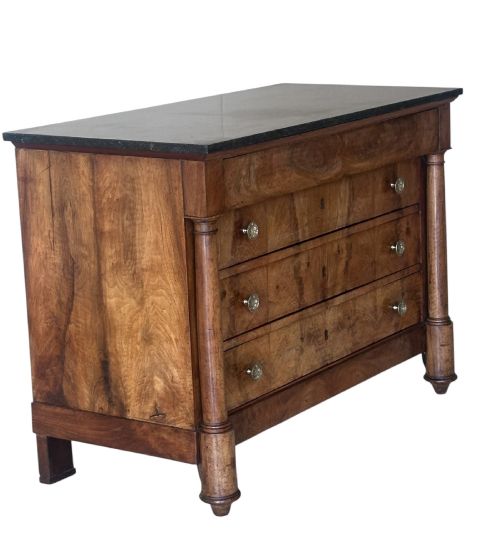
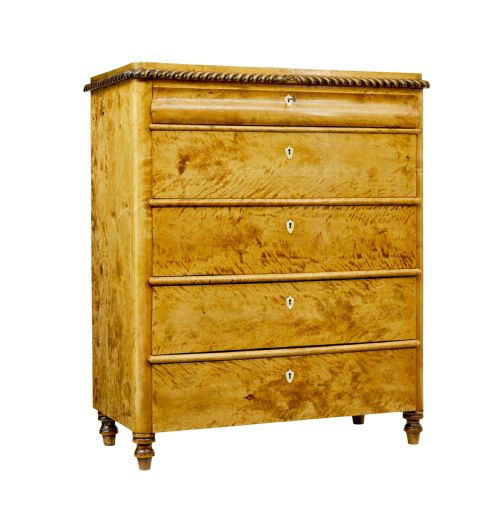
The pieces on this page appear most frequently as nineteenth-century Swedish birch chests of drawers, alongside Victorian mahogany variants and French burr elm or walnut commodes. Forms range from simple caddy top designs to secretaire commodes with fitted desk interiors.
Originating across continental Europe and Britain, these items reflect specific regional tastes from the nineteenth century, including Swedish Empire revival styles and Scandinavian country pieces. Each object balances utilitarian function with the clean structural lines characteristic of the period.
Materials and construction
Cabinetmakers constructed these pieces using solid pine or secondary woods as carcasses, applying figured veneers such as birch, satin birch, tiger birch, burr elm, and mahogany to the exterior surfaces. This technique displayed the natural grain patterns of the wood to maximum visual effect.
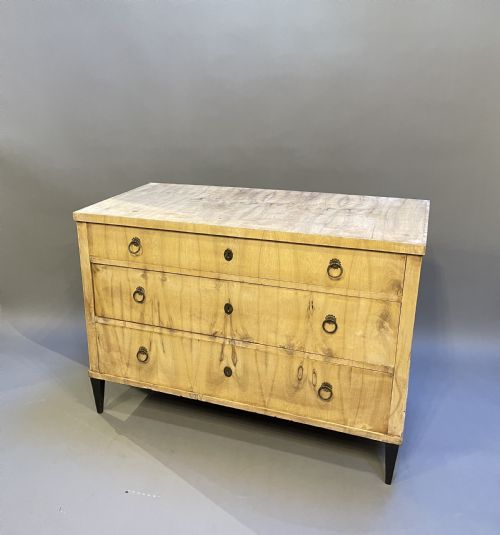
Details include contrasting ebonised wood accents and brass hardware such as keyplates and handles. Carved elements appear on specific regional pieces, while French and Swedish workshops relied heavily on smooth, polished veneer surfaces to define the aesthetic.
Biedermeier Style Commode Retail Price Guide 2026
Typical asking prices for biedermeier style commode among the pieces listed under this phrase on Sellingantiques today, from the lower quarter to the upper quarter. They describe what is for sale here now, not the wider market.
The selection includes regional variations such as Swedish Empire revival, Charles X, and Scandinavian country furniture forms.
Distinctions in quality
Joinery standards and the retention of original brass mounts or ebonised details dictate the integrity of each commode. Pieces featuring fitted interior compartments, such as secretaire drawers, demonstrate greater complexity in their original manufacture.
The Biedermeier Style Commode Glossary
- Commode
- A decorative chest of drawers or cabinet designed for domestic storage. Originating in France, the term applies broadly to low chests from the nineteenth century.
- Secretaire commode
- A chest of drawers featuring a pull-out or drop-front drawer that conceals a fitted writing desk with small compartments. This dual-purpose furniture type provides both storage and a writing surface.
- Serpentine front
- A furniture front characterised by a curving line, typically convex in the centre and concave at the sides. This contour requires skilled carpentry to shape the wood and matching veneers.
- Caddy top
- A raised, stepped tabletop edge resembling the lid of a tea caddy. This decorative moulding finishes the upper surface of a chest of drawers.
- Veneer
- A thin layer of figured wood applied over a secondary timber base. Cabinetmakers used birch, mahogany, and elm veneers to create decorative patterns on flat surfaces.
Biedermeier Style Commode: Frequently Asked Questions
How do I identify a Swedish biedermeier commode?
Swedish pieces often feature pale timbers like birch, tiger birch, or satin birch, combined with minimal ornamentation and clean architectural lines.
They frequently display dark ebonised wood details that contrast sharply against the lighter veneer bodies.
What is the difference between a commode and a chest of drawers?
In historical terms, a commode refers to a decorative low chest of drawers, often of continental European origin.
British examples from the nineteenth century are more commonly catalogued simply as chests of drawers, though both serve identical storage purposes.
Where should I place a commode in my home?
These chests function well in bedrooms, hallways, or living rooms as statement storage pieces that hold linens, clothes, or dry goods.
The finished top surface also provides a display area for lamps, mirrors, or decorative objects.
Are these commodes suitable for daily use?
Nineteenth-century chests of drawers are built with sturdy timber carcasses and robust drawer construction designed for enduring domestic utility.
Routine care involves maintaining consistent room humidity to protect the historical wood veneers from cracking.
What does Empire revival mean for these pieces?
Empire revival refers to nineteenth-century furniture that reinvents the earlier neoclassical styles popular during the French Empire period.
These pieces retain strong symmetrical forms, restrained classical proportions, and distinct wood grain selections.