




Stone Bridge Watercolour
A stone bridge watercolour brings the quiet permanence of masonry and water into a room through delicate washes on paper.
Stone Bridge Watercolour
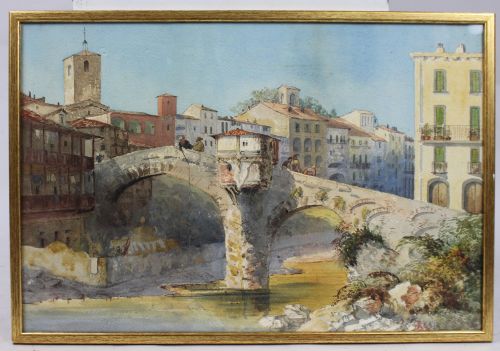
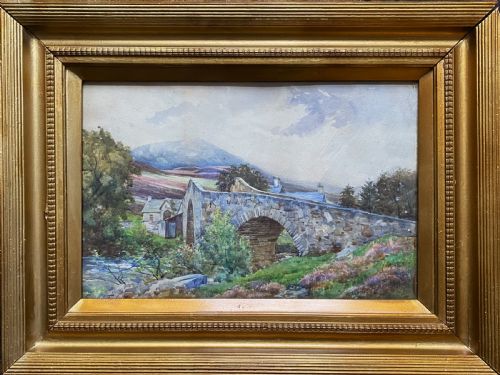
A stone bridge watercolour captures river crossings and rural pathways, recorded across the nineteenth and early twentieth centuries by artists working within the British School and regional traditions like the Norwich School. These works range in style from nineteenth century romanticism and Victorian detailed observation to later British impressionism and landscape painting.
The compositions frequently focus on structural spans set against countryside landscapes, mountain streams, or woodland rivers. Collectors find works from named hands alongside evocative pieces from the wider British school, documenting locations from Yorkshire and Dartmoor to Swiss and Italian vistas.
How they were made
Artists painted using watercolour pigments suspended in water, applied directly to paper surfaces to build up transparent washes of colour. The physical support relies on traditional paper sheets, occasionally housed within wood frames embellished with gilt metal or gilt accents.
Makers layered fluid pigments to capture the play of light over water and the solid texture of stone arches. Control of the brush and the absorbency of the paper determined the crispness of architectural details and the softness of atmospheric backgrounds.
Artists frequently paused by country streams to capture stone bridges, leaving behind enduring records of historic crossings and old mill wheels.
What varies in quality
The strength of a stone bridge watercolour rests on the artist's command of light and structural perspective, where confident washes define both the rigid masonry of the bridge and the fluid movement of the river below. Superior examples demonstrate a precise balance between architectural draughtsmanship and atmospheric landscape interpretation.
The handling of the paper surface and pigment saturation distinguishes accomplished watercolours from simpler topographical sketches. Works by established regional artists or named painters generally display a surer grasp of tonal depth and compositional harmony.
Percy Lancaster·Thomas Lound·James H Hulse·Fred Stead·Noel Harry Leaver·George Graham·Fred Lawson·Clarkson Frederick Stanfield·GBPS Lillingston
The Stone Bridge Watercolour Glossary
- Watercolour
- A paint consisting of pigment suspended in a water-soluble vehicle, used on paper to create translucent washes.
- British School
- A broad classification for artists trained or working in Britain, encompassing various regional and stylistic movements.
- Norwich School
- The first provincial art movement in Britain, focusing particularly on local landscape subjects in East Anglia.
- Gilt
- A thin layer of gold applied to wood frames or decorative elements to provide a metallic sheen.
Stone Bridge Watercolour: Frequently Asked Questions
How should I frame a watercolour?
Watercolours need protection from direct sunlight and moisture to prevent the pigments from fading and the paper from degrading. Framing under glass with acid-free mounts ensures the paper remains separated from the glazing.
Positioning the artwork away from direct heat sources and bright windows preserves the delicate balance of the original washes.
How do I date an antique watercolour?
Dating relies on stylistic clues, artist signatures, framing materials, and occasionally inscriptions left on the reverse of the paper. Mid-nineteenth century works often show tighter architectural precision, while later pieces lean towards impressionistic brushwork.
Comparing the paper type and any visible watermark helps confirm the period of manufacture alongside the recorded date of the painting.
What subjects appear in these paintings?
The primary focus centres on stone bridges spanning rural rivers, mountain streams, and country valleys. Artists recorded specific British locations in Yorkshire and Dartmoor, alongside continental views in Switzerland and Italy.
Figures, carts, and mills frequently accompany the central bridge motif, adding scale and narrative interest to the landscape.
How do regional schools differ?
Regional schools reflect the specific landscapes and training traditions available to artists outside the capital. The Norwich School, for instance, developed a distinct local approach to light and atmosphere in landscape painting.
Other works align with broader Victorian tendencies or early twentieth-century British impressionism, each bringing a different handling of colour and pigment density.