
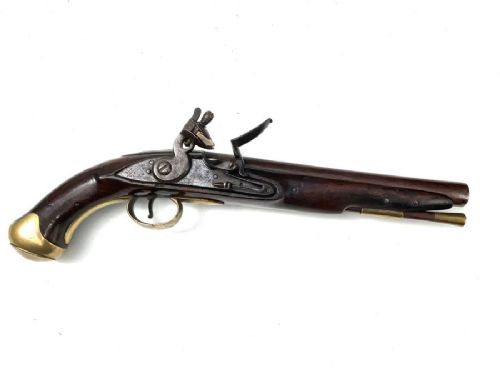


Steel Flintlock Handgun
A steel flintlock handgun demands attention for its mechanical heritage, combining iron, steel, and flint into a functional mechanism.
Steel Flintlock Handgun
A steel flintlock handgun encompasses various historical forms including pocket pistols, dragoon pistols, holster pistols, and long barrelled examples. These pieces emerge from periods spanning the seventeenth, eighteenth, and nineteenth centuries, taking influences from Georgian, Napoleonic, Victorian, and Ottoman styles.
The versions most likely to meet a buyer on this page include British military and civilian arms alongside Balkan, Ottoman, and French pieces. Such items range from heavy cavalry service weapons to small travelling and muff pistols intended for personal defence.
Makers and ordnance locations such as London, Tower, and specific regional workshops stamp their identity onto locks and barrels. Geographical origins stretch across England, Scotland, Ireland, France, Belgium, Russia, and Turkey.
Materials and Technique
Makers construct these firearms using forged steel and iron for the locks, barrels, and furniture, paired with stocks shaped from dense woods like walnut. Brass and silver appear frequently as mountings, decorative wire inlays, and sideplates.
Craftsmen employ flint to generate a spark against the steel frizzen, igniting the powder charge within the barrel during the action. Stock surfaces often receive intricate carving, engraving on mounts, or mother-of-pearl embellishments, depending on the origin.
Listings feature walnut, brass, silver, and iron alongside flint and mother-of-pearl across Georgian and Napoleonic eras.
Distinctions in Execution
The quality of a steel flintlock handgun depends upon the crispness of the lock mechanism and the precision of the metal engraving. Superior examples display balanced proportions between the steel barrel and the figured walnut or ornamented stock.
Signed locks by recognised makers or military proof marks elevate the standing of a piece compared to unmarked civilian iterations. The integration of silver wire inlay and brass furniture reflects the tier of craftsmanship invested by the workshop.
Harrison of London·T. Potts·John Campbell of Doune·Henry Nock·La Motte·James Barber·Timothy Hughes·Brasher·Thomas Anelli·Meyer & Mortimer·Barber of Newark·Dutton
The Steel Flintlock Handgun Glossary
- Flintlock
- A firearm ignition mechanism that uses a piece of flint held in a cock to strike a steel frizzen, producing sparks to ignite gunpowder. This system dominated military and civilian arms for centuries.
- Snaphaunce
- An early predecessor to the flintlock featuring a manually operated frizzen and a separately released pan cover. It appears on regional pieces from the seventeenth and eighteenth centuries.
- Frizzen
- The vertical steel plate struck by the flint to create sparks while covering the priming pan. Its grooved surface aids in directing the spark downward.
- Canon barrel
- A barrel shaped with stepped contours resembling the profile of a cannon, commonly seen on eighteenth-century pocket pistols. This design reduces muzzle weight while maintaining thread strength at the breech.
- Scroll-butt
- A distinct stock termination curved in a scroll shape, frequently found on Scottish Highland pistols. This form allows a secure grip during use.
Steel Flintlock Handgun: Frequently Asked Questions
How do I care for a steel flintlock handgun?
Keep the metal components lightly oiled with a suitable preservative to prevent oxidation, and store the piece in a dry, stable environment away from humidity.
Avoid handling the bare metal excessively with bare hands, as natural oils can promote tarnishing on steel and silver surfaces.
Were these pistols used by the military?
Many examples on this page served military forces, including British cavalry regiments, dragoon units, and sea service personnel. These regulation arms bear inspection marks and ordnance stamps.
Civilian variants, such as pocket and travelling pistols, served private individuals for personal protection during travel.
How do I distinguish an eighteenth-century model?
Eighteenth-century pieces typically display graceful stock contours, distinctive lockplate flat profiles, and specific barrel proof marks. Stylistic cues like silver wire inlay or brass mountings often align with Georgian fashion.
Maker signatures engraved on the lockplate provide direct chronological anchors when cross-referenced with working decades.
What is the difference between Ottoman and British pistols?
British pistols prioritize standardised military utility or clean civil lines, often featuring walnut stocks and steel barrels with London proof marks. Government contracts dictate much of their output.
Ottoman and Balkan variants showcase elaborate silver inlay, rat-tail mechanisms, or mother-of-pearl surfaces, reflecting regional decorative traditions tailored for local officers and collectors.