
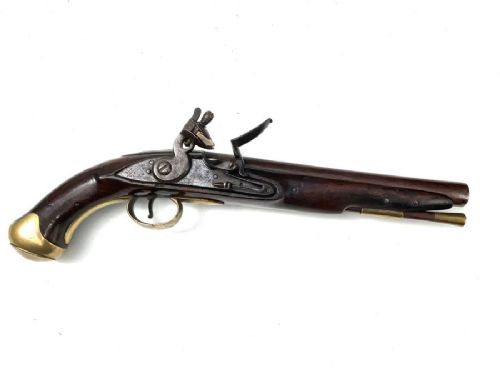


Flintlock Holster Pistol
A flintlock holster pistol is a large-bore handgun designed for saddle carry, combining practical military utility with remarkable craftsmanship.
Flintlock Holster Pistol
A flintlock holster pistol represents a substantial firearm engineered to be carried in saddle holsters by cavalrymen and travellers during the eighteenth and nineteenth centuries. These pieces span regions from Georgian Britain to the Ottoman Balkans, reflecting diverse military and civilian requirements of the period.
Buyers encounter forms ranging from British military sidearms to ornate Ottoman Balkan and Scottish Highland variants. The selection frequently includes pieces decorated with brass furniture, silver inlay, and carved wood stocks from the eighteenth century and the early nineteenth century.
Materials and construction
Gunmakers constructed stocks from dense timbers such as walnut, often enhancing the grip with silver wire inlay, intricate carving, or metal mounts. Barrels and lock plates utilised steel, iron, and brass, matched with mechanisms designed to strike a spark from flint against a steel frizzen.
Decorative elements incorporated precious metals including silver and gold, alongside mother-of-pearl accents particularly seen on regional Ottoman and Balkan pieces. Proof marks stamped into the metal certified the quality and testing of the barrel before assembly.
Flintlock Holster Pistol Retail Price Guide 2026
Typical asking prices for flintlock holster pistol among the pieces listed under this phrase on Sellingantiques today, from the lower quarter to the upper quarter. They describe what is for sale here now, not the wider market.
Distinctions in quality
Quality rests upon the crispness of the lock mechanism, the integrity and figure of the wooden stock, and the precision of any metal engraving or wire inlay. Master makers integrated functional reliability with balanced proportions, ensuring the piece balanced well in the hand.
Originality of components and the sharpness of maker signatures on the lock plate or barrel elevate a piece significantly. Pieces retaining their matching mounts, original flintlock geometry, and undisturbed patina command greater appreciation among collectors.
Harrison of London·John Campbell of Doune·T. Potts, London·Timothy Hughes·Thomas Anelli·R. Willoughby·Meyer & Mortimer·Ezekiel Baker·Collumbell Of London·Hofmann·Richards
The Flintlock Holster Pistol Glossary
- Flintlock
- A firearm ignition mechanism that uses a flint held in a cock to strike a steel frizzen, creating sparks to ignite the priming powder. This system dominated personal firearms technology for centuries.
- Holster pistol
- A large handgun intended to be carried in a saddle holster rather than on a belt. These arms feature substantial barrel lengths to achieve greater velocity.
- Miquelet
- A form of flintlock mechanism common in Spain, Italy, and the Ottoman Empire. It employs an external mainspring and a combined steel and frizzen.
- Bore
- The interior diameter of the barrel. Historical listings record various bores that dictate the size of the lead ball fired.
- Proof mark
- An official stamp applied to the barrel and lock confirming that the firearm successfully underwent pressure testing. British pieces frequently display London or provincial verification marks.
Flintlock Holster Pistol: Frequently Asked Questions
How were holster pistols carried?
These large pistols were housed in leather holsters draped across the pommel of a saddle, allowing a rider quick access on horseback.
Civilian travellers also utilised carriage holsters for personal protection during long journeys on the road.
Are these pistols fully working?
Many surviving examples retain mechanical functionality with crisp spring action in the lock, though historical pieces require expert assessment before any attempt at firing.
Several pieces are preserved as decorative or collection items for display rather than active use.
How do you identify British provincial pistols?
British provincial pieces often bear the maker signature on the lock plate alongside specific regional proof marks and hallmarks on the silver mounts.
Makers working outside London stamped their names to denote local craftsmanship and adherence to domestic standards.
What defines Ottoman Balkan pistols?
Ottoman Balkan holster pistols are distinguished by miquelet locks, brass or silver cladding, and elaborate rat-tail or scroll butt formations.
These arms frequently incorporate regional decorative techniques such as niello work, coral inlay, and embossed metal mounts.