
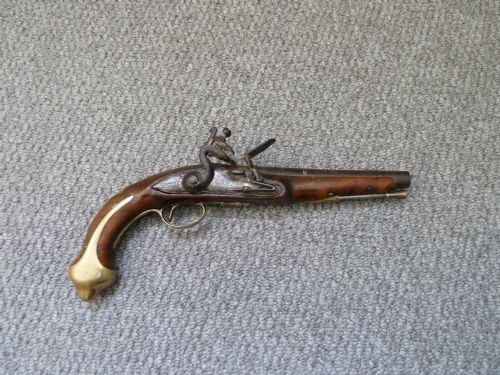
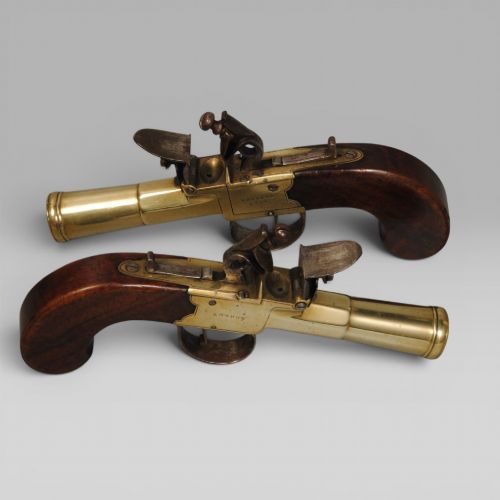


Brass Barrel Pistol
A brass barrel pistol is a historic firearm combining metal and timber, sought after for its distinctive alloy sheen and period mechanics.
Brass Barrel Pistol
A brass barrel pistol represents an era of personal defence and military equipment spanning the eighteenth and nineteenth centuries. These pieces encompass flintlock and percussion ignition systems, serving civilian travellers, naval officers, and cavalry regiments alike.
The versions most commonly met on this page range from compact pocket and overcoat pieces to heavier dragoon and holster arms. Styles extend across Georgian British forms, Napoleonic European pieces, and Ottoman examples from the Balkans.
Makers and regional workshops produced these firearms in distinct sizes, from short boxlock turn-off variants to long-barrelled service pieces. Each object reflects the specific tactical requirements of its original user.
Distinctions in Quality
The standard of a brass barrel pistol depends upon the crispness of the maker's signature engraving and the precision of the metal casting. Superior examples display clean lines on the brass work and well-executed scrollwork or silver inlay on the timber.
The integration of the lock mechanism with the stock indicates the skill of the original gunsmith. Better pieces maintain tight tolerances between the brass barrel, lock plate, and walnut body without excessive gaps.
Materials recorded across the archive include brass, steel, and walnut wood.
Henry Nock·La Motte·Thomas Henshaw·I Parr·John Rimes·J Robinson·Cairns And Co·Ketland And Co·Bunney·Bass·A W Spires·Wilson
The Brass Barrel Pistol Glossary
- Flintlock
- An ignition mechanism that uses a piece of flint struck against a steel frizzen to create sparks. This system dominated military and civilian firearms throughout the eighteenth century.
- Turn-off
- A barrel design that unscrews from the breech to allow loading from the front of the chamber. This feature appears frequently on pocket and coat pieces.
- Boxlock
- A firearm action where the lock mechanism is enclosed within a single metal frame rather than mounted on a separate side plate. It provides a clean exterior profile.
- Percussion
- A later ignition system utilising a hammer striking a percussion cap containing fulminate of mercury. This technology largely replaced flintlock arms during the nineteenth century.
- Bore
- The interior diameter of the barrel, often measured in standardised gauge or bore sizes. It determines the projectile diameter used by the weapon.
Brass Barrel Pistol: Frequently Asked Questions
What is a brass barrel pistol?
A brass barrel pistol is a historical firearm featuring a copper-alloy barrel designed to resist corrosion from black powder residue and sea air. These pieces were carried by officers, travellers, and naval personnel for personal protection.
They operate primarily via flintlock or percussion mechanisms, housed within timber stocks usually made from walnut. The brass components often display proof marks and maker signatures from London, Birmingham, or continental workshops.
How do you date a brass barrel pistol?
Dating relies upon examining the proof marks stamped onto the metal, the style of the lock plate, and the overall form of the stock. Maker signatures and stylistic cues such as Georgian or Napoleonic military patterns help narrow the period.
Changes from flintlock ignition to percussion systems provide a clear chronological divide between the eighteenth and nineteenth centuries. Barrel shapes and mounting styles also shifted noticeably across these decades.
Were brass barrels safe to fire?
Brass provided sufficient strength for the black powder loads used in pocket, holster, and blunderbuss pistols of the Georgian era. Metallurgy of the period balanced the malleability of brass with the explosive force of standard charges.
Modern handling of antique firearms generally treats them as historical artefacts rather than operational weapons. Proof marks indicate they passed contemporary testing standards when originally manufactured.
How should I clean a brass barrel pistol?
Maintenance of antique firearms focuses on preserving the stable surface patina rather than polishing the metal to a bright shine. Gentle dusting of the walnut stock and light oiling of steel parts prevents active corrosion.
Harsh chemical cleaners or abrasive polishes damage historical engravings, proof marks, and the natural ageing of the brass. Keeping pieces in stable humidity environments protects both the wood and metal components.