
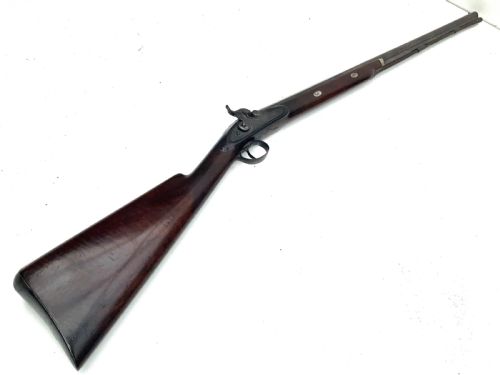


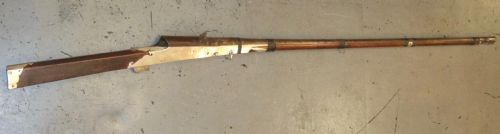
Steel Barrel Musket
A steel barrel musket carries the weight of centuries, offering collectors a tangible connection to military history and early firearms craftsmanship.
Steel Barrel Musket
A steel barrel musket represents a significant category of historic weaponry spanning multiple centuries and global regions. When you search for a steel barrel musket, you encounter firearms that served military campaigns, sporting pursuits, and ceremonial uses.
The pieces available on this page encompass various eras, including the eighteenth century and the Victorian period, reflecting both European military development and Eastern craftsmanship. You will find distinct forms ranging from British service arms to Indo-Persian matchlocks.
Geographic origins vary widely among the listings, showing examples from British makers alongside Indian Torador muskets and French military variations. Each piece demonstrates the specific technological priorities of its region and period of manufacture.
Materials and construction methods
Makers utilised robust metals for the functional components, pairing steel barrels with iron and brass furniture. Stocks were fashioned from dense timbers such as walnut and general hardwood to withstand the stresses of firing.
Decorative application involved meticulous hand inlay work, notably using mother-of-pearl to adorn complex matchlock and flintlock mechanisms. Woodwork was shaped using traditional hand tools, achieving ergonomic stocks suited to military drill and sporting use.
Some muskets are so heavily armoured in shimmering mother-of-pearl inlay that they look ready for a royal gala rather than a muddy battlefield.
Factors of distinction
Quality in these firearms rests upon the precision of the lock mechanism and the integrity of the metal barrel. Finer examples display superior metallurgical work and crisper execution of mechanical parts.
The level of decorative embellishment separates standard service arms from elite pieces. Elaborate mother-of-pearl inlay or signed maker locks indicate higher status and greater artisanal investment.
John Manton & Son
The Steel Barrel Musket Glossary
- Matchlock
- An early type of firearm ignition mechanism that uses a slow-burning match to ignite the gunpowder. This system represents one of the earliest mechanical methods for discharging a hand cannon or musket.
- Flintlock
- A firearm ignition mechanism relying on a piece of flint striking a steel frizzen to create sparks. It succeeded matchlock technology and dominated military arms for over a century.
- Percussion
- An ignition system developed in the nineteenth century that uses a detonating primer struck by a hammer. This method replaced flintlock arms and offered vastly improved reliability in wet weather.
- Toradar
- A traditional South Asian matchlock musket known for its long, slender barrel and extensive binding to the stock. These pieces often showcase intricate decorative treatments from the Indo-Persian sphere.
Steel Barrel Musket: Frequently Asked Questions
What is a steel barrel musket?
A steel barrel musket is a historic shoulder firearm utilising a smoothbore or rifled steel barrel designed for black powder use. These arms trace military and civilian evolution across several centuries.
They encompass diverse firing mechanisms, from early matchlocks to later percussion systems, originating from British, European, and Asian workshops.
How do I identify the period?
Period identification relies on examining the ignition mechanism, stock architecture, and overall manufacturing characteristics. Eighteenth-century arms typically feature flintlock systems, while Victorian examples often show percussion conversions.
Maker signatures, proof marks, and specific regional variations further help narrow down the exact decade or era of production.
Were these used in combat?
Many of these pieces saw active service during major historical conflicts, including revolutionary wars and colonial campaigns. Military issues like the Brown Bess and French cavalry muskons were standard combat gear.
Other examples served as sporting fowlers or court presentation pieces rather than frontline infantry weapons.
How should I display my musket?
Displaying a historic firearm requires a stable environment away from direct sunlight and excessive humidity to protect the wood and metal. Wall mounts or specialised glass cabinets are standard methods for secure presentation.
Ensure the mounting hardware supports the full length of the barrel and stock without placing undue stress on the lock mechanism.