


Flintlock Musket Rifle
These flintlock musket rifle pieces are centuries-old shoulder arms spanning diverse global workshops, offering tangible history for collectors and historians.
Flintlock Musket Rifle
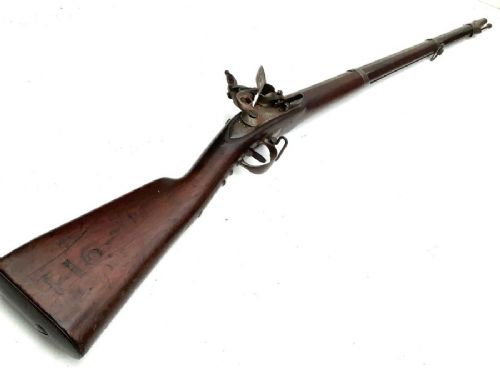
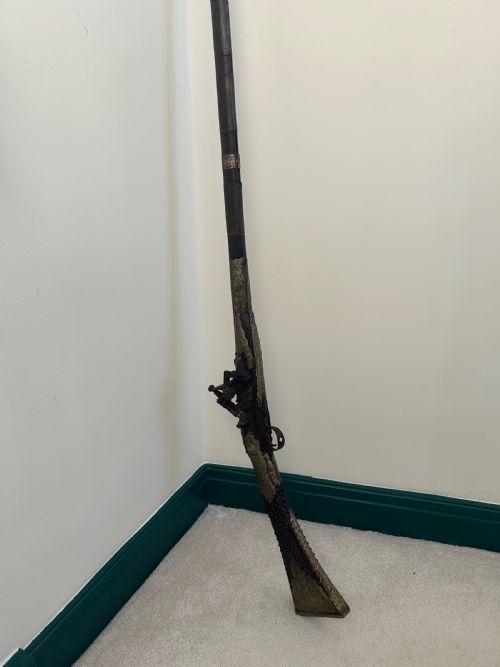
When you search for flintlock musket rifle, you encounter military and tribal long guns originating from regions such as Britain, France, North Africa, and the Ottoman Empire. The inventory includes regulation military arms alongside heavily ornamented tribal variants.
Military examples on this page comprise English Brown Bess muskets, French Charleville and Model 1777 pieces, and East India Company arms. These pieces reflect standard government contracts and active service during the Georgian and Napoleonic eras.
Tribal and regional variations form a major part of the selection, specifically Afghan jezail rifles, Indo-Persian arms, and Balkan frontier muskets. These examples often display distinct local lock mechanisms and regional stock configurations.
How They Were Made
Stocks utilise traditional timbers like walnut and other dense hardwoods shaped to support the heavy barrels and lock mechanisms. Makers secured these barrels to the woodwork using metal pins, bands, or elaborate wire wrapping.
Metal components combine forged iron and steel for barrels and lock plates, complemented by cast brass trigger guards, butt plates, and side plates. Flintlock mechanisms rely on precise spring tension to strike sparks from steel frizzen surfaces.
Decoration involves extensive inlay work using bone, mother-of-pearl, and brass wire to embellish the wooden stocks. These decorative elements reflect the aesthetic preferences of specific regional workshops and individual armorers.
Algierian toe-lock mechanisms offer a delightfully eccentric alternative to standard European locks, ensuring every tribal council had something unique to argue over.
What Varies in Quality
The degree of original martial service versus decorative transformation dictates the character of each piece. Some arms retain their standard military configuration, while others exhibit extensive tribal modification or conversion.
The intricacy and survival of stock ornamentation separate standard service arms from elite presentation pieces. Bone and mother-of-pearl inlays require significant skill to execute without compromising the structural integrity of the timber.
The crispness of the lock mechanism and the legibility of maker stamps or government acceptance marks heavily influence historical value. Original flintlock geometry indicates whether a piece maintains its functional period setup.
Sargant & Son·East India Company
The Flintlock Musket Rifle Glossary
- Flintlock
- An ignition mechanism that uses a piece of flint held in a cock to strike a steel frizzen, creating sparks to ignite the priming powder. This system dominated military and civilian firearms for centuries.
- Jezail
- A type of long gun used across Afghanistan and Central Asia, characterised by a distinct curved stock and often ornate bone inlay. These arms were frequently utilised by tribal forces.
- Brown Bess
- The colloquial name for the standard-pattern British muzzle-loading smoothbore musket used across the Georgian and Napoleonic periods. It served as the principal infantry arm of the British Empire.
- Frizzen
- The vertical steel plate struck by the flint during the ignition sequence to create sparks. Its proper hardening is essential for reliable firing.
Flintlock Musket Rifle: Frequently Asked Questions
What is a jezail rifle?
A jezail is a distinct type of long gun originating from Afghanistan and surrounding regions, recognisable by its pronounced curved stock. These arms were designed for mounted or foot use in rugged terrain.
They frequently feature elaborate bone or mother-of-pearl inlay work across the wooden stock, reflecting regional craftsmanship and tribal aesthetics.
How do I identify a Brown Bess?
The Brown Bess is the iconic British military smoothbore flintlock musket produced in several standard patterns throughout the eighteenth and nineteenth centuries. Look for government ownership marks and military contractor stamps on the lock plate.
These pieces span the Georgian era and saw extensive service during the Napoleonic Wars and the American Revolutionary period.
What is the difference between a musket and a rifle?
Muskets are traditionally smoothbore long arms designed for rapid loading and massed infantry volleys. Rifles feature spiral grooves inside the barrel to spin the projectile for increased accuracy.
Many historical listings group these terms together based on broad period definitions, though surviving examples reveal specific tactical purposes.
How should I display a wall piece?
Wall pieces and non-functional arms require secure mounting brackets that support the weight of the timber stock and metal barrel without causing stress. Ensure the display location avoids direct sunlight and dramatic humidity shifts.
Stable indoor environments protect historical woods and inlaid materials from warping or degradation over time.