

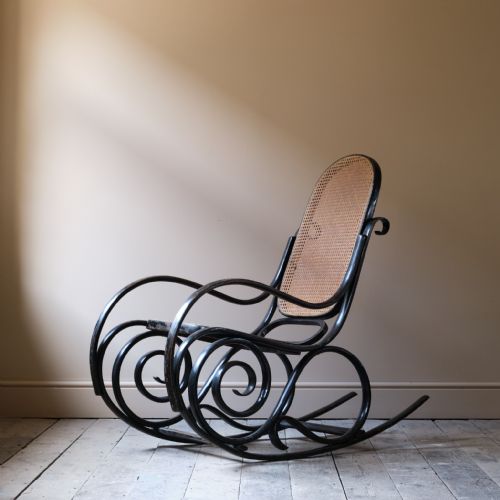
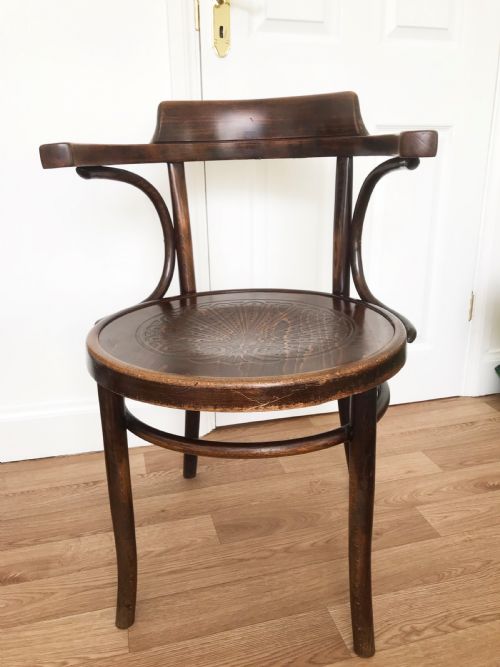


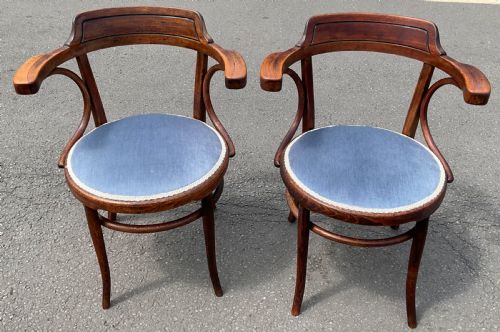


Steam Bentwood Armchair
A steam bentwood armchair brings lightness and organic curves to a room, formed through the simple alchemy of heat and timber.
Steam Bentwood Armchair
A steam bentwood armchair is an exercise in sculptural economy, using heated timber to create continuous curves for backs and arms. The listings on this page span the nineteenth century through the nineteen-twenties, capturing a period when industrial wood-shaping entered both domestic parlours and commercial bistros.
Most examples you encounter here are formed from beech or beechwood, often accompanied by cane seats or upholstered cushions. The styles range from Victorian and Edwardian interpretations to Vienna Secession and distinct Thonet designs, alongside variations like rocking chairs and carvers.
The enduring appeal of these armchairs lies in their deceptive fragility and genuine structural resilience. They offer a masterclass in nineteenth-century mass production that still sits comfortably in modern interiors.
How they were made
Makers utilised steam chambers to soften solid timber until it became pliable enough to force into metal strap-backed bending forms. Once dried and cooled, the beech retained its curved profile without losing structural integrity.
Component parts were typically joined with screws and internal blocks rather than traditional mortise and tenon joints, allowing for rapid assembly. Additional details such as perforated plywood seats or woven cane panels completed the construction with minimal weight.
Steam Bentwood Armchair Retail Price Guide 2026
Typical asking prices for steam bentwood armchair among the pieces listed under this phrase on Sellingantiques today, from the lower quarter to the upper quarter. They describe what is for sale here now, not the wider market.
Some nineteenth-century rocking chairs were built so vigorously that guests occasionally tipped themselves entirely backward into the fern pot.
What varies in quality
The distinction between a standard workshop product and a superior piece lies in the tightness of the curves and the uniformity of the timber grain. Finer chairs display smooth, unbroken sweeps of bentwood without compression wrinkles on the inner radii.
Original hardware, maker branding, and untouched surface patinas on the stained wood elevate certain examples. The precision of cane work or the quality of applied brass elements further separates mass-produced utility items from ambitious design pieces.
Thonet·Jacob and Josef Kohn
The Steam Bentwood Armchair Glossary
- Bentwood
- Wood that has been shaped by exposure to steam and mechanical pressure. This technique allows for sweeping, continuous structural lines that are impossible to achieve through sawing alone.
- Carver
- An armchair designed with arms, traditionally intended for the head of a dining table or for desk use. In bentwood forms, it offers light support without the bulk of upholstered seating.
- Cane
- Woven rattan peel used for seats and back panels. It provides a resilient, breathable surface that complements the light frame of bentwood furniture.
- Vienna Secession
- An artistic movement that emerged in eighteen-ninety-seven, rejecting historicism in favour of cleaner geometric forms. Pieces from this tradition often feature restrained decoration and expressive structural lines.
- Ebonised
- Timber treated with a finish to imitate ebony. This dark, uniform coating was popular in Victorian manufacturing to lend an air of formal elegance.
Steam Bentwood Armchair: Frequently Asked Questions
How do I date a bentwood armchair?
Dating relies on construction methods, labels, and stylistic cues such as Vienna Secession motifs or Victorian ebonising. Early examples often bear paper labels or stamps from the primary manufacturers.
Simpler forms without maker marks can generally be placed by the complexity of the bending and the type of hardware used in the joints.
Are these chairs comfortable for daily use?
Their ergonomic curves were originally engineered for long hours in cafes and homes. The flexible nature of the bent frame offers a slight give that adds to the comfort.
Models with cane seats or added cushions provide adequate support, though they remain lighter and more upright than modern upholstered armchairs.
How should I care for bentwood furniture?
Keep these chairs away from extreme temperature fluctuations and direct heat sources, which can dry out the wood and cause the steam-formed joints to strain. Regular dusting and occasional treatment with suitable wood wax will maintain the finish.
Avoid placing damp items on cane panels, as moisture weakens the woven rattan over time.
What is the difference between a rocking chair and a standard armchair?
Rocking variants feature curved wooden runners attached to the base of the legs, designed to allow a gentle swaying motion. They share the same steam-bent arm and back construction as static armchairs but offer a relaxed seating posture.
Standard armchairs stand on four fixed legs suited for desks, dining tables, or reading corners.