

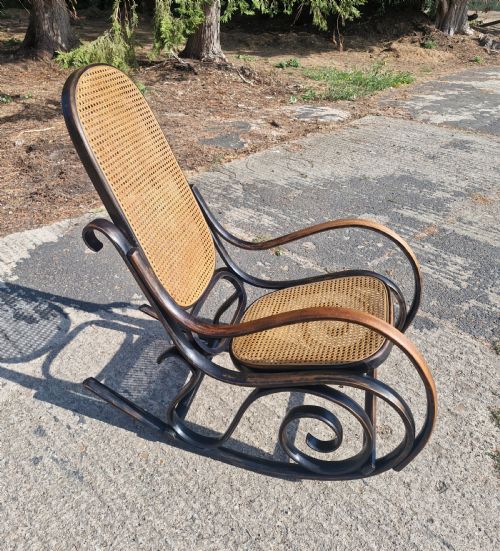
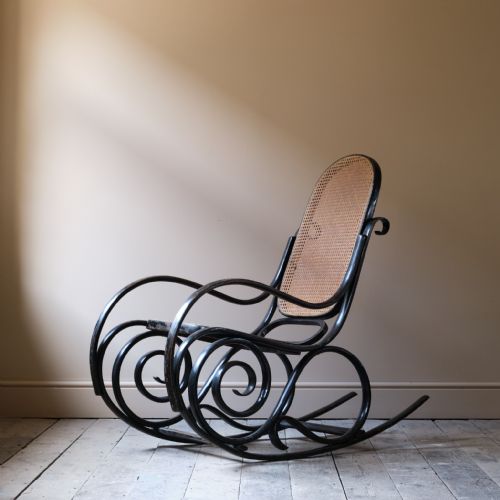


Bentwood Rocking Chair
A bentwood rocking chair brings sculptural fluidity and gentle motion to a room, crafted through the ingenious steaming of timber.
Bentwood Rocking Chair
A bentwood rocking chair offers a lightweight yet resilient seat designed for gentle movement, emerging from periods such as the nineteenth century, Edwardian era, and the 1900s. These pieces combine curved wooden frames with supportive seating surfaces, appearing in forms ranging from full-sized armchairs to smaller child rockers.
The most common examples on this page date from the nineteenth century and the early decades of the twentieth century, including pieces attributed to notable makers. Buyers frequently encounter designs featuring woven cane panels, rattan, or upholstered elements fitted within the characteristic looped wooden runners.
How they were made
Makers produced a bentwood rocking chair by steaming solid lengths of beech wood until pliable, then bending them in metal forms to achieve the sweeping curves of the frame and armrests. Plywood and shaped timber components added structural stability to the seats and backs.
Surfaces were often left with a natural polished finish, ebonised for a dark decorative look, or painted. Seating areas utilised woven rattan cane or fabric and leather upholstery secured directly to the wooden framework.
Bentwood Rocking Chair Retail Price Guide 2026
Typical asking prices for bentwood rocking chair among the pieces listed under this phrase on Sellingantiques today, from the lower quarter to the upper quarter. They describe what is for sale here now, not the wider market.
Listings feature bentwood rocking chair examples utilising beech, cane, plywood, leather, and fabric across nineteenth-century, Edwardian, and 1900 periods.
What varies in quality
Quality in a bentwood rocking chair rests on the complexity of the frame's curvature and the precision of the joinery connecting the bent components. Early production methods and attribution to significant workshops distinguish certain examples through more refined proportions and stamped manufacturer marks.
The condition and integrity of the woven cane or upholstery also influence the standard of a piece. Original surfaces and retained labels from period makers set finer examples apart from later or unmarked productions.
Thonet·Jacob and Josef Kohn
The Bentwood Rocking Chair Glossary
- Bentwood
- Wood that has been heated with steam to make it pliable and shaped into curves. This technique allows for continuous, flowing structural lines without traditional heavy joinery.
- Cane
- Woven material made from the outer portion of rattan palms. It provides a flexible, breathable surface for chair seats and backs.
- Ebonised
- Wood finished to resemble ebony, typically through dark staining or painting. This treatment was common on Victorian and Edwardian furniture.
- Vienna Secession
- An artistic movement of the early twentieth century focusing on modern design and rejection of historicism. Pieces from this style often feature geometric clarity.
- Rattan
- A climbing palm used extensively in furniture manufacturing for its combination of flexibility and strength. The cane derived from it forms durable woven panels.
Bentwood Rocking Chair: Frequently Asked Questions
How do I identify an older bentwood rocking chair?
Look for construction details such as screw fixings, stamped factory marks on the underside, and the specific tightness of the steam-bent curves. Nineteenth-century examples often display simpler lines and hand-woven cane work.
Compare the patina of the wood and the type of finish used, as older pieces exhibit natural wear patterns that develop over decades of domestic use.
Are these chairs comfortable for daily sitting?
Yes, the inherent springiness of the bent beech frame combined with the rocking motion provides a supportive and relaxing sit. The flexible nature of cane or upholstered seats adapts to the body.
They function well in living spaces and nurseries, offering both a functional seat and a striking decorative silhouette.
How should I care for cane seating?
Keep cane panels clean by gently dusting them with a soft brush and occasionally wiping them with a damp cloth to prevent the material from drying out. Avoid placing the chair near direct heat sources.
Proper humidity levels help maintain the elasticity of the rattan and prevent the woven strands from snapping under pressure.
What is the difference between an armchair and a standard rocker?
An armchair version includes integrated side supports formed from the continuous bentwood frame, providing additional upper body enclosure. Standard rockers may feature simpler open sides.
Both types share the same fundamental curved runners that create the rocking action.