



Standing Table Mirror Drawer
A standing table mirror drawer brings together a compact glass and a secure base for daily grooming.
Standing Table Mirror Drawer
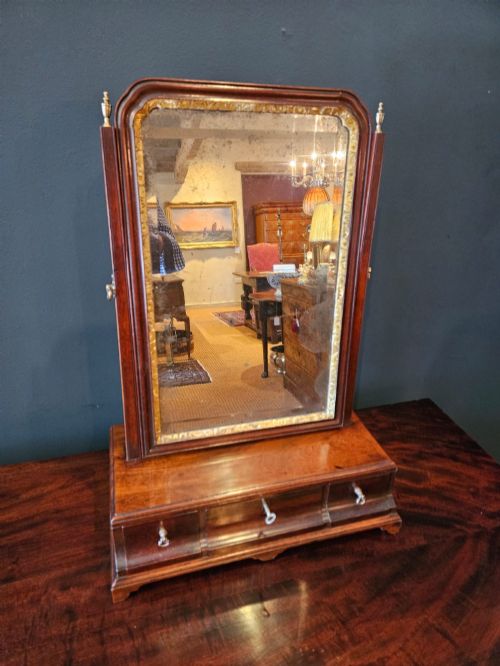
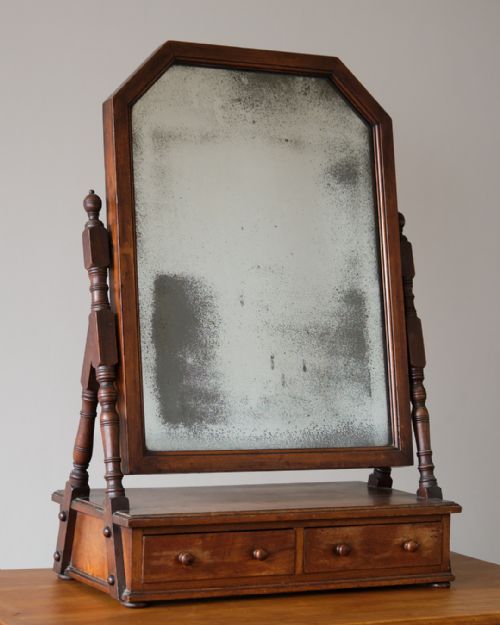
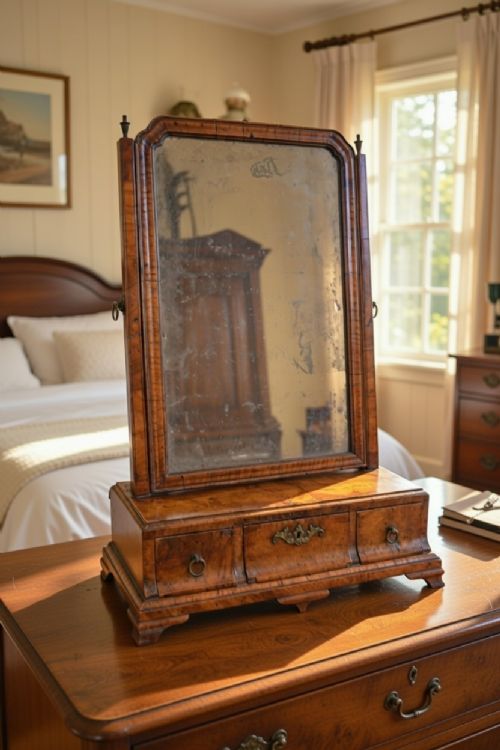
A standing table mirror drawer is a dressing glass designed to sit upon a chest or table while offering small storage compartments in the plinth. You will most frequently meet Georgian and Victorian examples constructed as toilet mirrors or dressing mirrors.
The form spans the eighteenth century through the Edwardian period, encompassing styles from Queen Anne and George II to Regency and Victorian. Makers adapted the proportions to suit changing fashions in interior dressing.
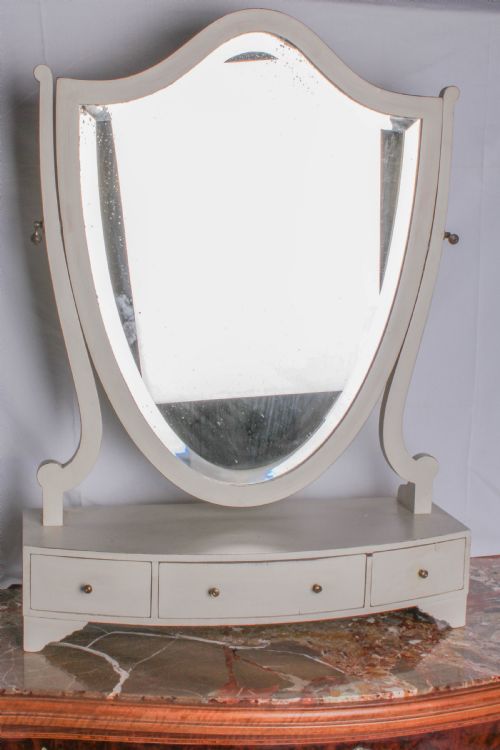
While many take the traditional rectangular or shield shape supported by upright arms, others incorporate bow fronts or satinwood inlays. The incorporation of a drawer sets these mirrors apart from simple swinging plates.
How they were made
Cabinet makers utilised dense hardwoods such as mahogany and walnut, often applying fine veneers and decorative stringing to the drawer fronts and frames. Giltwood, gold leaf, and painted metal also appear on specific periods and regional variants.
Glass plates were set into rebated frames and mounted on pivoting brass screw pins or pivots, allowing the user to adjust the angle of reflection. Secondary timbers such as pine or oak formed the internal linings of the drawers.
Listings feature mahogany, walnut, and satinwood pieces spanning the eighteenth century to the Edwardian era.
What varies in quality
The refinement of the cabinet work dictates the standing of a piece, observable in the tightness of the dovetails on the drawer and the selection of figured wood veneers. Superior examples display balanced proportions and crisply turned upright supports.
Originality of the glass plate and the brass hardware holds considerable weight among collectors. Replacements alter the integrity of the object, whereas surviving period brasses and aged silvering elevate the status of the mirror.
Heal & Sons·J. Shoolbred
The Standing Table Mirror Drawer Glossary
- Toilet mirror
- A portable mirror with a small base containing one or more drawers, historically placed on a dressing table. These pieces allowed users to adjust their reflection during personal grooming.
- Cheval mirror
- A full-length freestanding mirror supported on a frame with four legs, enabling the user to view their entire outfit. They emerged in larger proportions during the Georgian and Victorian eras.
- Bow front
- A convex curved front facade commonly seen on the drawer section of Regency dressing mirrors. This shape softens the rectilinear lines of the cabinet.
- Giltwood
- Timber that has been coated with a thin layer of gold leaf or gesso and gold paint. It provides a bright ornamental finish on decorative frames.
- Dovetail
- A traditional interlocking joint used to construct the corners of the mirror drawers. Fine craftsmanship is evident in the neatness and precision of these pins.
Standing Table Mirror Drawer: Frequently Asked Questions
What is a standing table mirror drawer?
It is a portable dressing glass mounted on a small wooden base that includes one or more integrated drawers.
These pieces were designed to sit upon larger tables or chests to aid with close personal grooming.
How do I date a mirror drawer?
Dating relies on observing the secondary timbers, the style of the drawer construction, and the overall aesthetic period.
Georgian and Victorian pieces exhibit distinct proportions, handle designs, and veneer choices characteristic of their decades.
Are the glass plates original?
Many older mirrors have replacement glass due to the fragile nature of early silvered plates over centuries.
Original plates often show slight foxing or distortion, whereas modern replacements appear clear and uniform.
Where should I place it?
These mirrors function well on top of sideboards, chests of drawers, or dressing tables in bedrooms and hallways.
Their compact footprints require only a stable surface and adequate natural or artificial light.