


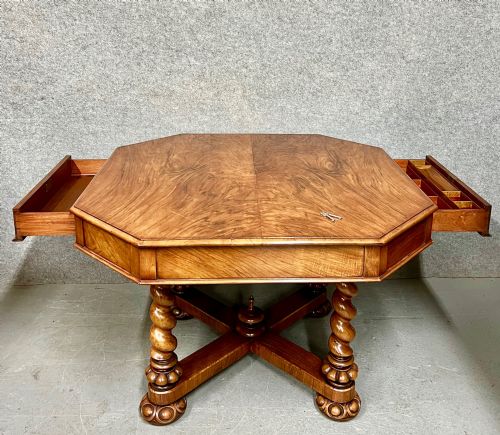
Spiral Twist Leg Desk
A spiral twist leg desk offers structural movement and historic depth, turning a simple workspace into a focal point of craftsmanship.
Spiral Twist Leg Desk
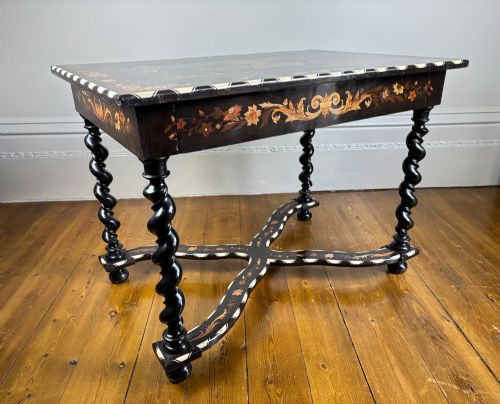
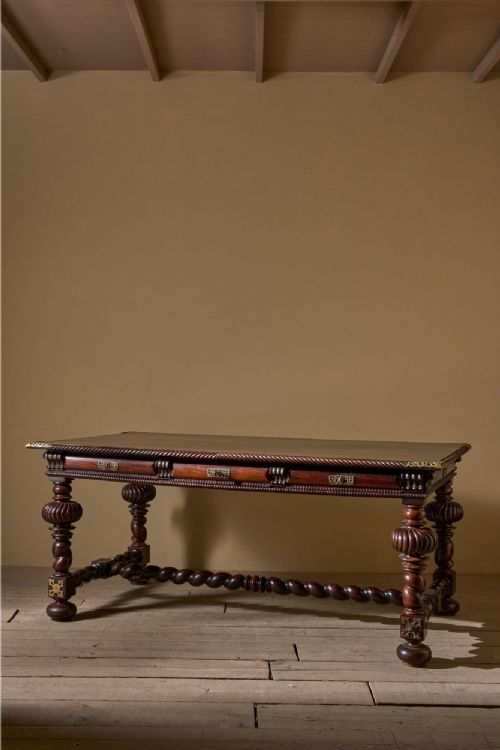
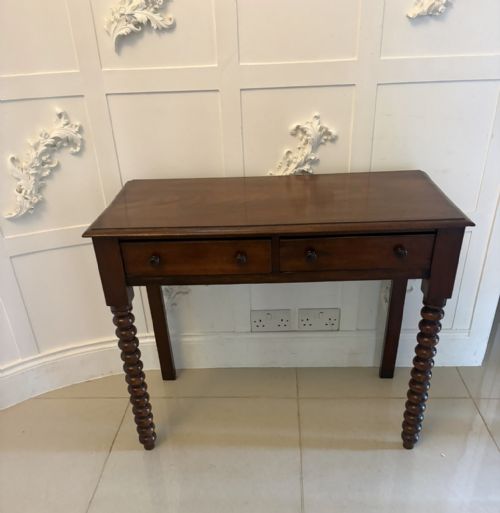
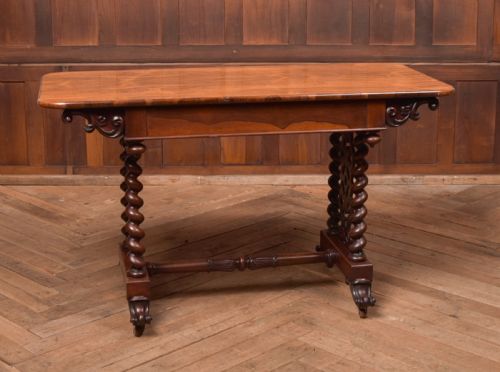
A spiral twist leg desk brings together functional writing surfaces and turned woodwork from centuries past. When you search for a spiral twist leg desk, you encounter forms ranging from compact side tables to library tables adapted for writing. The examples on this page predominantly span the seventeenth through the nineteenth centuries, drawing on Victorian, Georgian, and earlier revival styles.
Makers utilised various timber species to construct these pieces, including mahogany, oak, walnut, and rosewood. Some examples incorporate brass fittings, leather writing surfaces, bone inlay, or ebonised wood finishes. Their forms serve as side tables, library tables, and dedicated writing desks.
Construction and materials
Cabinetmakers shaped solid timbers like oak, mahogany, and walnut to form the structural frames and turned supports. The characteristic spiral or barley twist legs were produced by hand-carving or lathe-turning the wood to achieve precise helical rhythms.
Surface decoration frequently involved intricate marquetry, parquetry, or bone inlay set into the timber. Leather inserts were fitted to writing surfaces, while brass hardware provided functional handles and mounts.
The listings on this page span the seventeenth, eighteenth, and nineteenth centuries, featuring styles from William and Mary to Victorian Gothic Revival.
Assessing quality and character
Quality rests in the crispness of the spiral turning and the selection of figured timber veneers. Superior examples display precise joinery and harmonious proportions between the turned legs and the upper writing box or table top.
The choice of secondary materials, such as elaborate marquetry patterns, bone inlay, or fine brass detailing, elevates a piece. Consistency in the ageing of the timber and the integrity of the structural frame distinguish finer workshops from simpler production.
The Spiral Twist Leg Desk Glossary
- Spiral twist
- A turned wooden furniture leg resembling a helix or rope, popular in seventeenth-century and later revival furniture. It adds dynamic visual movement to vertical supports.
- Marquetry
- The art of applying decorative veneer pieces in wood, bone, or metal to form geometric or pictorial patterns. This technique decorates table tops and drawer fronts.
- Parquetry
- A geometric mosaic of wood pieces used for decorative floors and table surfaces. It creates repeating patterns using contrasting timbers.
- Ebonised wood
- Timber treated to resemble ebony, typically achieved by staining or painting dark finishes onto fruitwood or other light hardwoods. This finish provides high contrast against inlay work.
- Goncalo Alves
- A dense exotic hardwood with striking contrasting grain patterns, sometimes utilised in nineteenth-century British furniture. It offers a rich, decorative surface for high-status tables.
Spiral Twist Leg Desk: Frequently Asked Questions
What periods do these desks date from?
These pieces date from the late seventeenth century through the nineteenth century, encompassing William and Mary, Georgian, and Victorian eras.
Revival styles from the nineteenth century also replicate earlier seventeenth-century Dutch and Portuguese designs using period timbers.
How were spiral twist legs made?
Cabinetmakers turned timber on a lathe or carved the helical shape by hand to achieve the distinctive rope-like twist.
This labour-intensive technique required precise measurement to ensure symmetry across all four legs of a table or desk.
What woods are commonly found?
Common timbers include oak, mahogany, walnut, and rosewood, selected for their structural strength and rich grain patterns.
Exotic woods and ebonised finishes appear on specific continental and revival pieces alongside decorative bone inlay.
Are these tables suitable for daily writing?
Many examples function well as writing desks or side tables, provided the writing height and knee clearance suit modern seating.
Pieces with original leather inserts offer a traditional writing surface, though care must be taken with antique finishes.