
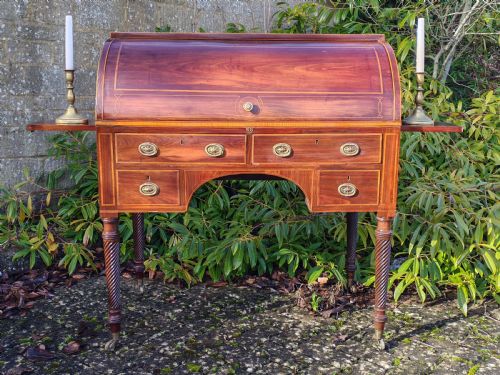


Spiral Leg Desk
A spiral leg desk brings character to a study, offering rich timber and the distinctive twist of barley twist supports.
Spiral Leg Desk
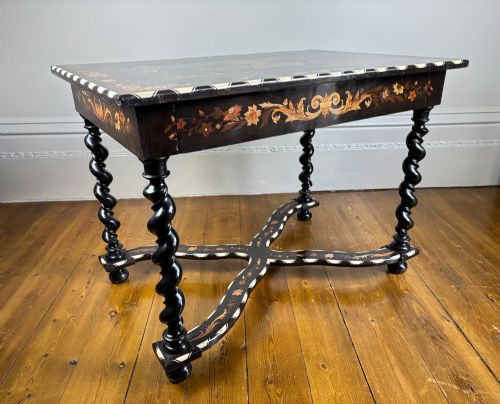
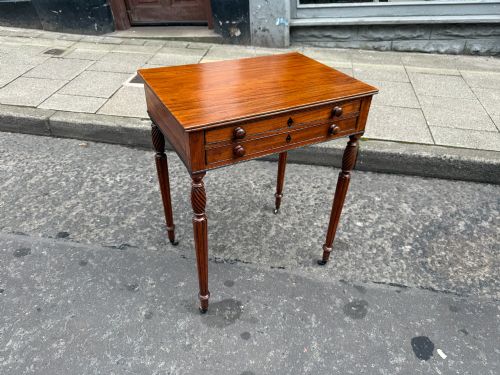
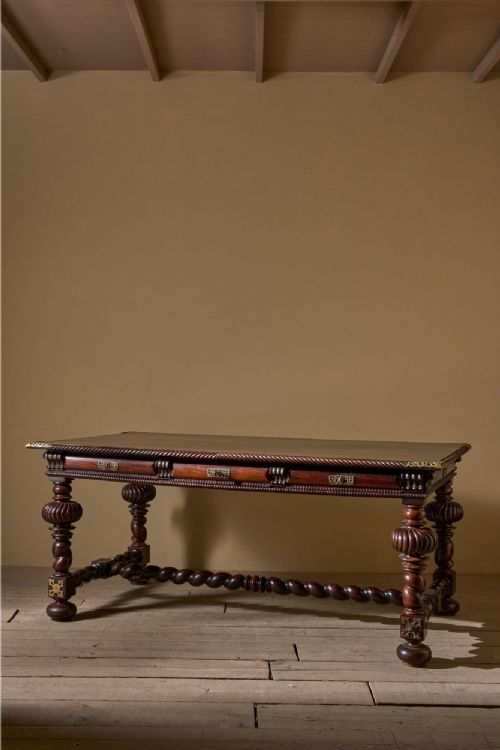
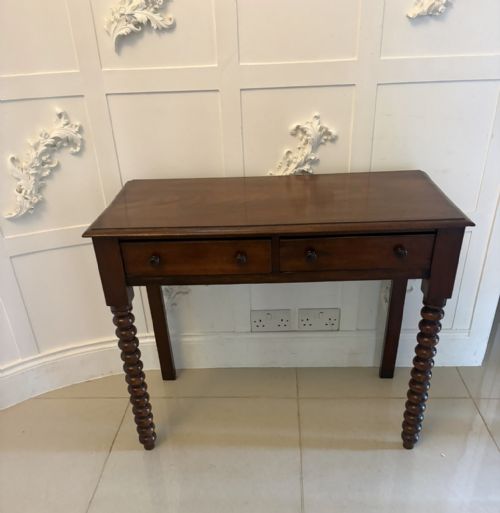
Buyers seeking a spiral leg desk will encounter examples shaped by Georgian, Regency, and Victorian aesthetics, alongside earlier seventeenth-century influences such as William and Mary or Dutch Baroque Revival styles. Some pieces incorporate detailed marquetry, bone inlay, or brass fittings alongside their signature turned supports. These tables and desks served for correspondence, study, and administrative duties in domestic and institutional settings.
How they were made
Cabinet makers constructed these desks using dense hardwoods including mahogany, oak, walnut, rosewood, and satinwood, often selecting veneers for top surfaces to display rich grain patterns. Marquetry and bone inlay appear on specific examples, adding decorative contrast to the primary timber body.
The defining spiral legs were turned on a lathe or hand-carved to create the continuous helical twist known as barley twist. Drawers utilised traditional joinery techniques, and writing surfaces frequently incorporated inset leather panels for a durable workspace.
A solitary nineteenth-century maker marked their work, leaving a quiet signature on an otherwise silent lineage of spiral supports.
What varies in quality
Quality in a spiral leg desk rests upon the crispness of the turned twists and the selection of cabinet timbers used for the top and structural frame. Finely executed barley twists exhibit precise symmetry and smooth finishing, whereas lesser examples show uneven cutting or crude proportions.
The integration of secondary materials, such as finely figured veneers, parquetry, or intact brass hardware, elevates the distinction of a piece. Structural integrity in the joints and the original condition of the writing surface or drawer linings also distinguish superior craftsmanship.
Gillows
The Spiral Leg Desk Glossary
- Barley twist
- A decorative turning resembling a spiral or rope. This form appears frequently on the legs and supports of seventeenth-century and revival furniture.
- Marquetry
- The art of applying pieces of veneer to a structure to form decorative patterns. Craftsmen utilised various woods and sometimes bone inlay to create complex pictorial designs.
- Parquetry
- A geometric mosaic of wood pieces used for decorative floors and furniture surfaces. It creates repeating patterns across table and desk tops.
- Cylinder top
- A desk featuring a rolling curved wooden shutter that conceals the writing surface and interior pigeonholes. This form provides a neat enclosure for correspondence.
- Goncalo Alves
- A dense exotic hardwood with striking contrasting grain patterns. Makers occasionally selected this material for high-status nineteenth-century tables.
Spiral Leg Desk: Frequently Asked Questions
What is a spiral leg desk?
A spiral leg desk is a writing table or desk supported by twisted timber legs, commonly referred to as barley twist supports. These pieces combine functional workspace with decorative turning derived from seventeenth-century and later revival styles.
They appear in various timbers such as mahogany, oak, and rosewood, reflecting the design preferences of periods from the seventeenth century through to the Victorian era.
How do I date a spiral leg desk?
Dating requires examining the timber species, construction methods, and secondary woods used in the drawers and internal framing. Earlier seventeenth-century pieces often feature oak and walnut with pronounced hand-turned twists.
Nineteenth-century revival examples frequently utilise mahogany, rosewood, or walnut combined with machine-assisted turning and nineteenth-century drawer construction techniques.
Where should I place a spiral leg desk?
These desks suit studies, home offices, and living rooms where the distinctive twisted legs can be viewed from multiple angles. Many examples function effectively as freestanding library tables or centre tables.
Ensure the room humidity remains stable to protect solid hardwoods, veneered surfaces, and any inset leather writing panels from drying out.
What woods were used for these desks?
Cabinet makers employed a variety of domestic and exotic timbers depending on the period and region of manufacture. Common choices include mahogany, oak, walnut, rosewood, and satinwood.
Some pieces incorporate contrasting materials like ebonised wood, marquetry, or bone inlay to enhance the decorative scheme of the desk.