





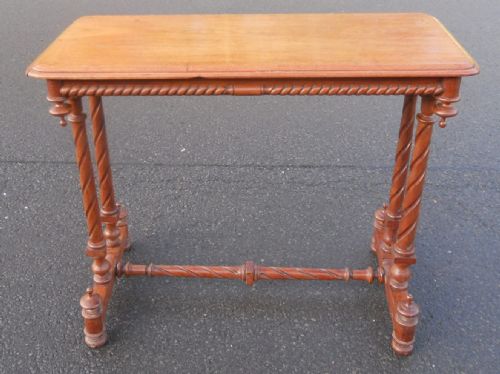
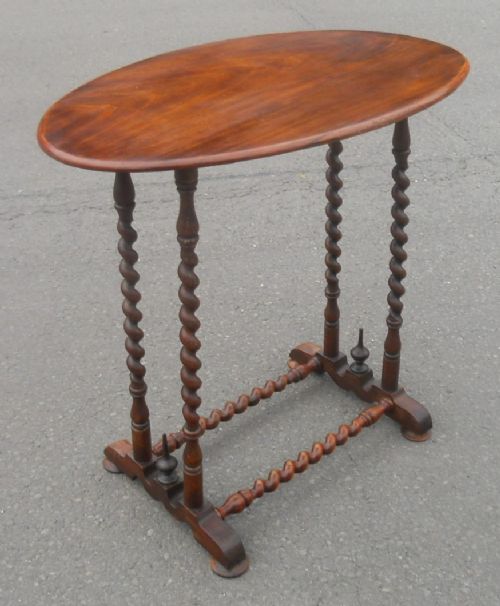

Barley Twist Sofa Table
These barley twist sofa tables are nineteenth-century pieces crafted in woods like walnut and mahogany, offering practical surfaces with distinctive turned supports.
Barley Twist Sofa Table
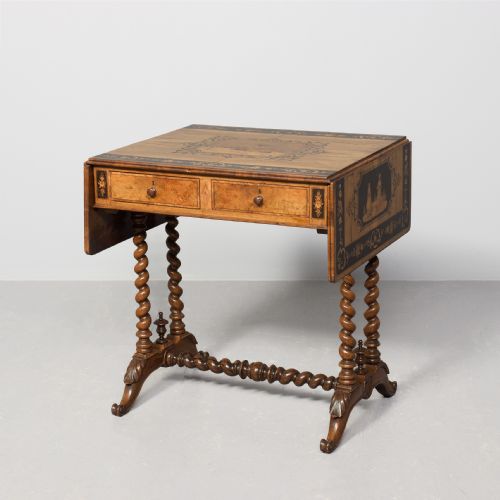
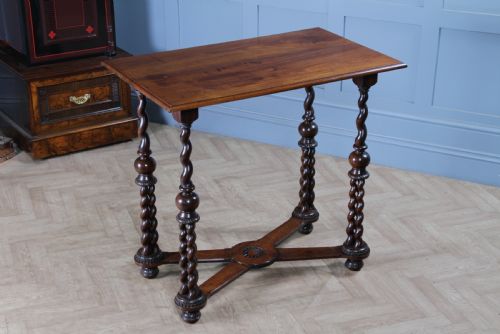
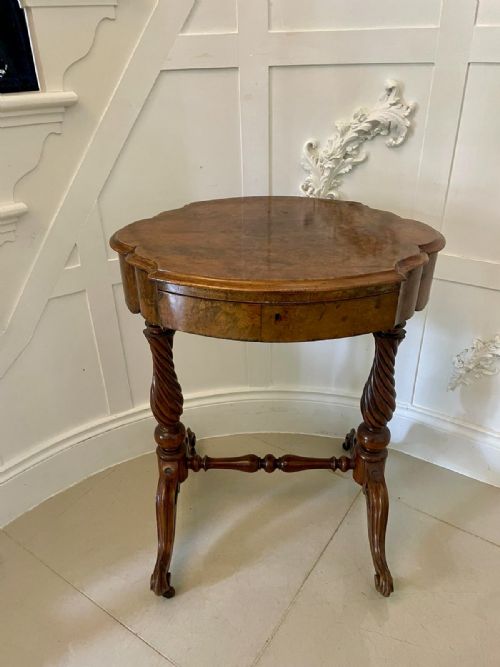
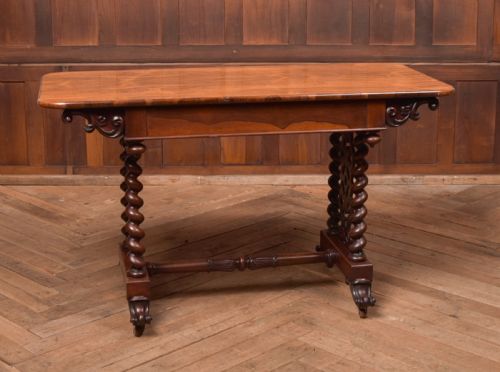
A barley twist sofa table is a nineteenth-century form designed to stand beside seating or against a wall, appearing in periods from Regency to Victorian. The evidence shows forms ranging from early Victorian rosewood two-drawer tables to Italian Sorrento olivewood inlaid pieces and walnut centre tables.
Buyers will most frequently meet Victorian examples on this page, often dated across the 1850s, 1860s, 1870s, and 1880s. These listings include side tables, occasional tables, and writing tables that incorporate characteristic turned uprights and stretchers.
Materials span rich timbers such as burr walnut, goncalo Alves, and rosewood, sometimes augmented by brass fittings and marquetry inlay. The defining visual trait across these tables remains the spiral or twist turning, whether single or triple.
Materials and construction methods
Cabinet makers utilised dense hardwoods like mahogany, rosewood, and walnut to construct these tables, ensuring structural stability for daily use. Timbers were selected for their grain patterns, particularly in burr walnut and olivewood veneers.
Decorative elements such as marquetry inlay and brass mounts were integrated into the surfaces of specific regional and Victorian pieces. Turned elements, including the triple barley twist supports, required precise lathe work to achieve uniform spirals.
Evaluating quality and execution
Quality in a barley twist sofa table rests on the crispness of the turning and the selection of timber veneers. Tables featuring dense burr walnut or figured rosewood demonstrate superior material choice compared to plainer counterparts.
The integration of drawers, brass details, and marquetry inlay indicates the level of craftsmanship invested in the piece. Refined proportions and stable stretcher construction separate standard utility tables from finer regional and Victorian examples.
The Barley Twist Sofa Table Glossary
- Barley twist
- A turned wooden column carved in a spiral shape resembling a twist of barley. This decorative motif appears on the legs and supports of nineteenth-century tables.
- Marquetry
- The art of applying pieces of veneer to a structure to form decorative patterns. Italian Sorrento examples frequently utilise this technique.
- Goncalo Alves
- A dense exotic hardwood with distinctive dark brown and gold markings. It was occasionally employed for nineteenth-century writing and sofa tables.
- Sutherland table
- A narrow drop-leaf table with folding leaves supported by swing legs. The evidence includes Victorian walnut examples of this form.
Barley Twist Sofa Table: Frequently Asked Questions
What is a barley twist sofa table used for?
These tables served various domestic functions in nineteenth-century homes, acting as surfaces for lamps, writing, or needlework. Their narrow proportions allowed them to sit conveniently beside seating or in hallways.
Today, they function well as occasional surfaces in living spaces or as decorative hall tables. Their historic character complements both traditional and contemporary interiors.
How do I date a Victorian table?
Dating relies on observing timber choices, construction techniques, and stylistic markers recorded in the evidence. Pieces from the 1850s often display early Victorian rosewood craftsmanship, while 1870 and 1880 examples introduce specific walnut and marquetry variations.
Examining drawer linings and secondary timbers also helps narrow the period of manufacture. Hallmarks or stylistic cues such as Sorrento inlay further point to specific decades.
What woods were used for these tables?
Cabinet makers relied primarily on durable hardwoods including mahogany, walnut, and rosewood. Finer examples incorporated decorative veneers like burr walnut, olivewood, and goncalo Alves.
Contrasting timbers and brass fittings were sometimes added to enhance the visual appeal of the piece. Each timber selection reflects the design preferences of the nineteenth century.
Are these tables sturdy enough for daily use?
Solid construction in dense hardwoods like mahogany and walnut provides the structural integrity needed for regular placement in a room. Stretcher bases and turned supports distribute weight evenly across the frame.
Careful placement away from direct heat sources helps preserve the timber and any delicate marquetry inlay. Routine maintenance keeps these nineteenth-century pieces functional for modern living.