




Spiral Leg Console Table
A spiral leg console table brings architectural weight and fluid movement to a hallway, drawn from Georgian, Regency, and Victorian periods.
Spiral Leg Console Table
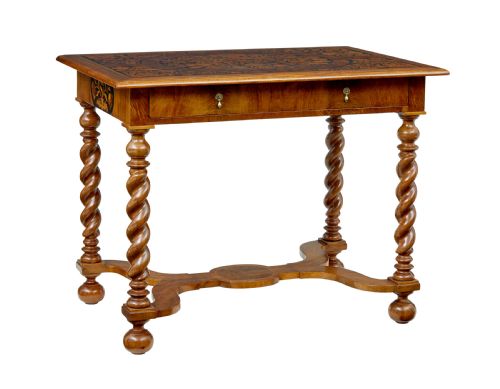
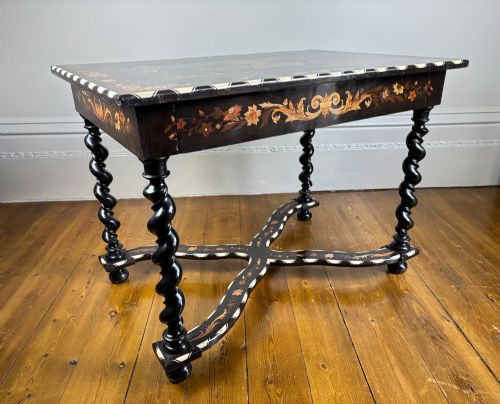
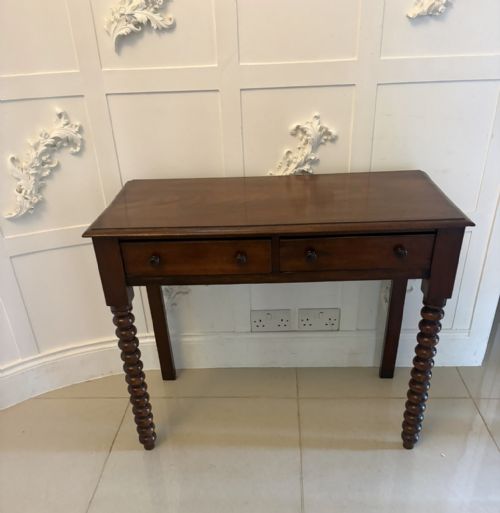
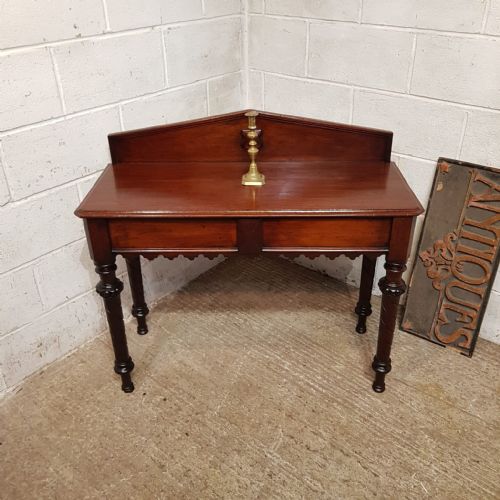
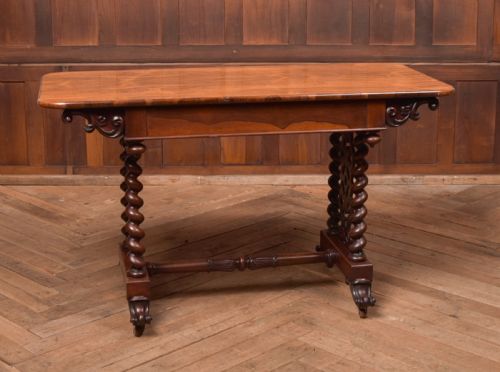
A spiral leg console table represents a specific form of side furniture defined by twisted or barley twist supports holding a timber top. These tables appear across Georgian, Regency, and Victorian periods in mahogany, rosewood, and ebonised wood.
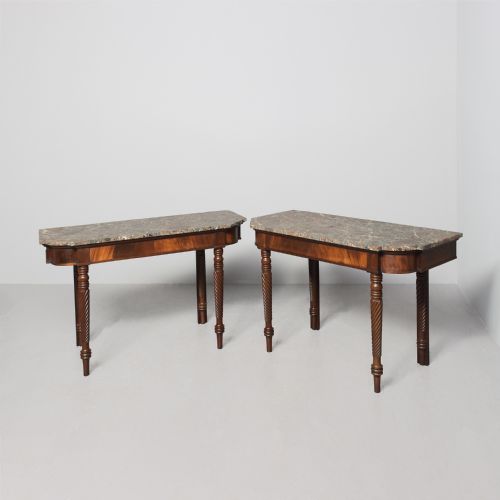
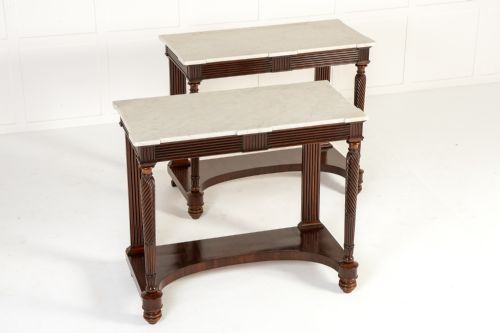
The versions most commonly met on this page span the nineteenth century, including pairs of mahogany hall tables and single writing or sofa tables. Makers deployed varied timber selections such as goncalo alves and marquetry veneers alongside marble surfaces.
Origin points range from British workshops to Dutch, Italian, and Portuguese makers, showing distinct regional preferences in turning and inlay. Forms include foldover tea tables and buffet servers sharing the characteristic twisted leg profile.
Materials and construction methods
Workshops relied heavily on solid mahogany and exotic hardwoods like goncalo alves, shaped by hand to create the distinctive spiral turned supports. Marquetry veneers, bone inlay, and ebony stringing were applied carefully to enrich the timber surfaces.
Heavy marble slabs frequently formed the tops of nineteenth century examples, fitted directly onto mahogany frames designed to bear the stone weight. Brass mounts and leather inserts appear on specific writing and sofa table variants.
Listings feature mahogany as the dominant primary material, alongside rosewood, goncalo alves, and ebonised wood across the nineteenth century.
Distinctions in quality and execution
The precision of the woodturning dictates the visual strength of the spiral legs, separating sharp, deep relief carving from softer, shallower cuts. Timber selection drives the distinction between straightforward domestic pieces and grander examples utilising dense mahogany or goncalo alves.
Integration of secondary materials such as contrasting bone inlay, intricate marquetry veneers, or thick marble tops elevates the sophistication of the piece. Matching pairs demonstrate greater ambition in workshop output than isolated single tables.
The Spiral Leg Console Table Glossary
- Barley twist
- A carved wooden leg form resembling a spiral rope or column, prevalent in seventeenth and nineteenth century furniture. It provides strong vertical movement beneath the table top.
- Console table
- A side table designed to stand against a wall, frequently secured with brackets or resting on distinct front legs. These tables served reception rooms and hallways.
- Goncalo alves
- A dense exotic hardwood with mottled brown figuring, favoured by nineteenth century cabinet makers for fine tables. It yields a rich finish under polish.
- Marquetry
- Decorative veneer work arranged in geometric or pictorial patterns using contrasting timbers and organic materials. Craftsmen applied these veneers to table tops to create visual depth.
- Sofa table
- A rectangular occasional table with drop leaves, designed to stand directly in front of a sofa. They typically feature trestle or pillar supports.
Spiral Leg Console Table: Frequently Asked Questions
What is a spiral leg console table used for?
These tables function as surface furniture in hallways, living rooms, and reception spaces, holding lamps, decorative objects, or serving as server units.
Historically, they occupied prominent wall positions in grand homes to display silver, porcelain, or act as writing surfaces.
How do I date a spiral leg console table?
Dating relies on timber choice, secondary woods, turning style, and construction methods associated with Georgian, Regency, or Victorian cabinet making.
Earlier eighteenth century examples display different turning profiles and carcase construction compared to later Victorian iterations.
Where were these tables made?
Surviving examples originate from British workshops alongside continental centres in Italy, the Netherlands, and Portugal.
Regional differences appear in the choice of primary timbers, such as rosewood or goncalo alves, and the execution of decorative inlay.
Can these tables be used every day?
Solid mahogany and sturdy twist legs provide the structural stability needed for daily placement in modern hallways or living areas.
Care should be taken with polished timber and marble tops to protect against moisture and heavy impact.