

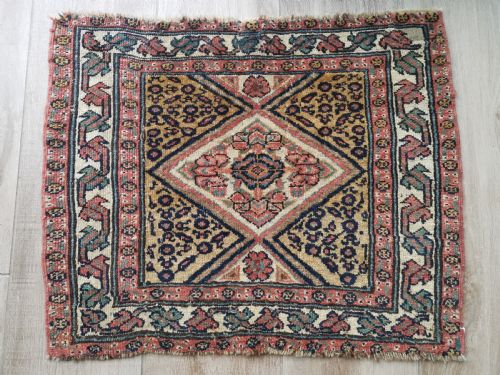


Small Oriental Rug Fragment
These small oriental rug fragment pieces are portable remnants of nomadic weaving, prized for dense wool and tribal design.
Small Oriental Rug Fragment
A small oriental rug fragment represents the surviving portion of a larger nomadic or tribal textile, typically originating from Persian or Turkmen weavers during the nineteenth and early twentieth centuries. These pieces take the form of bag faces, torbas, chuvals, and saddlebags, capturing specific utilitarian items created for domestic or tribal life. When searching for a small oriental rug fragment, buyers encounter square or rectangular formats like torba faces and bag faces displaying distinct medallions and repeat guls.
Materials and construction
Weavers constructed these textiles using hand-spun wool and standard wool foundations, occasionally incorporating cotton and silk details for contrast. The knotting technique yields a dense pile suited to daily utilitarian service on saddlebags, storage torbas, and chuvals.
Dyes derived from natural sources interact with the wool over decades, producing the characteristic crimson silks and ivory cotton highlights seen in Turkmen and Persian tribal weaving. The structural weave relies on sturdy wool warps and wefts that hold the cut pile secure across surviving fragments.
Small Oriental Rug Fragment Retail Price Guide 2026
Typical asking prices for small oriental rug fragment among the pieces listed under this phrase on Sellingantiques today, from the lower quarter to the upper quarter. They describe what is for sale here now, not the wider market.
Many surviving fragments began life as humble camel bags before finding new dignity on modern walls.
Assessing quality in tribal remnants
Quality rests upon knot density, the clarity of tribal motifs like the gul or central medallion, and the integrity of the remaining structure. Pieces with fine weave, such as specific dowry trappings, demonstrate superior technical execution by the weaver.
The handled handle of the wool and the vibrancy of the palette separate standard production from exceptional examples. Retention of original borders or complete field designs elevates the visual impact of any surviving fragment.
The Small Oriental Rug Fragment Glossary
- Torba
- A small storage bag produced by Turkmen tribes, often used for household goods inside a yurt. Surviving faces preserve the main decorative gul patterns.
- Chuval
- A large storage bag used by nomadic groups for bedding and clothing. The face typically displays multiple guls arranged in rows.
- Gul
- A medallion motif used repeatedly in Turkmen and oriental rugs. Each design identifies specific tribal groups and weaving traditions.
- Khorjin
- The Persian term for a double saddlebag used on animals during migration. Bag faces on the market represent the surviving front panels of these functional items.
- Bag face
- The decorative front panel of a utilitarian nomadic bag, preserved after the plain back and sides wore away or were cut down.
Small Oriental Rug Fragment: Frequently Asked Questions
What is a rug fragment?
A rug fragment is the surviving portion of a larger textile, such as a saddlebag or storage bag, cut or worn down from its original complete state.
These pieces preserve the central design field and knotting of antique nomadic weaving while discarding missing borders or plain backing materials.
How were tribal bags used?
Nomadic groups utilised these bags for storing household goods, bedding, and personal items inside tents or during seasonal migrations.
Animal trappings and saddlebags served practical transport functions while displaying tribal identity through distinct geometric motifs.
How do I date a fragment?
Dating relies on wool quality, dye palette, structural materials like hand-spun wool, and traditional tribal design markers.
Nineteenth-century examples display specific structures and natural colour variations that distinguish them from later twentieth-century productions.
How should I display a fragment?
These small pieces mount easily on fabric backings or display flat against walls as textile art.
Keeping them away from direct sunlight preserves the wool pile and the natural tones of the dyes.