



Silver Cloche Cover
These silver cloche cover options bring gravitas to a dining table, offering traditional serving vessels crafted to keep roasts warm.
Silver Cloche Cover
A silver cloche cover serves primarily as a heavy domed lid designed to protect and insulate large joints of meat or poultry on a platter. Collectors also encounter these pieces referred to as meat domes, game covers, or dish covers across Georgian, Victorian, and Edwardian periods.
Most examples found on this page date through the nineteenth century, encompassing Regency, William IV, and French Restoration styles alongside Victorian and Edwardian periods. These forms range from small game covers to large graduated sets suitable for formal dining arrangements.
Materials and construction methods
Makers utilised solid silver, silver plate, Old Sheffield Plate, EPNS, and copper with base metal cores to fabricate these substantial domes. Old Sheffield Plate combines a thin sheet of silver fused to a copper base, visible where underlying metal emerges at seams or wear points.
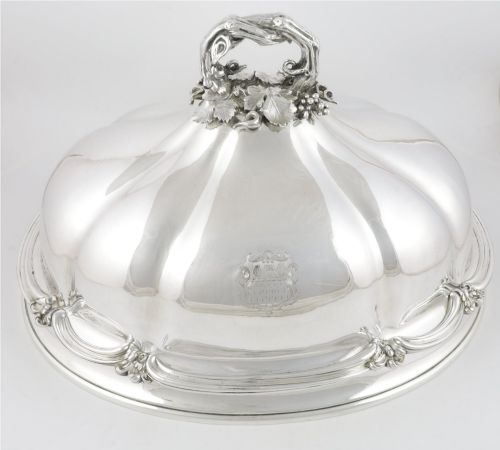
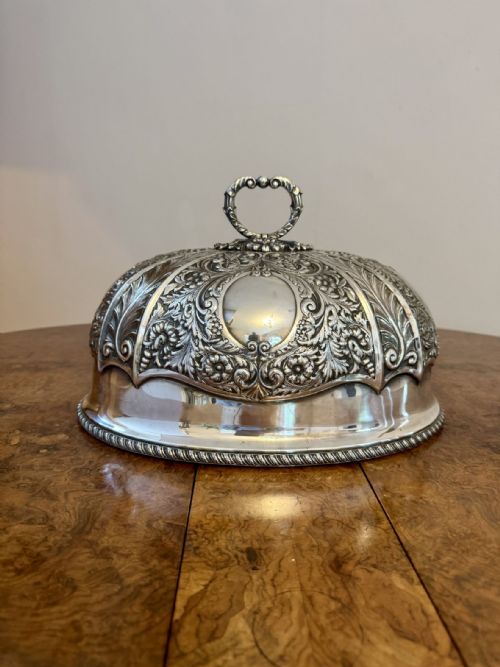
Many covers feature applied crests, engraved armorials, or cast handles often styled as foliage or animal motifs. Individual pieces demonstrate specialised manufacturing techniques developed by prominent makers across Sheffield, Birmingham, and Paris.
Some covers still bear the engraved crests of distant dukes and clans, ready to preside over modern roast dinners.
Distinctions in quality and finish
Quality rests in the weight of the metal, the crispness of chased or engraved armorial crests, and the structural integrity of the handle attachment. Superior examples maintain a heavy gauge of silver or Old Sheffield Plate that resists denting under daily use.
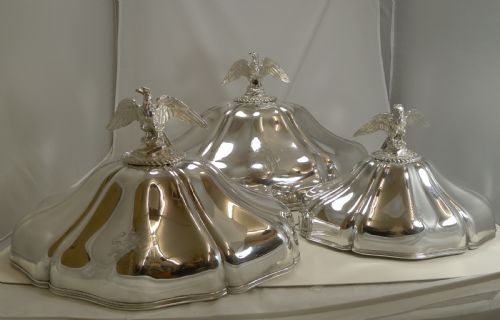
The sophistication of the maker elevates certain domes, particularly those bearing recognised marks from workshops such as Boulton, Roberts Cadman, Henry Wilkinson, or Durand of Paris. Original matching sets of graduated covers also command greater attention than assembled groups.
Roberts Cadman·Henry Wilkinson·Boulton·Durand
The Silver Cloche Cover Glossary
- Old Sheffield Plate
- A fused composite material made by melting a sheet of silver onto a copper ingot before rolling them together into sheets. This early plating method produces a soft lustre and distinctive edge wear.
- EPNS
- Electroplated Nickel Silver, a manufacturing technique introduced in the nineteenth century that replaced older plating methods by depositing a silver layer via an electrical current. It provides a durable and even finish.
- Meat Dome
- A large domed cover placed over a platter to retain heat and juices at the table. These objects are interchangeable with dish covers and game covers.
- Regency
- A British design period spanning the early nineteenth century characterised by classical restraint and Greco-Roman influences. Pieces from this era often feature clean lines and understated mounts.
- Crest
- An engraved or applied heraldic device representing a family lineage. These personalisations frequently appear on high-end dining silver.
Silver Cloche Cover: Frequently Asked Questions
What is a silver cloche cover used for?
These items function as protective domed lids placed over platters of meat, poultry, or game to keep food warm at the dining table.
Historically, servants lifted the dome at the table to reveal the main course, combining practical heat retention with ceremonial presentation.
How do I identify Old Sheffield Plate?
Old Sheffield Plate shows a characteristic subtle golden or reddish copper glow where the thin exterior layer of silver has worn thin over raised edges.
This fusion technique precedes electroplating and exhibits distinct hand-finished qualities.
What periods do these covers date from?
The pieces span the eighteenth century through the Edwardian era, with strong representation from Georgian, Regency, and Victorian periods.
Stylistic shifts reflect changing tastes from classical restraint to ornate Victorian ornamentation.
Are graduated sets common?
Graduated sets consist of multiple domes of decreasing sizes designed to nest together or serve different cuts of meat on a large table.
Complete surviving sets by makers like Durand are particularly valued for uniformity.