



Antique Meat Cover
An antique meat cover keeps a joint warm at table, bringing heavy metal domed grandeur to the dining room.
Antique Meat Cover
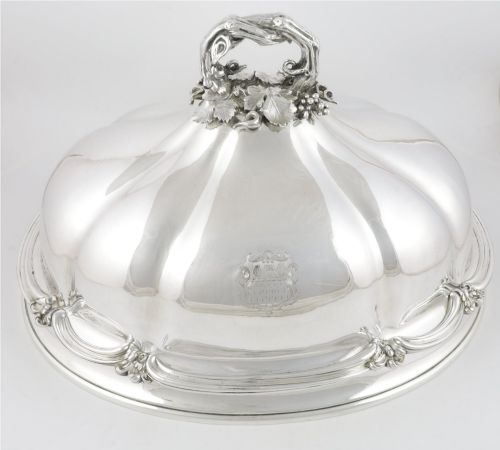
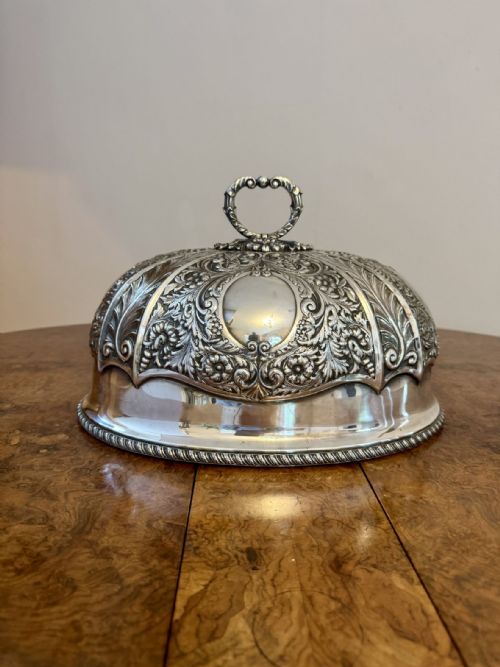
These pieces are substantial serveware designed to retain heat over joints and platters during grand meals. An antique meat cover most frequently appears as a domed metal cover from the Victorian or Georgian eras, often shaped to fit matching warming dishes.
Makers produced these covers in varying scales, from small game covers to massive twenty-inch domes intended for large dining halls. Examples span styles from Regency and William IV to Edwardian, reflecting the changing tastes of the nineteenth century.
Materials and construction
Silversmiths constructed these covers primarily in silver plate, Old Sheffield Plate, and copper, alongside solid silver and base metal variations. Old Sheffield Plate pieces often reveal a rich fusion of silver and copper visible along edges and wear points.
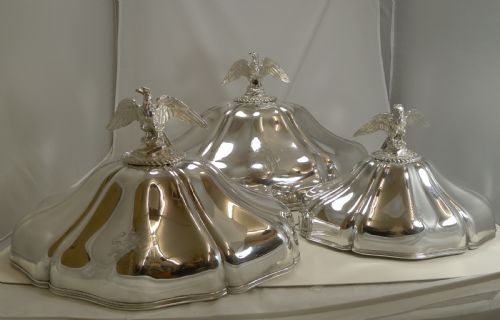
Workshops added cast handles shaped as oak leaves, acorns, or eagles, and engraved intricate crests or decorative borders across the domed surfaces.
One enterprising historical owner converted a heavy meat dome into a wine cooler, trading roast beef for chilled bottles.
Distinctions in craftsmanship
The distinction between standard domestic serveware and superior examples rests in the weight of the metal and the crispness of the cast handles. Finely executed pieces display balanced proportions, substantial gauges of silver plate, and detailed hand engraving.
Graduated sets and pieces bearing maker marks demonstrate higher workshop ambition, whereas unmarked base metal items represent simpler utilitarian production.
Roberts Cadman·Henry Wilkinson·Boulton·Dan Holy·Durand Paris·Elkington·Mappin & Webb
The Antique Meat Cover Glossary
- Old Sheffield Plate
- A fused composite material made by melting a sheet of silver onto a thicker copper base before rolling them together. This technique predates electroplating and leaves characteristic copper edges.
- Cloche
- A bell-shaped dome used in food service to cover dishes and retain heat. The term borrows from the French word for a bell.
- EPNS
- Electroplated Nickel Silver, a common nineteenth-century base metal method that coated a nickel alloy with a thin layer of pure silver. It succeeded Old Sheffield Plate as industrial plating techniques advanced.
- Warming Dish
- A specialised serving vessel featuring a compartment beneath the main platter to hold hot water. These often accompanied large domes.
- Graduated Set
- A collection of matching covers in diminishing sizes designed to nest together. These sets allowed hosts to serve different joints with uniform table presentation.
Antique Meat Cover: Frequently Asked Questions
How were antique meat covers used?
Servants placed the heavy metal dome over a roasted joint or platter on the dining table to trap steam and keep the food warm between courses. The cover was lifted just before carving.
In larger houses, these domes sat atop matching warming dishes filled with hot water to prolong heat retention during lengthy formal dinners.
What is the difference between silver plate and Old Sheffield Plate?
Old Sheffield Plate uses a mechanical fusion process where a sheet of silver is melted onto a thick copper block and rolled out together. This leaves subtle lines of copper visible at the seams.
Electroplated silver, or EPNS, involves using an electrical current to bond a thin layer of silver over a base metal alloy, a method introduced later in the nineteenth century.
How do I clean and polish an antique meat cover?
Polishing requires a gentle silver cream applied with a soft cloth to avoid wearing through the thin silver layer, particularly on Old Sheffield Plate where the copper underneath can show. Avoid harsh dips that strip the aged patina.
Store the dome in a dry environment and handle it by the base rather than straining the decorative handle.
How can I display a meat cover at home?
Many collectors exhibit large domes on sideboards or mounted securely on dining room walls to showcase the engraved crests and heavy cast handles. They also serve as dramatic centrepieces when placed over platters on open shelving.
Some pieces find new life repurposed as wine coolers or decorative accents in traditional interiors.