


Sheraton Toilet Mirror
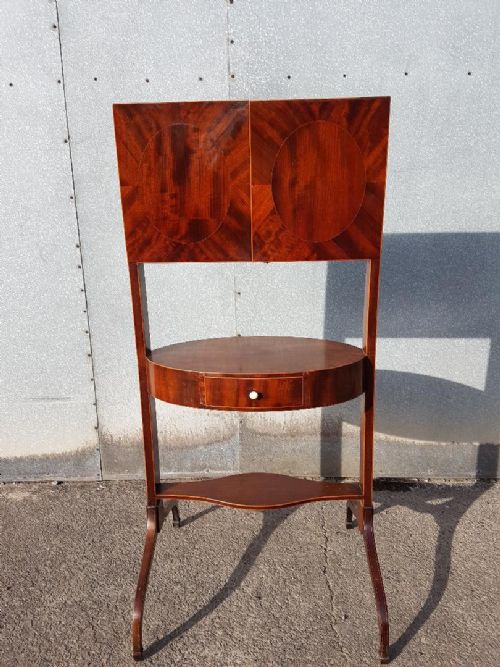
These Sheraton toilet mirror pieces bring refined Georgian elegance to a dressing surface with their delicate crossbanding and pivoting plates.
Sheraton Toilet Mirror
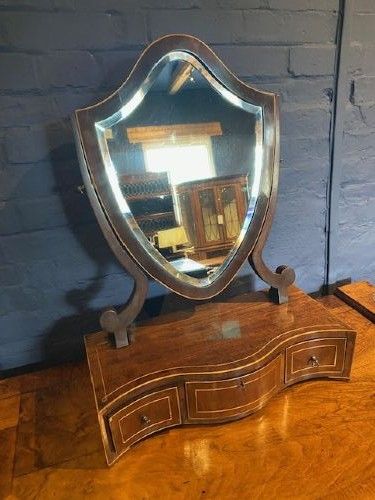
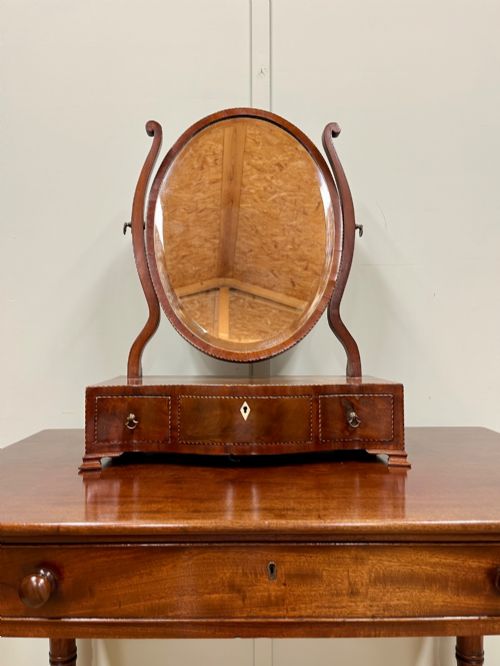
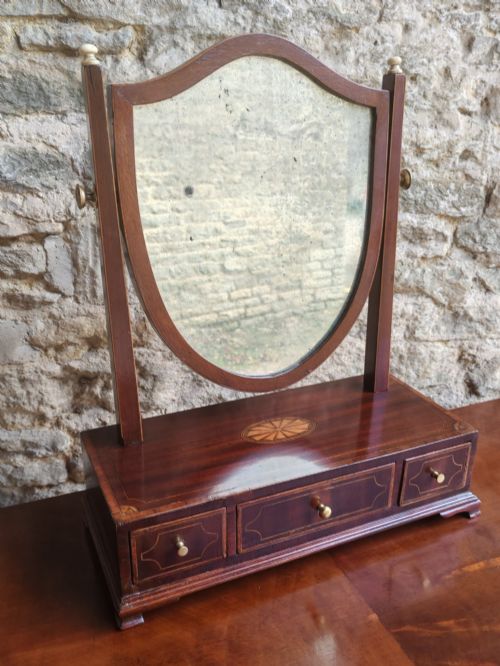
A sheraton toilet mirror sits upon a small box base fitted with drawers, designed to rest on a larger table or chest for personal grooming. The evidence shows these pieces appear predominantly in Georgian and 18th Century formats, alongside later Sheraton Revival interpretations.
Makers shaped the glass plates in oval, shield, or rectangular forms, suspended between upright support arms above serpentine or bow-fronted bases. Buyers encounter variants featuring bone escutcheons, brass finials, and intricate boxwood inlay.
The selection ranges from mid Georgian period examples to Edwardian revivals, offering both compact tabletop swing mirrors and larger scale dressing table mirrors. Mahogany and satinwood dominate the construction across these historical periods.
Distinctions in quality
Finer examples distinguish themselves through the crispness of their boxwood and ebony inlay work and the depth of figure in the flame mahogany veneer. Superior pieces maintain harmonious proportions between the pivoting mirror plate and the serpentine or bow-fronted base below.
The choice of secondary timbers and the precision of the dovetail joints inside the small drawers indicate the level of workshop care. Original brass hardware, bone keyhole escutcheons, and untouched mirror plates elevate an example above later altered pieces.
The listings on this site combine genuine Georgian and 18th Century pieces with later Edwardian and Victorian Sheraton Revival interpretations.
Gillows
The Sheraton Toilet Mirror Glossary
- Sheraton
- A neoclassical design style associated with the late 18th century, defined by straight lines, tapered legs, and delicate contrasting veneer inlay. This aesthetic favoured elegance and geometry over heavy ornamentation.
- Bow-fronted
- A convex curved cabinet front that swells outward in the centre. This shape softens the profile of the toilet mirror base.
- Serpentine
- A furniture front shaped with a central convex curve flanked by two concave curves. It requires advanced woodworking skill to execute properly on small drawer fronts.
- Crossbanding
- A border of veneer laid with the grain running perpendicular to the main surface. It frames panels of mahogany or satinwood on the mirror base.
- Shield mirror
- A mirror plate cut into the outline of a heraldic shield. This distinct shape appeared frequently during the Georgian period.
Sheraton Toilet Mirror: Frequently Asked Questions
How do I date a Sheraton toilet mirror?
Examine the secondary woods inside the drawers, the style of the brasswork, and the construction methods of the frame. Earlier pieces from the 18th century typically show hand-cut dovetails and older glass plates.
Later Edwardian revivals utilise machine-cut elements and cleaner internal pine or oak linings while copying the classic Sheraton aesthetic.
Were these mirrors fixed or adjustable?
The glass plates are mounted on pivots held by brass screw pins set into upright arms. This allows the user to tilt the mirror angle as needed.
Original brass hardware and functional pivot pins remain an important detail for authenticity.
What woods were used for these mirrors?
Mahogany serves as the primary timber across the majority of pieces, often selected for rich flame grain patterns. Satinwood and harewood appear in finer examples alongside contrasting boxwood inlay.
Secondary timbers inside the small drawer boxes generally include pine or oak.
Where should I place a toilet mirror today?
These compact mirrors sit securely on top of modern chests of drawers, sideboards, or dressing tables. Their small footprint makes them practical for adding height and reflection to bedroom or hallway surfaces.
Keep them away from direct sunlight to protect the antique wood finishes and interior veneers.