




Sheraton Side Tables Pair
Sheraton side tables pair describe matched sets of occasional and console furniture, sought after for symmetrical placement in traditional interior schemes.
Sheraton Side Tables Pair
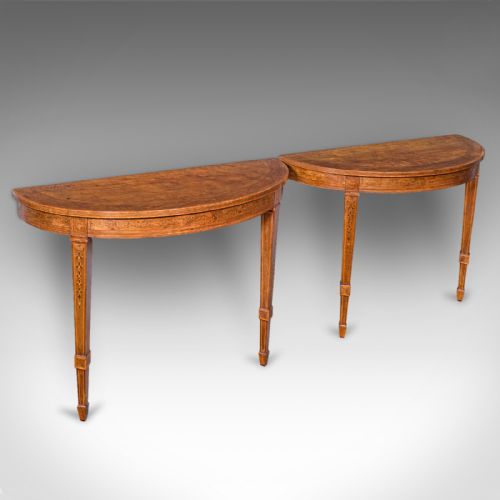
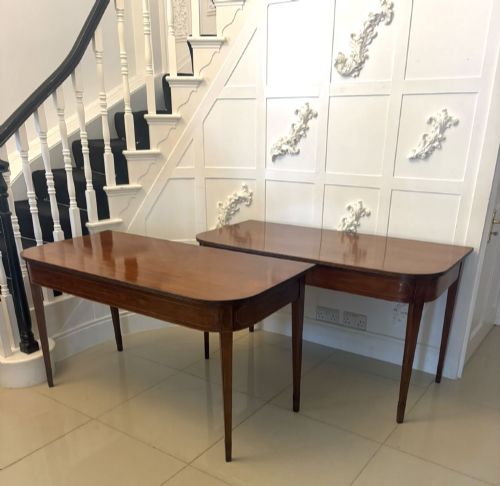
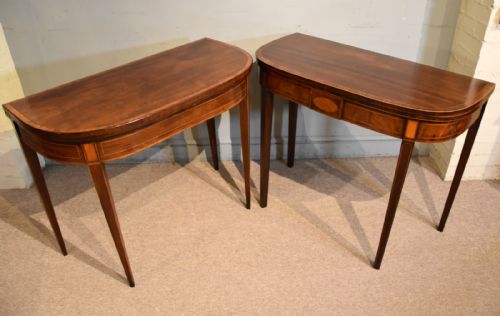
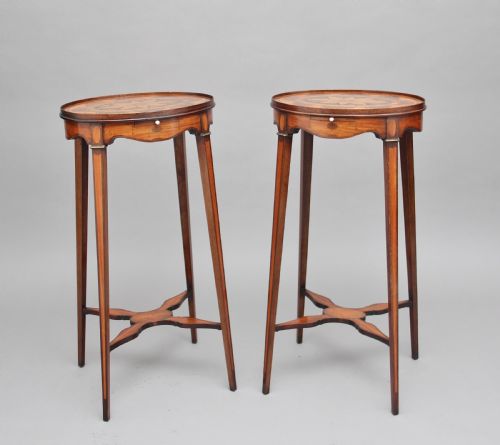
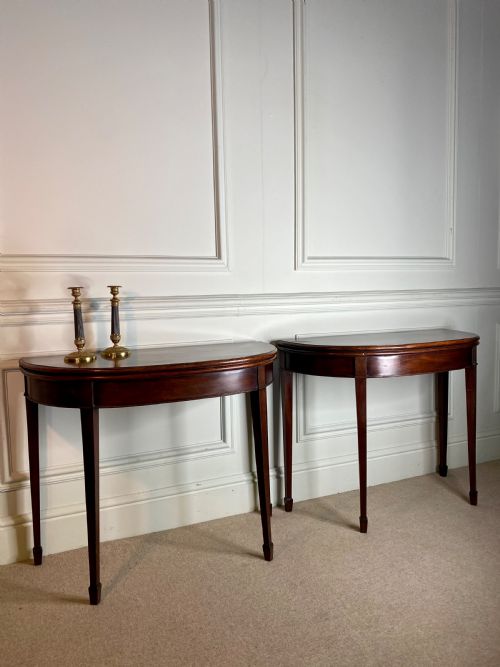
When you search for a Sheraton side tables pair, you encounter symmetrical items originating primarily from the Georgian and Edwardian eras, spanning original 18th century pieces to later revival periods. The selections available on this page encompass varied forms such as demi-lune console tables, fold-over card tables, and occasional stands.
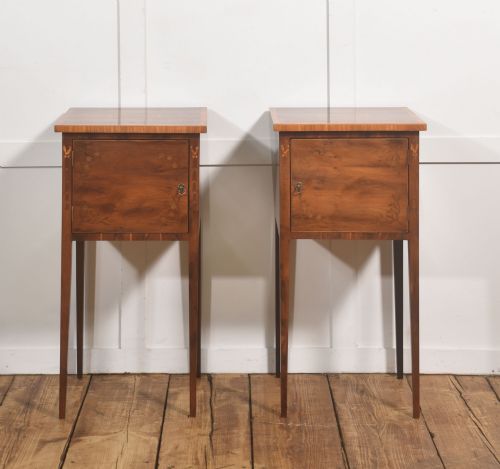
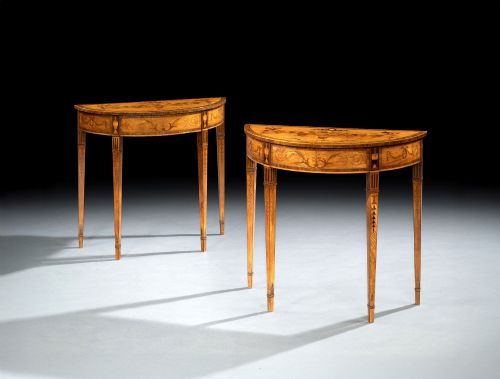
The dominant configurations on this page include mahogany and satinwood demi-lune tables designed to stand flat against a wall, alongside occasional tables and bedside cabinets. These items reflect both the neoclassical restraint of the late eighteenth century and the decorative revival movements of the Victorian and Edwardian decades.
Construction and Materials
Cabinet makers utilised dense hardwoods such as mahogany and rosewood as structural bases, frequently applying light satinwood veneers to create contrasting surfaces. Timber selection governed both the durability of the frame and the visual impact of the top panel.
Inlay work defined much of the surface decoration, employing boxwood and other contrasting timbers alongside marquetry patterns to trace geometric and floral motifs. Individual elements were joined using traditional cabinet-making techniques suited to curved demi-lune and fold-over top constructions.
Sheraton Side Tables Pair Retail Price Guide 2026
Typical asking prices for sheraton side tables pair among the pieces listed under this phrase on Sellingantiques today, from the lower quarter to the upper quarter. They describe what is for sale here now, not the wider market.
Listings on this page span the 18th century, Georgian, Victorian, and Edwardian periods, featuring satinwood, mahogany, and rosewood.
Quality Variations
The standard of execution in inlay and marquetry work dictates the visual distinction between individual pairs, where precise cutting of contrasting woods creates crisp botanical or geometric borders. Finer examples maintain tight joints and well-figured veneer grains across both matching pieces.
Proportion and structural integrity distinguish superior forms, particularly in delicate items like urn stands and card tables where slender legs must support folding or elevated tops without sway. The depth of hand-finishing and the integrity of the underlying timber define the upper tier of the range.
Edwards and Roberts of London
The Sheraton Side Tables Pair Glossary
- Demi-lune
- A half-moon shape used for console and card tables designed to stand flush against a wall. This profile became characteristic of neoclassical side furniture.
- Marquetry
- Decorative veneer patterns assembled from various tinted woods to form pictorial or geometric designs. Craftsmen applied these across table tops and cabinet fronts.
- Satinwood
- A durable, light-yellow timber imported from tropical regions, prized for its lustrous grain. It served as a primary face veneer in neoclassical and revival cabinet-making.
- Fold-over
- A table top hinged to double its surface area when opened, commonly utilised on card and tea tables. This mechanism required precise carpentry to align when closed.
- Boxwood
- A dense, pale wood used traditionally for fine stringing and contrasting inlay lines. Its uniform texture allowed for sharp, narrow cuts.
Sheraton Side Tables Pair: Frequently Asked Questions
How do I date a Sheraton table?
Dating relies on examining the underlying secondary woods, construction methods, and the crispness of the satinwood veneers or inlay.
Revival pieces from the Edwardian era typically show machine precision in their joins compared to eighteenth-century originals.
Were these tables always made in pairs?
Cabinet makers produced many console and card tables as matched pairs to flank fireplaces or architectural doorways symmetrically.
Surviving matched sets remain desirable for maintaining balanced room layouts.
What is Sheraton Revival furniture?
Sheraton Revival furniture refers to pieces manufactured during the late Victorian and Edwardian periods that copied late eighteenth-century neoclassical designs.
These later items incorporated satinwood inlay and classical proportions inspired by original pattern books.