





Sheraton Revival Nest Tables
Sheraton Revival nest tables are ingenious multi-tiered surfaces offering versatility without clutter, combining eighteenth-century elegance with practical living.
Sheraton Revival Nest Tables
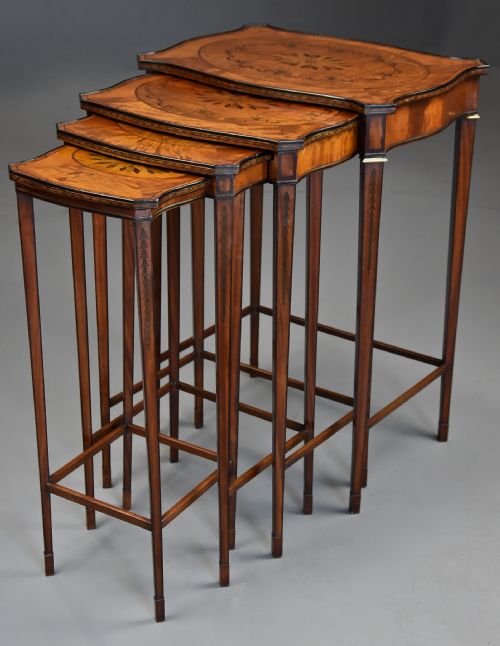
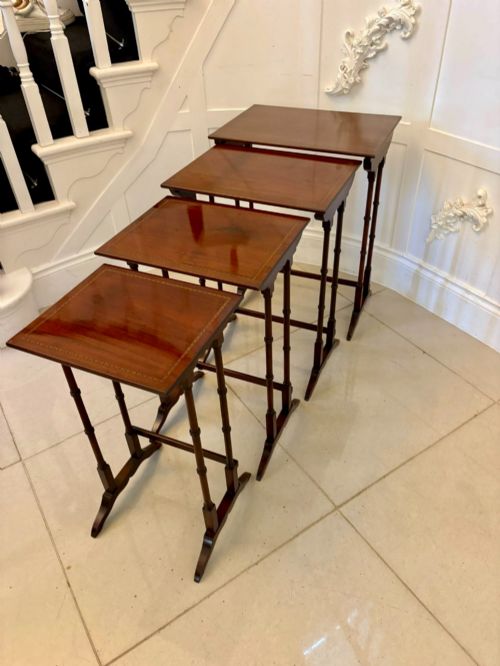
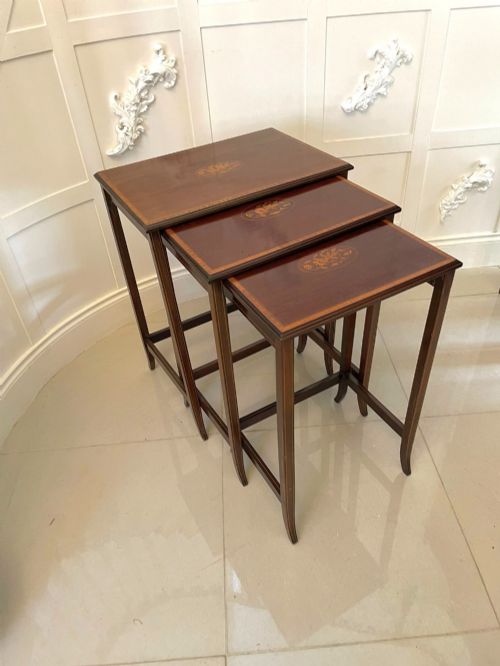
Sheraton Revival nest tables present themselves primarily in Edwardian and late Victorian variations, often grouping four tables together in a quartetto arrangement or occasionally three. These pieces emerge in mahogany, satinwood, and amboyna, designed to slide neatly beneath one another when floor space is at a premium.
The form draws directly on late eighteenth-century classical proportions, reinterpreted around nineteen hundred with lighter frames and delicate proportions. Buyers most frequently encounter sets comprising four graduated tables, which separate easily for serving tea or displaying objects.
Makers of these tables utilise traditional forms to create functional hierarchies within a single footprint. The surface variations range from plain polished mahogany to intricate painted decorations and contrasting wood inlays.
Materials and Construction
Cabinet makers constructed these tables using solid and veneered timbers, predominantly mahogany and satinwood, supported by boxwood stringing and delicate inlay work. The wood selection dictates the overall tone of the piece, moving from deep red-brown mahogany to pale, luminous satinwood.
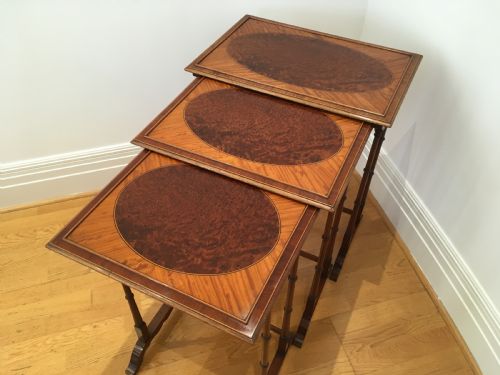
Craftsmen applied painted decoration alongside traditional woodworking joints to achieve the light, neoclassical aesthetic characteristic of the period. Amboyna wood occasionally appears to add rich, mottled contrast to the primary timber framing.
Sheraton Revival Nest Tables Retail Price Guide 2026
Typical asking prices for sheraton revival nest tables among the pieces listed under this phrase on Sellingantiques today, from the lower quarter to the upper quarter. They describe what is for sale here now, not the wider market.
Some sets required four separate tables to be deployed in a strict numerical sequence like Russian nesting dolls to fit back together properly.
Judging Quality
Quality reveals itself in the crispness of the satinwood inlay and the precision with which the smaller tables nest beneath the master frame. Superior examples demonstrate careful timber selection, where the grain patterns on each tier complement the rest of the set.
The refinement of the legs and the subtlety of the painted decoration separate standard production from finer workshop output. Well-executed pieces maintain structural stability across all four tiers despite the slender proportions required by the design.
The Sheraton Revival Nest Tables Glossary
- Quartetto
- A set of four graduated tables designed to nest together. This term frequently appears in period descriptions for nesting sets.
- Satinwood
- A pale, hard tropical timber prized for its lustrous grain and golden colour. It serves as a primary wood or contrasting veneer in inlaid pieces.
- Boxwood
- A dense, pale wood utilised for fine stringing lines and geometric borders on tabletops. Cabinet makers employ it to create crisp visual boundaries.
- Amboyna
- A highly figured burl wood yielding a warm, mottled red-brown surface. It provides dramatic contrast panels within tabletop designs.
- Stringing
- Thin inlay lines of contrasting wood embedded into the surface to outline panels and legs. This technique defines classical neoclassical decoration.
Sheraton Revival Nest Tables: Frequently Asked Questions
What is a quartetto nest?
A quartetto nest consists of four tables designed to slide neatly beneath one another into a single compact unit. This configuration maximises surface area while occupying minimal floor space.
Cabinet makers of the Edwardian and Victorian eras favoured this format for entertaining, allowing hosts to distribute small tables around a room as needed.
How do I identify Sheraton Revival pieces?
Sheraton Revival pieces borrow neoclassical motifs, slender tapered legs, and symmetrical stringing from the late eighteenth century. They display the lighter construction methods typical of the late nineteenth and early twentieth centuries.
Examining the secondary woods and interior framing helps distinguish these later interpretations from genuine eighteenth-century originals.
Where were nest tables used?
These tables served primarily in drawing rooms and parlours for holding tea cups, reading materials, or decorative objects. Their portability made them essential furniture for flexible entertaining.
Owners could separate the tiers across a room during gatherings and stack them compactly against a wall afterwards.