
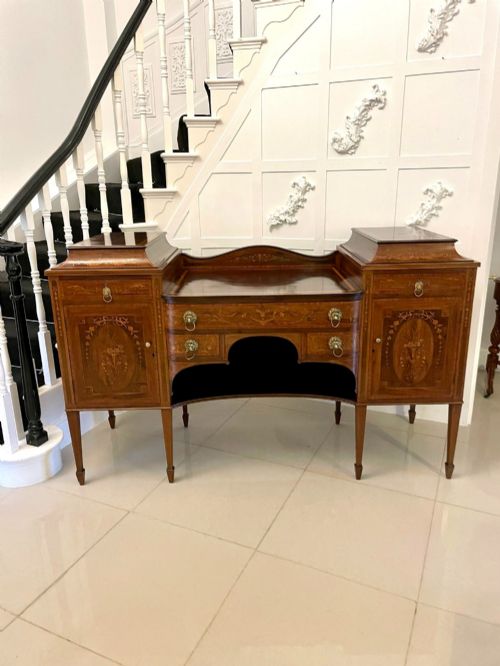
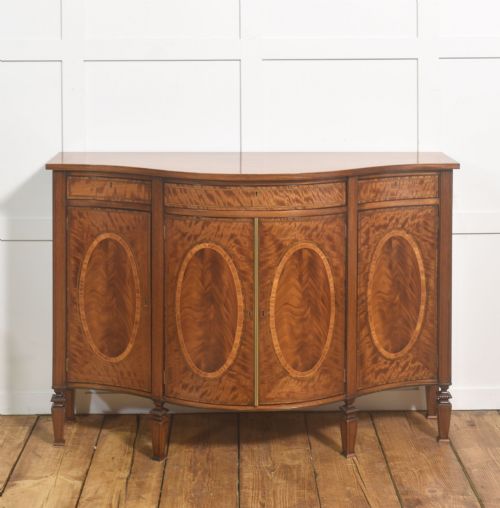
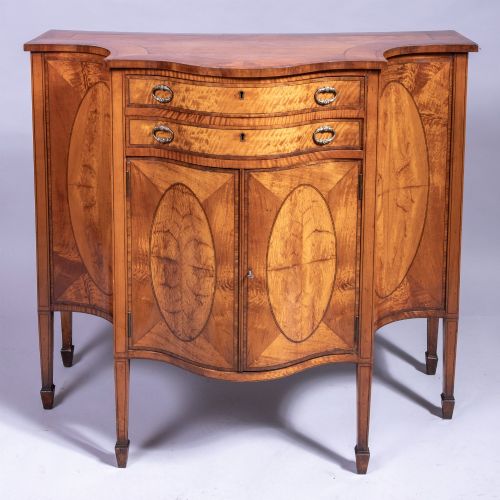
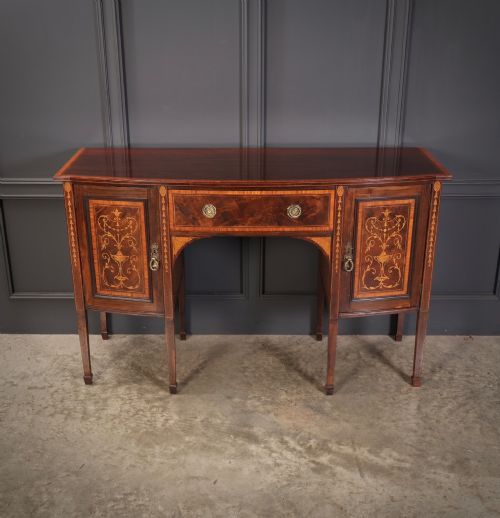



Sheraton Revival Buffet
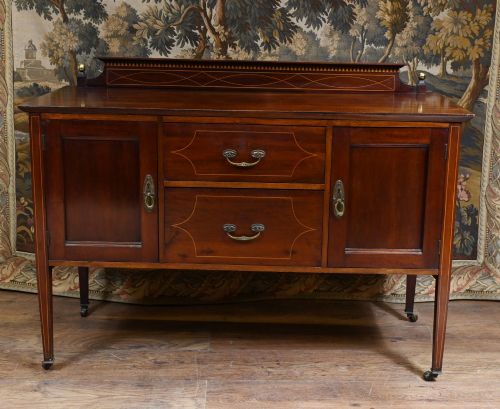
A sheraton revival buffet brings late eighteenth-century elegance into a room through refined mahogany and satinwood craftsmanship.
Sheraton Revival Buffet
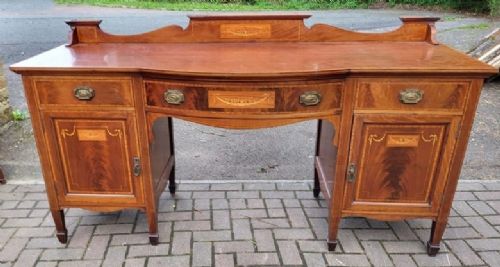
A sheraton revival buffet represents the refined cabinet-making tastes of the late nineteenth and early twentieth centuries, drawing heavily on earlier neo-classical forms. These pieces serve primarily as dining room storage and display surfaces, taking shapes such as bow-fronts, serpentine curves, and breakfronts.
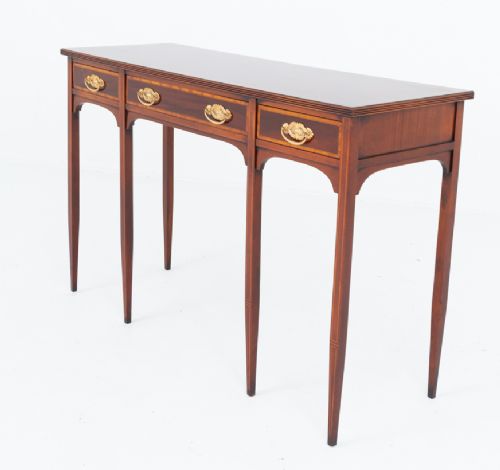
The version most commonly met on this page is the Edwardian mahogany sideboard or server, often produced around nineteen hundred and decorated with intricate stringing. Alongside these, buyers find related side cabinets and serving tables sharing the same light proportions and revival styling.
Materials and Construction
Cabinet makers built these pieces using solid and veneered timbers, predominantly relying on rich mahogany alongside bright satinwood for key panels. Boxwood and various other contrasting woods provided delicate stringing lines and geometric borders.
Surface ornament frequently relied on fine marquetry and wood inlay to create floral or classical urn motifs across doors and drawer fronts. Brass fittings such as drop handles and backplates completed the construction, paired occasionally with glass in cabinet doors.
Listings feature mahogany, satinwood, and rosewood timbers enhanced by boxwood stringing and brass hardware across multiple Edwardian and Victorian forms.
Distinguishing Quality
The distinction between standard and superior pieces rests largely on the ambition of the timber selection and the precision of the inlay. Flame mahogany veneers and complex satinwood cross-banding require a high degree of joiner skill to execute cleanly.
Execution of the marquetry and floral painted decoration also dictates the standing of a piece, alongside well-figured grain that follows the curves of serpentine and bow-front carcases without buckling.
Hewetsons London·Edwards and Roberts·Howard And Sons
The Sheraton Revival Buffet Glossary
- Sheraton Revival
- A late nineteenth and early twentieth-century design movement inspired by the neoclassical furniture of George Sheraton. It favours light proportions, tapered legs, and symmetrical inlay.
- Marquetry
- The art of forming decorative patterns by fitting together small pieces of wood veneer. Craftsmen use contrasting timbers like satinwood and boxwood to build pictorial scenes.
- Serpentine
- A furniture front or edge shaped with a central convex curve flanked by two concave curves. This contour demands expert woodworking to shape timber smoothly.
- Cross-banding
- A border strip of veneer laid around the main panel of a drawer or top with the grain running perpendicular to the centre. It creates a neat visual frame.
- Flame Mahogany
- A wood veneer cut from crotch sections of the tree where branches meet the trunk. This produces a distinctive flickering flame pattern prized in cabinet work.
Sheraton Revival Buffet: Frequently Asked Questions
What is a sheraton revival buffet?
A sheraton revival buffet is a decorative dining room storage piece made during the late Victorian and Edwardian eras. It mimics the lighter, neoclassical furniture designs of the eighteenth century.
These pieces typically feature mahogany or satinwood construction, complemented by delicate inlaid borders and tapered legs.
How do I date these sideboards?
Dating relies on combining construction clues with the specific revival styles recorded on this page. Pieces often date from the late nineteenth century through to the Edwardian period around nineteen hundred.
Look at the secondary timbers, handle styles, and veneer thickness to help narrow down the decade of manufacture.
Where were these buffets placed?
These items were designed for the dining room to hold silver, linen, and serving dishes. The top surface provided a convenient station for serving food during formal meals.
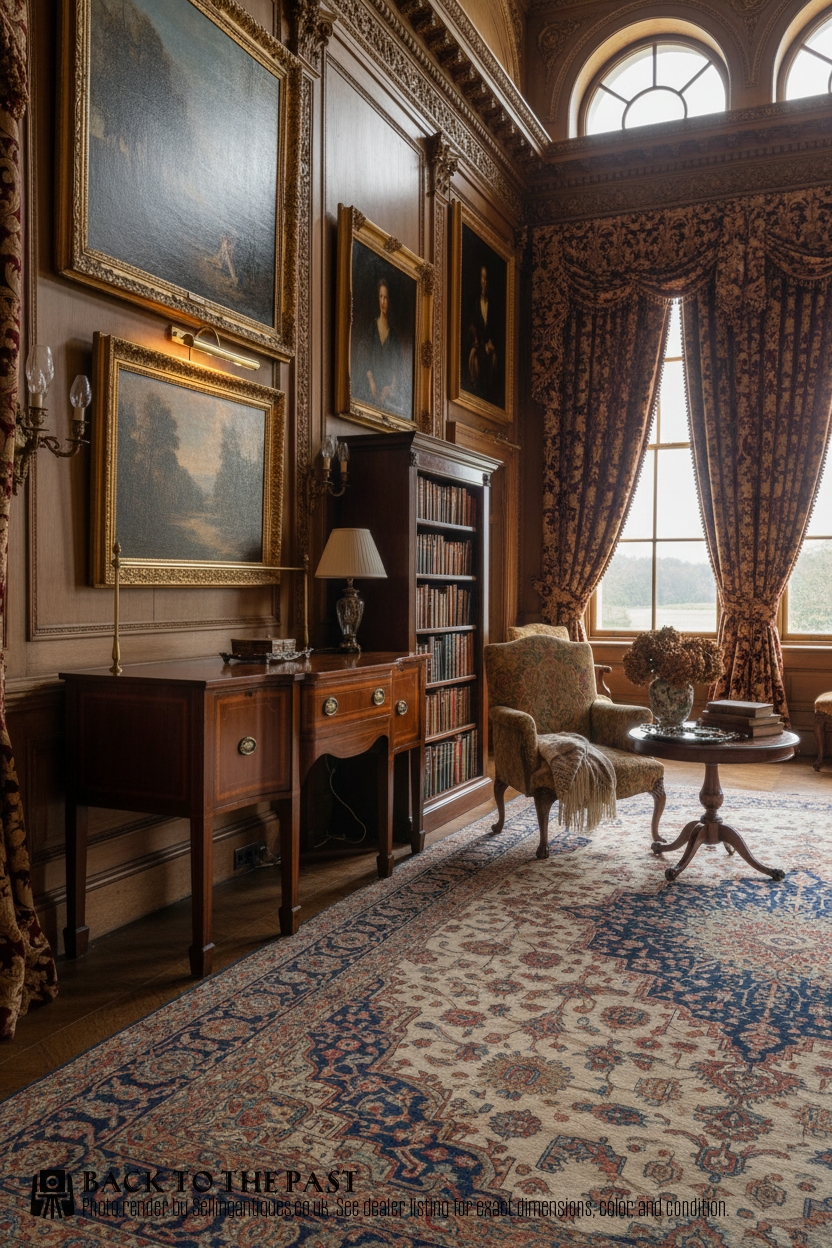
Today, buyers use them in dining rooms, hallways, and living spaces as both storage furniture and display surfaces.
What is satinwood inlay?
Satinwood inlay involves setting contrasting light-yellow satinwood pieces into a darker mahogany carcase. This technique creates geometric lines, fans, or floral motifs.
It provides the bright, elegant contrast characteristic of Sheraton revival furniture.
Are these pieces fragile?
While structurally sound for modern use, these buffets feature delicate veneers and fine inlay that require sensible care. They benefit from stable room temperatures away from direct heat sources.
Polishing with appropriate wax helps protect the polished mahogany and satinwood surfaces.