

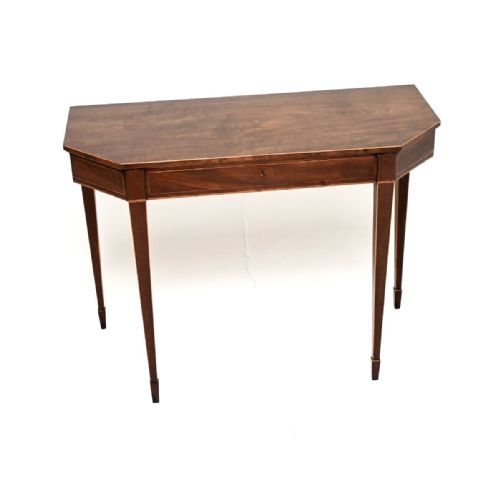
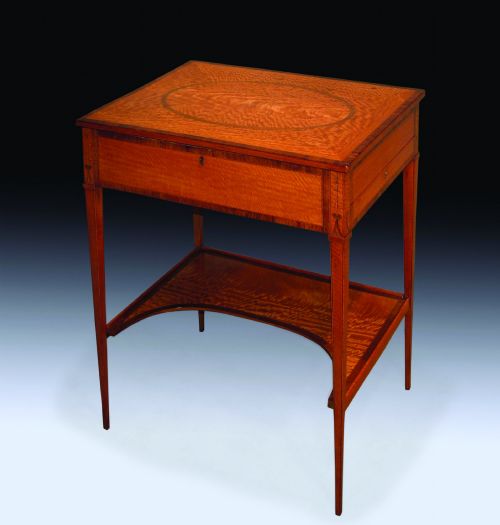
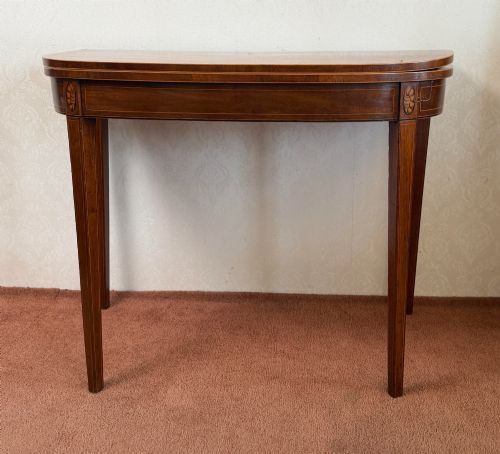


Sheraton Period Tea Table
A sheraton period tea table brings light woods, refined geometry and classical proportions straight into a Georgian interior.
Sheraton Period Tea Table
A sheraton period tea table represents the refined neoclassical taste of the late eighteenth and early nineteenth centuries, emerging from the design vocabulary popularised during the Georgian era. Buyers hunting for a sheraton period tea table will find pieces in mahogany, satinwood and rosewood, often featuring delicate inlay work and geometric forms.
The versions most frequently encountered on this page include fold-over card tables, demi-lune shapes and occasional tables from the eighteenth century, around 1800, and the wider Georgian period. These tables were designed for polite society, serving both as decorative furniture pieces and practical surfaces for tea service or card playing.
Makers and workshops of the time worked within the Sheraton style to produce functional items that relied on straight tapered legs and contrasting veneers rather than heavy carving. The surviving examples demonstrate how cabinetmakers adapted the style into various formats, from kettle stands to side tables.
How they were made
Cabinetmakers constructed these tables using a foundation of solid timbers such as Honduras mahogany, onto which they applied fine veneers of satinwood and rosewood. The surfaces frequently incorporate boxwood stringing and marquetry inlay to create subtle contrasts in tone and grain.
Joinery relied on precise cutting and fitting to support folding tops and delicate table structures without adding bulk. Surface decoration extended to japanned finishes in the manner of Chinoiserie and occasional applications of gold leaf to accentuate specific design elements.
Sheraton Period Tea Table Retail Price Guide 2026
Typical asking prices for sheraton period tea table among the pieces listed under this phrase on Sellingantiques today, from the lower quarter to the upper quarter. They describe what is for sale here now, not the wider market.
Materials recorded across these tables include Honduras mahogany, satinwood, rosewood, boxwood, lacquer, and gold leaf.
What varies in quality
The grade of a piece rests heavily on the choice of timber and the natural figuring displayed in the grain, particularly across mahogany and satinwood tops. Finer examples exhibit carefully matched veneers and intricate inlay work that demands considerable skill from the cabinetmaker.
Proportion and structural harmony distinguish superior pieces from more utilitarian workshop output. The crispness of the tapered legs and the precision of the cross-banding reveal the original hand behind the construction.
The Sheraton Period Tea Table Glossary
- Demi-lune
- A half-moon shape commonly utilised for the tops and frames of side and tea tables in the late eighteenth century. This silhouette allowed tables to sit flush against a wall when closed.
- Cross-banding
- A strip of veneer applied to the border of a table top so that the grain runs at right angles to the central panel. This technique creates a distinct visual frame.
- Satinwood
- A pale, lustrous timber native to Ceylon and the West Indies, prized for its golden yellow colour and silky sheen. It was widely used in fine Sheraton furniture for veneers and stringing.
- Stringing
- A thin inlay of contrasting wood, such as boxwood, set into channels cut into the surface of the timber. It outlines panels and edges to add linear definition.
- Marquetry
- The art of forming decorative patterns by fitting together thin pieces of coloured wood and other materials into a veneered surface.
Sheraton Period Tea Table: Frequently Asked Questions
What is a sheraton period tea table?
A sheraton period tea table is a piece of furniture from the late eighteenth or early nineteenth century designed in the neoclassical style associated with designer Thomas Sheraton.
These tables typically feature straight tapered legs, light wood veneers like satinwood, and geometric forms such as demi-lune shapes or fold-over tops.
How were these tables used originally?
In Georgian homes, these tables provided a surface for serving tea or hosting card games in fashionable drawing rooms.
Many featured folding leaves that allowed them to double as console or side tables when not in active use for tea service.
How do I tell mahogany from satinwood?
Mahogany is a dense, reddish-brown timber that often shows deep natural figuring and warm dark tones. Satinwood is a pale, golden-yellow wood with a luminous, reflective grain.
Many Sheraton pieces combine both timbers, using mahogany for structural integrity and satinwood for decorative contrast.
What is a fold-over card table?
A fold-over card table has a hinged top that opens out to double the surface area, supported by a pivoting leg or a swing frame.
These tables were built to save space in polite interiors while offering a stable baize-lined surface for evening entertainment.
How do I date an 18th century table?
Dating relies on examining the timber species, construction methods, and stylistic markers such as inlay patterns and leg profiles.
Pieces from this era often show hand-cut joinery and period-specific veneers like boxwood stringing and satinwood cross-banding.