






Sheet Music Storage Rack
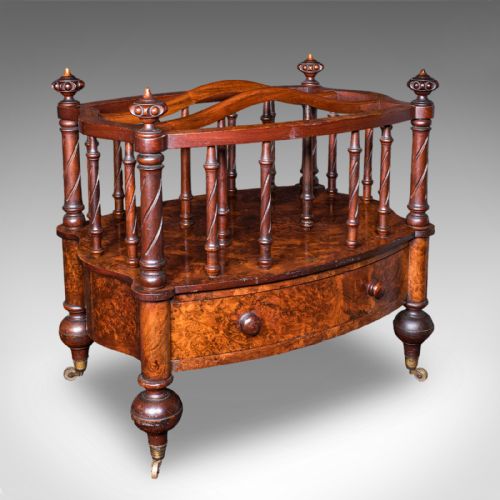
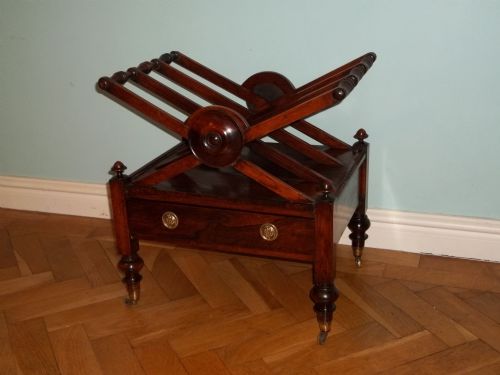
These pieces for sheet music storage rack collect your scores and folios in timber divisions designed to keep portfolios upright and close to hand.
Sheet Music Storage Rack
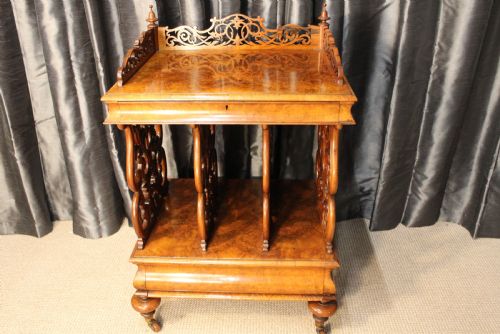
A sheet music storage rack on this page typically takes the form of a canterbury or music cabinet, designed to hold folios and paper upright in partitioned sections. You will most frequently meet pieces fashioned from mahogany and rosewood, alongside burr walnut examples from later periods.
The origins span the Georgian, Regency, and Victorian eras, showing how domestic music rooms evolved through the nineteenth century. These items double as magazine racks and newspaper tidies, reflecting their adaptable domestic utility over generations.
Forms range from open three-division and four-division stands with carrying handles to enclosed cabinets with glass and ceramic details. Each variant serves the fundamental purpose of keeping unbound sheets tidy while sitting neatly beside a piano or seating area.
What Varies in Quality
The refinement of the timber selection dictates the visual weight of the piece, with richly figured burr walnut and dense Cuban mahogany sitting at the higher end. Subtle details like ebony banding and precise turning on the corner posts separate standard joinery from finer workshop production.
Structural integrity rests on the original divisions and the strength of the carrying handles, which experience considerable stress during everyday use. The presence of integrated drawers or fitted lower compartments adds complexity and distinguishes more elaborate forms from basic open racks.
Listings feature mahogany, rosewood, and burr walnut across Georgian, Regency, and Victorian periods.
The Sheet Music Storage Rack Glossary
- Cuban Mahogany
- A dense, dark timber prized for its rich grain and stability during the Georgian and Regency periods. Cabinet makers used it for high-status furniture.
- Burr Walnut
- Timber taken from the warted excrescences of the walnut tree, showing intricate swirling patterns. It was sliced into veneers for decorative Victorian cabinet work.
- Stringing
- Thin inlay lines of a contrasting wood used to edge panels and borders on tables and stands. This linear detail defines the geometry of the piece.
- Music Cabinet
- An enclosed piece of furniture with shelves or drop-down fronts designed to store scores securely. They often incorporate glass doors or brass mounts.
Sheet Music Storage Rack: Frequently Asked Questions
What is a canterbury used for?
A canterbury holds sheet music, folios, magazines, and newspapers in upright divisions to keep them organised and accessible near a keyboard or seating area.
The lower drawer or compartment often provides additional storage for smaller accessories or unbound pamphlets.
How do I date a mahogany piece?
Dating relies on timber characteristics, stylistic details, and construction methods. Georgian and Regency examples typically exhibit dense Cuban mahogany with restrained lines.
Later Victorian versions introduce heavier carving, contrasting veneers like burr walnut, and functional brass or ceramic elements.
Can these racks hold modern magazines?
The partitions easily accommodate standard modern magazines, art folios, and large paperback books alongside traditional sheet music.
Measuring the width and height of the divisions ensures your specific publications fit comfortably between the upright slats.
Are brass castels original?
Many nineteenth-century pieces retain their original brass or brass-and-ceramic castors to allow smooth movement across carpets and floorboards.
Examining the fixings and the wear around the feet helps determine whether the hardware matches the period of the main timber structure.