
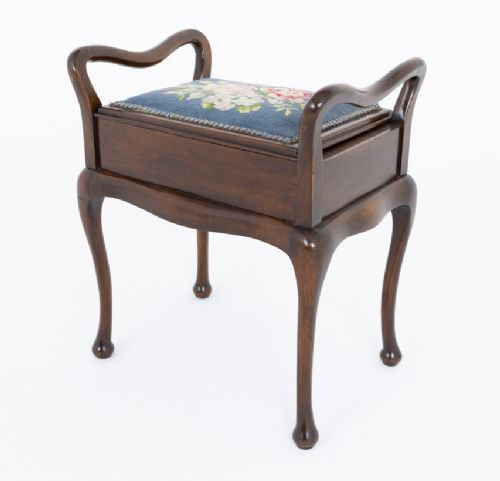


Sheet Music Storage Bench
These sheet music storage bench pieces provide practical seating with concealed compartments for your scores, most frequently found in Edwardian and Victorian designs.
Sheet Music Storage Bench
A sheet music storage bench combines a functional seat with internal space designed to keep scores organised near the instrument. When you search for a sheet music storage bench, you encounter piano stools and duet stools originating from the late nineteenth and early twentieth centuries. These forms serve pianists and musicians by keeping sheet paper tidy while offering a stable seat.
The versions most common on this page date from the Edwardian era and the Victorian period. You will find single and duet formats, some featuring lift-up seats and others equipped with fall-front compartments. They combine domestic furniture with musical utility, reflecting the popularity of home piano playing during these decades.
How They Were Made
Cabinet makers constructed these benches primarily from mahogany and walnut, occasionally utilising oak. Workshops frequently embellished mahogany frames with boxwood inlay, adding delicate lines and geometric motifs to the exterior panels.
Seating areas required padding and textile finishes, leading makers to employ fabric, velvet, and tapestry for upholstery. Internal mechanisms relied on brass hinges and fittings to support the lifting lids and drop-down fronts.
Many of these benches still retain the faint, comforting scent of old paper and furniture polish inside their music compartments.
What Varies in Quality
The refinement of the timber selection and the precision of the boxwood inlay distinguish standard production from finer work. Superior examples display carefully matched wood grain and crisp, clean stringing rather than coarse or hastily applied decoration.
The integrity of the mechanical action for the lift-up seat or fall-front compartment dictates the daily utility of the piece. Better construction ensures smooth movement and durable joints that withstand frequent opening.
The Sheet Music Storage Bench Glossary
- Fall-front
- A hinged front panel that drops forward to reveal internal compartments or shelving for sheet music. This mechanism allows easy access to scores without requiring the user to lift the seat.
- Duet stool
- An extended seating bench designed to accommodate two players side by side at the piano. These wider variants offer proportionately larger internal storage capacities.
- Boxwood inlay
- Narrow strips of pale wood inserted into contrasting darker timber to create decorative borders. Makers applied this technique to accentuate the outlines of Edwardian cabinet work.
- Sheraton Revival
- A late nineteenth and early twentieth century design style drawing inspiration from eighteenth century neoclassical furniture. Pieces in this manner feature restrained proportions and classical motifs.
Sheet Music Storage Bench: Frequently Asked Questions
What is a sheet music storage bench?
A sheet music storage bench is a specialised seat designed to hold musical scores inside its base. These pieces combine domestic seating with hidden compartments.
They emerged to serve parlours and music rooms where pianists needed quick access to bound scores and loose sheets.
How do I date an Edwardian music stool?
Edwardian music stools date from the reign of King Edward VII between 1901 and 1910, though the style extends slightly either side. They often feature mahogany frames with delicate boxwood inlay.
Compare the timber finish and decorative details against known period pieces to establish the approximate decade of manufacture.
Can I use these benches for modern storage?
These benches accommodate modern books, documents, and general household items alongside traditional sheet music. The internal compartments provide practical concealed space.
Ensure the internal dimensions suit your intended items before placing modern objects inside the vintage cavity.
How do lift-up seats work on these benches?
Lift-up seats operate on internal hinges that allow the upholstered top to rise vertically or angle upward. This grants direct access to the storage well below.
Some variants utilise a fall-front mechanism instead, where the front panel drops forward rather than the seat lifting.