
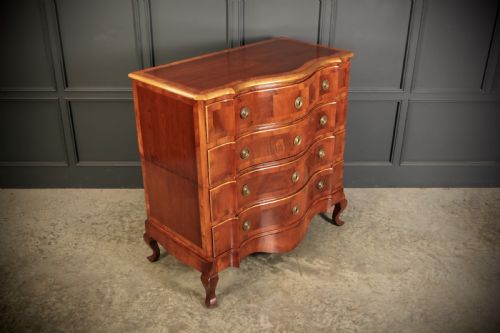


Shaped Front Chest Drawers
These shaped front chest drawers bring sweeping curves and rich cabinet timbers into a room, offering both practical storage and sculptural presence.
Shaped Front Chest Drawers
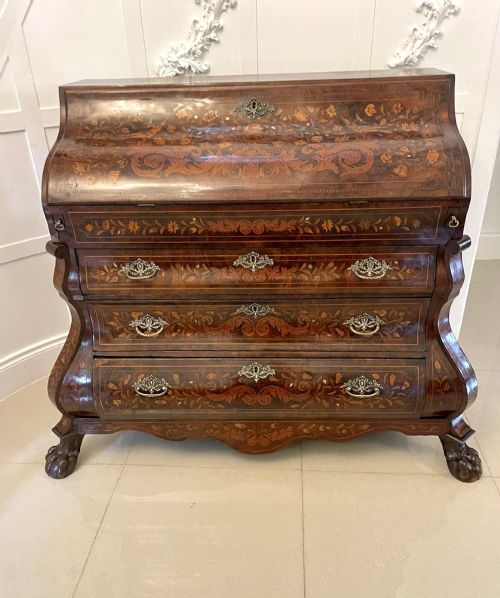
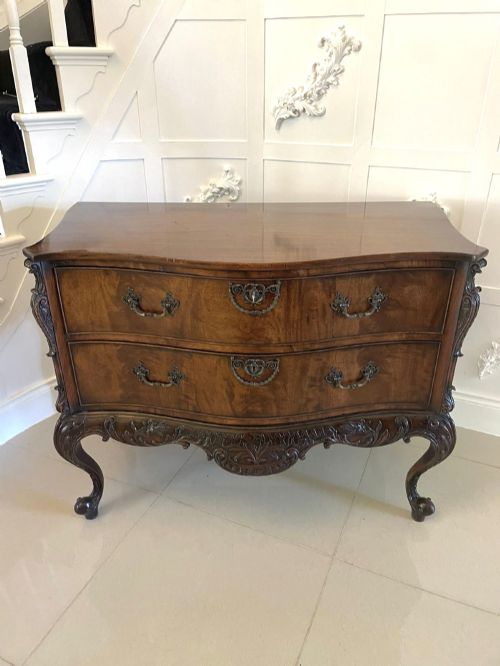
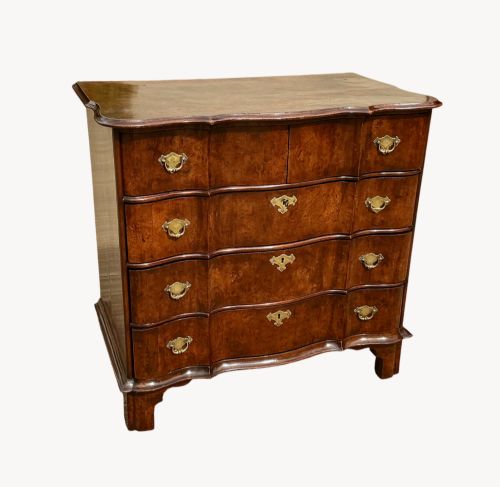
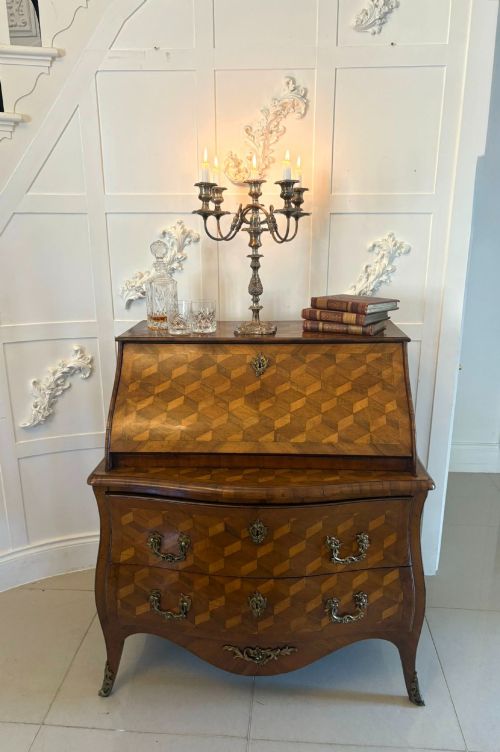
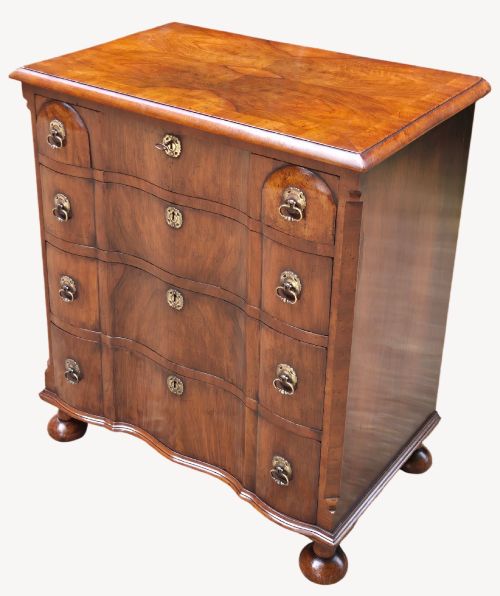
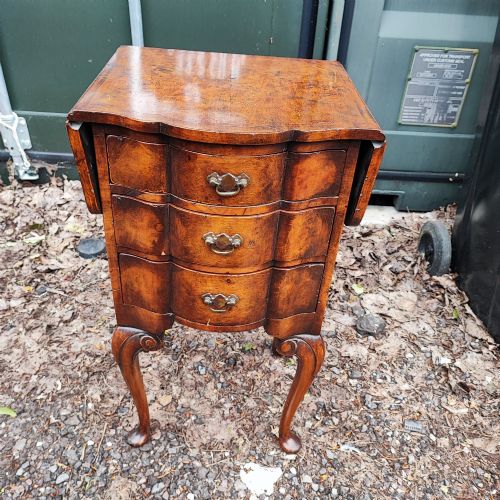
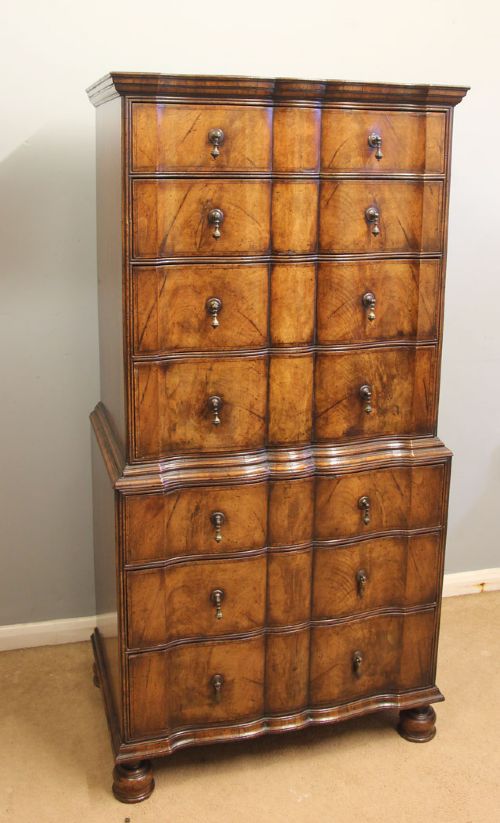
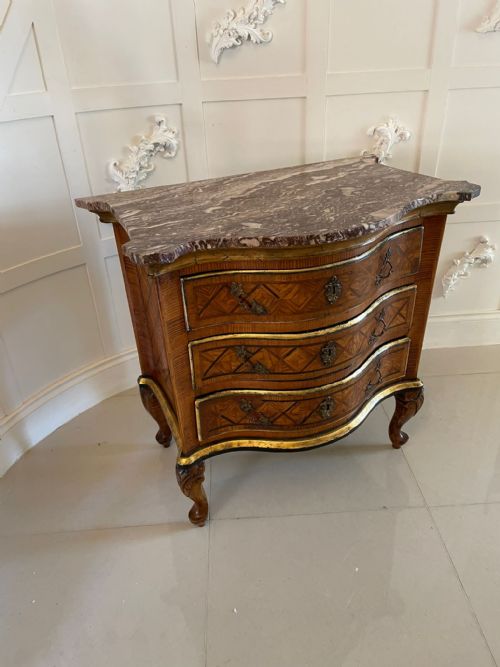
A shaped front chest drawers spans several centuries of cabinetmaking, with examples appearing from the eighteenth century onwards in various regional styles. The selection includes serpentine profiles, bombe silhouettes, and commode forms alongside bureau desks and bedside tables.
The eighteenth-century pieces often display Dutch Baroque, Dutch Rococo, or Italian Rococo influences, frequently rendered in burr walnut or mahogany with marquetry. Later nineteenth-century Victorian examples bring figured mahogany and walnut into the domestic interior, while subsequent revival pieces draw on Queen Anne, George II, and Chippendale traditions.
Materials and Technique
Cabinetmakers utilised dense timbers such as walnut, oak, mahogany, and burr walnut, often applying elaborate fruitwood marquetry, parquetry, and floral inlay across curved surfaces. Selected pieces incorporate marble tops or brass fittings to complement the figured grain of the wood.
Achieving the distinctive shaped front requires skilled handling of solid timber and veneers over curved frames, particularly in bombe and serpentine designs where every angle departs from the flat plane.
Several chests hide their curves behind elaborate floral marquetry, where wooden petals outlast the gardens that inspired them.
Judging Quality
The standard of a shaped front chest drawers rests on the selection of timber veneers, such as figured or burr walnut and mahogany, and the precision of the inlay work. Finer examples display meticulous alignment in floral marquetry and parquetry patterns across complex curves.
Construction methods and the handling of the serpentine or bombe profile dictate the overall refinement of the piece, distinguishing standard utility from master cabinetwork.
Druce And Co
The Shaped Front Chest Drawers Glossary
- Serpentine
- A furniture front curved in a concave-convex-concave shape. This undulating line requires precise woodworking to maintain symmetry across the drawer fronts.
- Bombe
- A swollen or bulging outward profile found on continental pieces. The sides and front curve outward in sweeping convex forms.
- Marquetry
- Decorative patterns formed by fitting together small pieces of veneer. Floral and geometric designs are composed using various woods like fruitwood.
- Parquetry
- A geometric mosaic of wood pieces used for surface decoration. It creates repeating patterns across table tops and drawer faces.
- Commode
- A low chest of drawers, often of French or Italian origin. These pieces frequently feature marble tops and elaborate shaped fronts.
Shaped Front Chest Drawers: Frequently Asked Questions
How do I identify a serpentine front?
A serpentine front presents an undulating line with a convex centre flanked by concave curves. This profile flows across the drawer tiers.
Cabinetmakers used this shape to soften the appearance of heavy timber furniture.
What timbers were used for these chests?
Common timbers include walnut, figured mahogany, burr walnut, and oak. Some examples incorporate fruitwood marquetry.
Selected pieces also feature marble tops set above the wooden carcase.
Which periods do these chests come from?
The pieces date from the eighteenth and nineteenth centuries, with later revival examples from the early twentieth century. Eighteenth-century models often show Dutch or Italian influence.
Victorian and Edwardian versions continue the tradition using mahogany and walnut.
How do I care for a walnut chest?
Keep the timber away from direct heat sources and strong sunlight to prevent the veneers from drying. Regular dusting with a dry cloth maintains the finish.
Avoid commercial silicone sprays and use traditional wax sparingly to nourish the grain.