
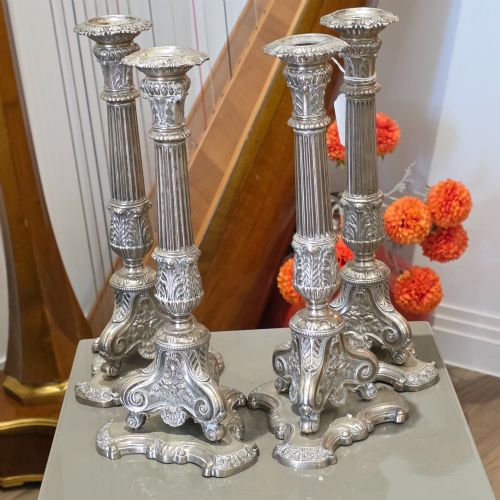
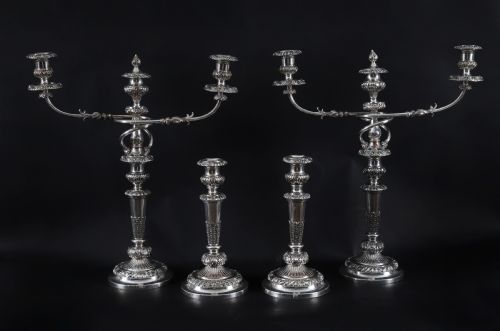
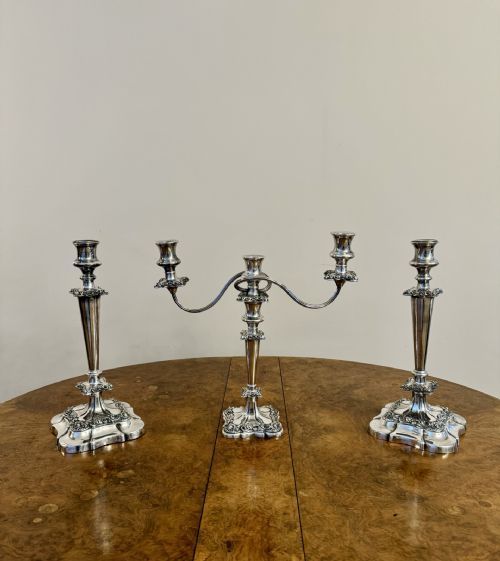


Set of Silver Candlesticks
A set of silver candlesticks brings dining tables and mantelpieces alive with period metalwork from the eighteenth, nineteenth and twentieth centuries.
Set of Silver Candlesticks
When you search for a set of silver candlesticks, you encounter matched groups of lighting pieces designed to hold taper candles in domestic interiors. These assemblies appear most commonly in counts of four, reflecting traditional dining table arrangements from the Georgian, Victorian and Edwardian eras. Alongside standard upright shafts, the selections include multi-light candelabra, low chambersticks equipped with handle pans, and compact desk sets.
The material composition spans solid sterling silver, silver gilt, and various plated methods including Old Sheffield Plate and nickel silver. Styles range from restrained Neoclassical columns to elaborate Victorian Rococo Revival forms and George V designs. Pieces hail from workshops across Britain and continental Europe, bearing the aesthetic markers of their respective decades.
What varies in quality
Quality rests upon the crispness of the chased ornament and the integrity of the underlying structure. Pieces with deep, hand-punched detail retain their definition through decades of cleaning, whereas worn plated surfaces reveal the base metal underneath.
A matched set displaying uniform hallmarks or matching maker marks commands greater cohesion than assembled groups. The weight of the metal and the balance of the weighted base also dictate the enduring stability of each stick.
Several chambersticks still retain their tiny conical snuffers, saved from loss over two centuries of midnight corridor journeys.
Conrad Eduard Mappe·Smith and Sissons·Marson and Jones·John Cafe·Gibbons of Wolverhampton·Barker Ellis·Thomas Bradbury·William Gibson and John Langman·James Dixon and Sons·J Torstrup·Hawksworth and Eyre
The Set of Silver Candlesticks Glossary
- Old Sheffield Plate
- A composite material made by fusing a thin sheet of silver to a thicker copper ingot before rolling them together into sheets. This technique predates modern electroplating and leaves a characteristic copper seam visible on edges.
- Chamberstick
- A low candlestick featuring a wide drip pan and a loop handle, designed for carrying bedroom illumination safely. Many examples include a small conical snuffer resting in the pan.
- Candelabra
- A branched lighting fixture holding multiple candles from a single central stem. These units often convert into standard candlesticks by removing the upper branch attachment.
- Silver Gilt
- Silver objects treated with a gold wash applied via chemical or electrochemical methods, imparting a rich yellow sheen. This finish protects the underlying silver and adds decorative contrast.
- Hallmark
- An official stamped mark applied to precious metal items indicating the assay office, purity standard, and year of manufacture. British pieces carry distinct town marks and date letters.
Set of Silver Candlesticks: Frequently Asked Questions
How were silver candlesticks used?
These pieces provided illumination across dining tables, sideboards, and desks before the arrival of gas and electric lighting. Servants carried chambersticks through dark corridors at bedtime.
Larger candelabra and four-piece candlestick sets lit formal evening meals, reflecting candlelight off polished mahogany surfaces and silverware.
How do I clean them safely?
Use a soft cloth and a gentle silver polish formulated to preserve antique surfaces. Avoid abrasive pads that wear through thin silver plating.
Keep polish away from weighted bases and felt undersides to prevent moisture damage to the internal filling materials.
How can I date my candlesticks?
Look for stamped hallmarks on the base or nozzle, which reveal the assay office and exact year of manufacture for British silver. Stylistic clues like neoclassical columns or rococo scrolls help narrow down unmarked pieces.
Construction methods also aid dating, such as the distinct copper seams found on older plated items.
Why do sets usually have four pieces?
Dining tables during the Georgian and Victorian periods required balanced illumination across large spreads. Four candlesticks placed symmetrically provided adequate light for guests.
Matching quartets were standard for formal dining room settings and social gatherings.