
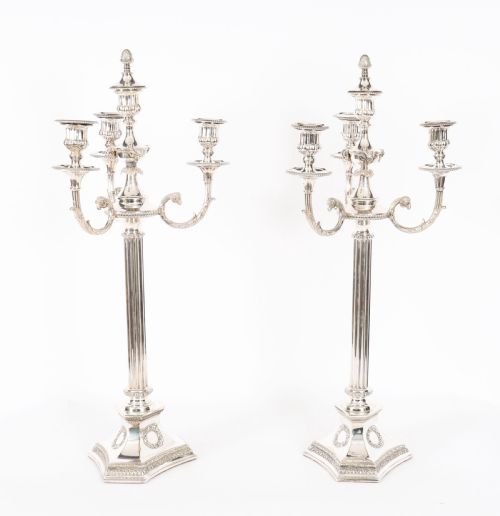
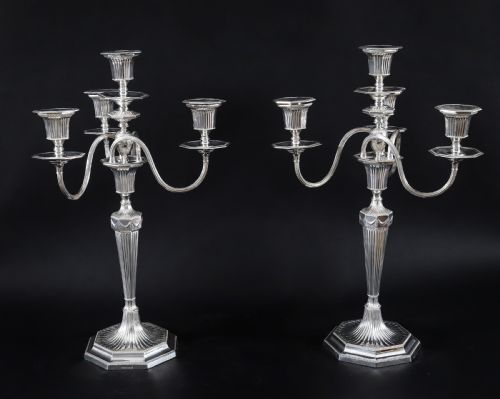


Four Silver Candlesticks
Four silver candlesticks bring symmetry to a table, offering matched illumination through solid metal and plated forms spanning multiple centuries.
Four Silver Candlesticks
When buyers search for four silver candlesticks, they seek a balanced matched set for formal dining or display. These assemblies appear in various forms, including traditional four-light candelabra, extending columns, and standard pillar sticks.
The selections on this page span the Georgian, Victorian, Edwardian, and later twentieth-century periods. Sets arrive in both solid sterling silver and various plated compositions, reflecting changing domestic requirements across generations.
Makers and silversmiths from Sheffield and London produced these sets to light grand rooms. Buyers frequently encounter nineteenth-century silver plate alongside early twentieth-century sterling examples.
Materials and Construction
Many pieces utilise solid sterling silver marked with standard hallmarks for assay office and date. Silversmiths also employed silver plate, Old Sheffield plate, and nickel silver over copper bases to achieve the appearance of solid metal.
Certain designs incorporate glass components alongside metal columns, while extending and telescopic mechanisms allow adjustable heights. Construction methods involve casting, plating, and assembled components secured internally.
Makers represented include prominent workshops from Sheffield and London alongside Italian manufacturers.
Distinctions in Quality
Quality rests upon the crispness of cast ornamentation and the integrity of the underlying metal. Heavy gauge sterling silver or thick Old Sheffield plate demonstrate superior original manufacture compared to lighter plated alternatives.
The clarity of makers' marks and hallmarks adds significant weight to a set. Complete, unblemished sets of four matching sticks retain greater uniformity than assembled groups collected over time.
Hawksworth Eyre·Smith and Sissons·John Cafe·Garrard and Co·Thomas Bradbury·Mappin and Webb
The Four Silver Candlesticks Glossary
- Sterling silver
- A silver alloy containing 92.5 percent pure silver and 7.5 percent other metals, usually copper. This standard composition is frequently stamped with official assay marks.
- Old Sheffield plate
- An early fused plating technique where a thin sheet of silver is fused to a thicker copper base. This process creates distinct edges where copper may subtly show through.
- Candelabra
- A branched candlestick holding multiple lights on a single base. These large pieces often feature four or more arms for illumination.
- Hallmark
- An official stamp applied by an assay office indicating metal purity, origin, and date of manufacture. These small marks help date silver items accurately.
- Telescopic
- An extending mechanism allowing the candlestick column to alter in height. This clever design appears in several nineteenth-century pieces.
Four Silver Candlesticks: Frequently Asked Questions
How do I care for silver candlesticks?
Clean sterling and plated pieces gently with appropriate silver cloths and non-abrasive polishes. Avoid harsh chemical dips that strip patination from recessed areas.
Store them away from direct heat sources and damp environments to prevent tarnishing and damage to internal weighted bases.
Are these sets actually matched?
Most professional sets leave the workshop as a unified group of four with matching hallmarks or identical plating. Some historical offerings were gathered as pairs over time.
Check the base stamps and decorative details to confirm whether all four components share identical manufacture and weight.
What is the difference between sterling and plate?
Sterling silver consists of solid precious metal throughout the entire object, bearing official assay office stamps. Silver plate involves a thin layer of silver applied over a base metal such as copper or nickel.
Plated items offer the visual appeal of solid silver at a different weight and material composition.
How do I read date letters on silver?
British assay offices stamped pieces with specific alphabetical characters corresponding to the year of testing. These date letters appear alongside the maker's mark and the lion passant for sterling.
Reference tables for London, Sheffield, and Chester provide the exact years for each letter style.