
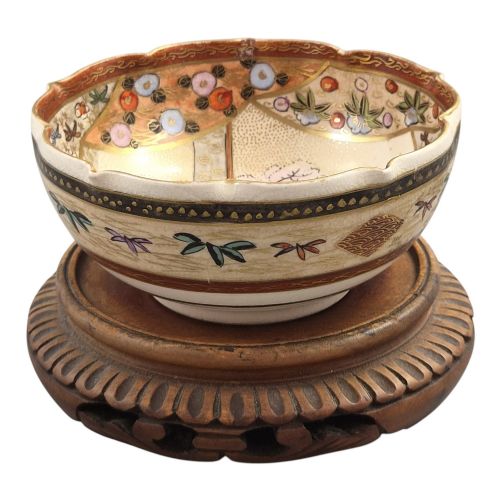


Satsuma Ware Dish
A satsuma ware dish brings intricate Japanese artistry into a room, offering finely painted scenes in enamel and gold.
Satsuma Ware Dish
A satsuma ware dish typically appears as a decorative bowl, plate, or saucer originating from Japan during the nineteenth century and the Meiji period. Makers from Kyoto and Yokohama produced these items, featuring detailed hand-painted compositions of figures, birds, flowers, and thousand-flower patterns.
The objects on this page span the Victorian and Edwardian eras, reflecting both smaller cabinet pieces and larger shallow dishes. Bowls and saucers frequently incorporate cobalt blue backgrounds alongside dense gilding and Shimazu crests.
Collectors encounter signed pieces bearing historical workshop marks such as Kinkozan, Shuzan for Yasuda, Nikko, Hododa, and Meizan. These signatures anchor the pieces to specific Meiji period workshops renowned for export ceramics.
Materials and construction
Potters formed these items using earthenware bodies, which provided a porous foundation suitable for absorbing complex glaze and enamel layers. Artisans then applied colourful enamels alongside gold leaf and gilt highlights to build up the intricate surface decoration.
Painting required steady brushwork to render multi-figure scenes, botanical subjects, and millefleur motifs with high precision. Gilding and enamel work were fired repeatedly to set the metallic sheen against the cream-coloured crackle glaze.
Materials recorded across the inventory include earthenware, enamel, gold leaf, gilt, and wood.
Judging quality and execution
Quality rests upon the density and execution of the enamel painting, where finer pieces display precise multi-figure groupings and crisp botanical detailing. The application of gold leaf and gilt also separates standard production from masterwork output.
The presence of clear, well-known signatures from makers such as Kinkozan or Meizan elevates an object through documented craftsmanship. Furthermore, the complexity of the composition, such as intricate millefleur coverage, dictates the visual richness of the item.
Kinkozan Kyoto·Shuzan for Yasuda·Nikko·Hododa Yokohama·Meizan
The Satsuma Ware Dish Glossary
- Satsuma
- A type of Japanese earthenware traditionally featuring a crackled, ivory-coloured glaze decorated with enamel and gilt. Kyoto and Yokohama served as primary production centres for export wares.
- Meiji Period
- The era of Japanese history lasting from 1868 to 1912, corresponding to the reign of Emperor Meiji. Pieces from this time often exhibit exceptional decorative detail tailored for Western markets.
- Millefleur
- A decorative pattern translating to thousand flowers, where the surface is densely packed with tiny blossoms. This motif requires immense patience from the painter.
- Gilt
- A thin layer of gold or gold-like material applied to the surface of the earthenware. It accentuates borders, motifs, and figural scenes.
- Shimazu Crest
- The heraldic symbol of the Shimazu clan, featuring a cross within a circle. It frequently appears on Satsuma ceramics as a mark of patronage or origin.
Satsuma Ware Dish: Frequently Asked Questions
How do I date a satsuma ware dish?
Dating relies on stylistic markers, historic signatures, and the historical periods associated with Japanese export ceramics. Items frequently align with the Meiji period, the Victorian era, or the Edwardian years.
Makers often signed their work or included workshop marks that correspond to active production dates between the late nineteenth and early twentieth centuries.
Are these dishes meant for food?
These pieces function primarily as decorative objects rather than functional tableware. The delicate earthenware body and raised enamel decorations suit display in cabinets or on walls.
Using them for serving food risks damaging the historic enamel and gold gilt surfaces.
What is the difference between a bowl and a dish?
Bowls feature deeper, rounded walls designed to hold contents or showcase interior and exterior painted scenes. Dishes typically present a shallower profile, such as plates or shallow saucers.
Both forms utilise the same earthenware and enamel techniques characteristic of the workshops.
Why do some pieces have crackled glaze?
The crackled glaze is a deliberate characteristic of traditional Satsuma earthenware. The network of fine lines forms naturally during the cooling process as the glaze contracts over the clay body.
Artisans often enhanced these lines with subtle staining to highlight the texture beneath the painted enamel.