
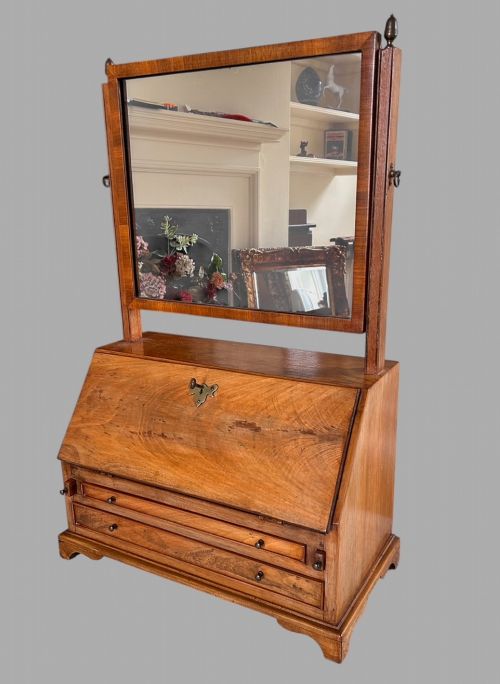


Satinwood Toilet Mirror
Satinwood toilet mirrors bring warmth and fine grain to a dressing surface, offering a practical glass mounted on a compact drawer base.

Satinwood Toilet Mirror
A satinwood toilet mirror sits upon a tabletop, providing a portable glass for grooming that doubles as a small chest for trinkets. Buyers searching for a satinwood toilet mirror will encounter tabletop bureau combinations alongside traditional swing glasses mounted on box bases.
The surviving pieces span the Georgian and Victorian eras, with Sheraton Revival and George III examples appearing alongside later 19th century interpretations. Forms range from simple upright frames to large scale dressing table mirrors fitted with multiple drawers.
Makers utilised contrasting timbers alongside the primary light wood, incorporating mahogany, harewood, and boxwood to frame the glass. These mirrors originated in English and Scottish workshops, reflecting the shifting domestic fashions of the 18th and 19th centuries.
Materials and construction
Cabinetmakers built these mirrors using dense timber carcases overlaid with fine satinwood veneers, often framing the drawer fronts and mirror surrounds with contrasting boxwood and harewood stringing. Brass pivoting screws secure the upright arms, allowing the glass to tilt.
Glass plates were silvered and fitted into rebated wooden frames, supported by upright standards rising from miniature box bases or bureau compartments. Inlaid decoration relies on precision carpentry, embedding dark woods into the pale satinwood ground to create geometric or neoclassical patterns.
Many a small drawer hides a secret compartment designed for clandestine love letters and rouge pots.
Distinctions in quality
Quality rests in the selection of the satinwood veneer, where chatoyant grain and rich figure elevate the visual depth of the timber. Finer examples display meticulous inlaid stringing and well proportioned miniature drawer units that operate smoothly within their carcases.
The architectural balance between the swing frame and the supporting base defines the better pieces in this range. Superior proportioning ensures the glass remains stable on its brass pivots without sagging over time.
Gillows
The Satinwood Toilet Mirror Glossary
- Satinwood
- A dense, light yellow tropical timber with a lustrous, reflective grain that takes a high polish. It was favoured by cabinetmakers for high-status cabinet furniture during the Georgian and Victorian periods.
- Toilet mirror
- A small mirror designed to stand on a dressing table, chest of drawers, or washstand. These pieces typically feature a swivelling glass mounted above a small box base fitted with drawers.
- Sheraton Revival
- A late 19th century design movement that reinterpreted the light, neoclassical furniture forms associated with the designer Thomas Sheraton. Pieces in this style frequently incorporate delicate satinwood veneers and stringing.
- Stringing
- A narrow band of contrasting wood inlaid into the surface of a piece to create decorative borders and linear patterns. It is commonly found on Georgian and Sheraton Revival toilet mirrors.
- Box base
- The lower section of a toilet mirror constructed as a miniature chest containing one or more small drawers. This design provides structural stability for the upright arms holding the glass.
Satinwood Toilet Mirror: Frequently Asked Questions
What is a satinwood toilet mirror?
A satinwood toilet mirror is a tabletop dressing glass mounted on upright arms above a small drawer base. The frame and base utilise pale satinwood veneers, often accented with inlaid stringing.
These pieces were designed for bedroom use to assist with grooming and personal care. They provide both a reflective surface and small storage compartments for jewellery or cosmetics.
How do I date a satinwood toilet mirror?
Dating relies on examining the construction methods, secondary timbers, and overall stylistic influences of the piece. Georgian and George III examples often display restrained neoclassical proportions, while Victorian and Sheraton Revival pieces show later interpretations.
Hardware such as brass pivoting screws and the cut of the wood inside the drawer boxes also help establish the period. Comparing the secondary woods like mahogany or pine provides further chronological clues.
Where were these mirrors placed?
These mirrors sat atop dressing tables, chest of drawers, or dedicated washstands within the bedroom. Their compact footprint allowed them to be moved easily around the room to catch the best light.
Some larger versions formed part of integrated dressing table furniture sets. Tabletop bureau variants combined the mirror with a sloping writing surface.
How do I care for satinwood?
Care involves keeping the timber away from direct sunlight and excessive heat sources to prevent the veneer from drying or fading. Dusting with a dry, soft cloth maintains the polished finish without risking moisture damage.
Avoid using silicone-based polishes or harsh chemical cleaners on antique wood surfaces. Periodic application of appropriate wax preserves the lustre of the grain.