
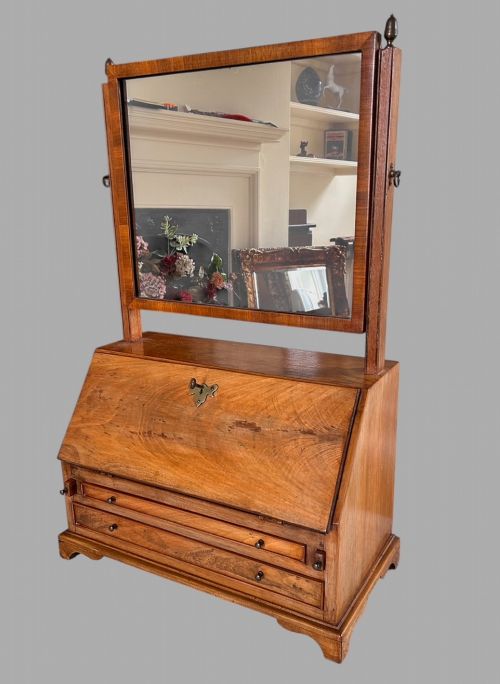


Satinwood Vanity Mirror
Satinwood vanity mirror pieces bring warm figured timber and crisp reflection to a bedroom, combining practical glass with polished historic surfaces.
Satinwood Vanity Mirror
When searching for a satinwood vanity mirror, you encounter everything from compact tabletop toilet glasses to grand dressing table mirrors and larger fitted dressing tables with integrated mirror glass. The selection spans distinct eras, including Georgian, Victorian, Edwardian, and Art Deco periods, alongside specific revivals like Sheraton Revival.
The version you are most likely to meet on this page is a tabletop toilet mirror or a freestanding dressing table mirror featuring satinwood veneer or solid construction. These pieces often incorporate box bases with small drawers, brass fittings, and contrasting timbers such as mahogany or walnut.
Origins range across English and Scottish workshops from the late eighteenth century through to the early twentieth century. Forms stretch from simple swing glasses on shaped supports to elaborate gentleman's wash stands and ladies writing tables equipped with mirrored superstructures.
How they were made
Cabinetmakers utilised satinwood alongside secondary timbers like mahogany, walnut, satin birch, and satin walnut, applying the pale, lustrous veneer over sturdy carcases. Hand-painted decoration, contrasting stringing, and geometric inlay frequently adorn the primary surfaces of these mirrors and tables.
The optical components rely on traditional mirror glass held within pivoting frames supported by brass screws and arms. Brass handles, escutcheons, and hinges provide functional hardware, while structural joinery incorporates dovetailed drawer construction and precise framing.
Satinwood Vanity Mirror Retail Price Guide 2026
Typical asking prices for satinwood vanity mirror among the pieces listed under this phrase on Sellingantiques today, from the lower quarter to the upper quarter. They describe what is for sale here now, not the wider market.
Some gentleman's wash stands hide secret rising compartments inside their satinwood frames.
What varies in quality
The standard of execution rests on the grain selection of the satinwood veneer and the crispness of any inlaid marquetry or hand-painted details. Superior pieces display book-matched figuring across the panels and immaculate cabinet joinery that keeps the pivoting mirror frame steady and true.
Originality of components defines the upper tier of examples, particularly the survival of the original mirror glass, brass hardware, and secondary drawer linings. The balance between the proportions of the glass frame and the supporting box base or dressing chest dictates the visual success of the piece.
Gillows·Harry and Lou Epstein·John Taylor of Edinburgh
The Satinwood Vanity Mirror Glossary
- Satinwood
- A hard, dense timber with a natural golden sheen and smooth grain. It forms the primary visual characteristic for these mirrors and dressing tables.
- Toilet mirror
- A small mirror mounted on a box base or upright supports designed to sit atop a chest of drawers or table. These pieces served personal grooming needs in bedrooms and dressing rooms.
- Sheraton Revival
- A late nineteenth and early twentieth century design movement that reinterpreted the neoclassical furniture forms of the eighteenth century. Pieces often feature delicate satinwood inlay and refined proportions.
- Box base
- The compartmented plinth or drawer-fitted chest that supports the pivoting side arms of a dressing mirror. It provided secure storage for small personal items.
- Superstructure
- An upper framework of shelves, small drawers, and a fixed or pivoting mirror attached to the top of a desk or dressing table. It extended the utility of the writing or vanity surface.
Satinwood Vanity Mirror: Frequently Asked Questions
What is a satinwood vanity mirror?
A satinwood vanity mirror is a dressing glass framed in or constructed from pale, figured satinwood, often mounted on a supportive box base or integrated into a larger dressing table.
These pieces range from portable tabletop toilet mirrors dating from the Georgian period to larger Edwardian and Victorian examples designed for bedroom use.
How do I date a satinwood mirror?
Dating relies on examining the construction methods, secondary timbers, and stylistic markers such as inlay patterns and edge moulding profiles. Georgian examples often feature simpler, heavier proportions, while Edwardian pieces frequently show refined Sheraton Revival influences.
Hardware styles, including brass screw caps and drawer pulls, also help determine whether a piece originates from the eighteenth, nineteenth, or early twentieth century.
Where were these mirrors used?
These mirrors primarily served in bedrooms, dressing rooms, and boudoirs for personal grooming, hair styling, and applying cosmetics. Tabletop versions sat upon existing chests of drawers, while freestanding cheval and dressing table mirrors formed standalone furniture.
Some integrated forms combined writing surfaces with mirrored superstructures, serving dual purposes for correspondence and dressing.
Are the mirror plates original?
Many surviving pieces retain their historic mirror glass, which can exhibit light foxing, minor silvering loss, or subtle distortions characteristic of older manufacturing techniques. Later replacements are sometimes present where original glass suffered accidental breakage over the centuries.
Inspecting the backing boards and the fit within the rebate helps determine the age of the glass relative to the timber frame.