


Satinwood Swing Mirror
A satinwood swing mirror brings a luminous timber grain and adjustable glass to a dressing table.
Satinwood Swing Mirror
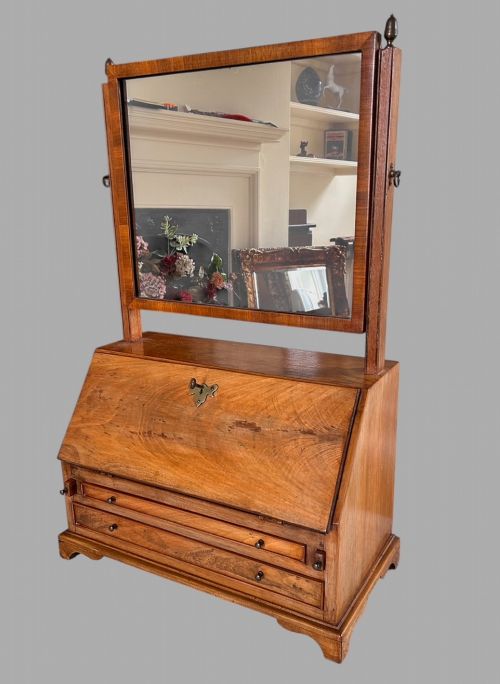
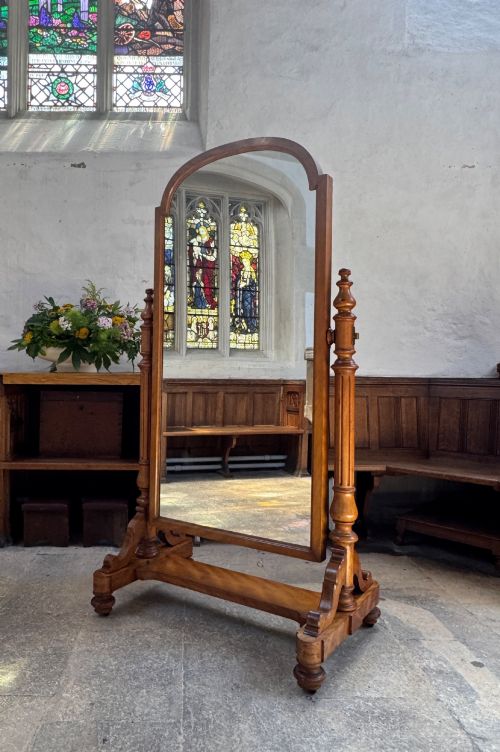
When you search for a satinwood swing mirror, you encounter pieces designed to sit on a tabletop or chest, pivoting within an upright frame. The items on this page span the Georgian, Victorian, and Edwardian eras, taking the form of toilet mirrors, dressing table mirrors, and larger cheval mirrors.
Origins represented in the evidence lean heavily towards English cabinetmaking, encompassing stylistic revivals such as Sheraton Revival and Grand Regency alongside pieces from the George III period. The timber itself provides a distinctive pale, golden-yellow hue that defines the visual character of these vanity glasses.
How they were made
Cabinetmakers constructed these pieces primarily using satinwood, mahogany, and satin birch, frequently employing brass for the pivot screws, hinges, and candle sconces that support the moving frame. The glass itself is held within a delicate wooden plate, suspended between two upright standards.
Inlay and marquetry form a significant part of the construction technique, particularly on pieces from the Georgian and Sheraton Revival periods where contrasting veneers highlight the borders and drawer fronts. Harewood and mahogany are often utilised alongside satinwood to create geometric stringing and decorative panels.
Some nineteenth-century dressing mirrors included hidden compartments behind the small drawers for secret correspondence.
What varies in quality
The distinction between standard examples and the finest pieces lies in the selection of the timber figure and the subtlety of the inlay work. Highly figured satinwood exhibits a shimmering, chatoyant grain that catches the light differently as you move around the room.
Joinery detail and proportion dictate the upper tier of the range, seen in the clean execution of dovetailed miniature drawers and the weight of the cast brass hardware. Superior pieces maintain a balanced relationship between the tilting mirror plate and its supporting uprights without sagging.
Holland and Sons
The Satinwood Swing Mirror Glossary
- Satinwood
- A dense, hard timber known for its lustrous, golden sheen and smooth texture. It serves as the primary veneer or solid wood for high-status eighteenth and nineteenth-century furniture.
- Cheval mirror
- A full-length swing glass supported on a freestanding wooden frame with four feet. This large form allows a person to view their entire outfit.
- Toilet mirror
- A smaller tabletop glass designed for grooming seated at a dressing table or chest of drawers. These often incorporate small storage drawers in the base plinth.
- Harewood
- Sycamore timber that has been stained grey, frequently utilised for contrasting inlay and crossbanding on decorative surfaces.
- Sheraton Revival
- A late nineteenth-century design style drawing inspiration from the neoclassical furniture of George Sheraton. It is characterised by delicate proportions, painted motifs, and satinwood veneers.
Satinwood Swing Mirror: Frequently Asked Questions
What is a swing mirror?
A swing mirror is a plate of glass mounted on pivots between two upright posts, allowing the user to tilt the angle of reflection. They were standard dressing table accessories in bedrooms before wall-mounted mirrors became common.
Most examples sit on a small chest of drawers or a plinth base, providing both a vanity glass and compact storage for small personal items.
How do I date a satinwood mirror?
Dating relies on observing construction methods, timber choices, and stylistic cues such as inlay patterns and edge moulding. Georgian pieces often display finer dovetailing and delicate stringing, while Victorian and Edwardian examples may show heavier framing or revival styling.
Examining the mirror plate itself and the brass hardware provides additional clues regarding the period of manufacture.
Where should I place a toilet mirror?
These mirrors suit placement on top of a sturdy chest of drawers, a dedicated dressing table, or a sideboard in a bedroom or hallway. Because they are freestanding, they require a stable surface with enough depth to support the base plinth.
Positioning them near a natural light source enhances their function as a working mirror while highlighting the grain of the timber.
What is satin birch?
Satin birch is a variant of birch timber prized for its distinctive, rippled grain pattern that resembles the lustre of satinwood. Cabinetmakers often utilised it as an alternative decorative wood during the Victorian period.
It shares the pale, warm tones found in other light woods seen across these listings.