
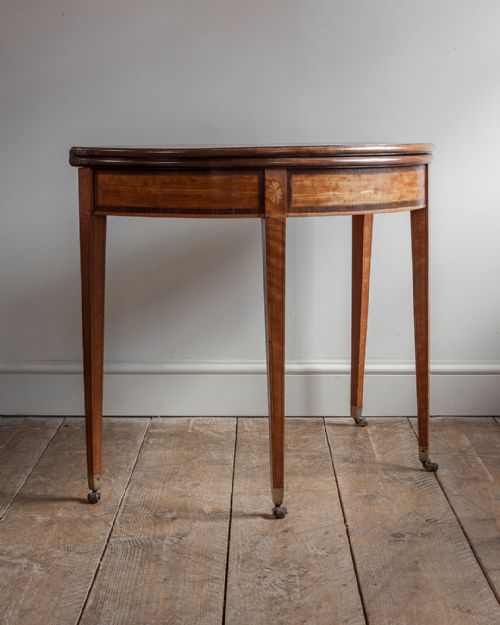


Satinwood Inlaid Card Table
When you search for a satinwood inlaid card table, you are looking at fold-over furniture designed for evening entertainment in Georgian, Regency, and Edwardian parlours.
Satinwood Inlaid Card Table
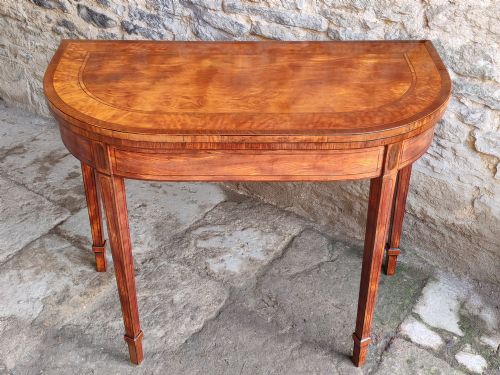
A satinwood inlaid card table is a versatile piece of multi-use furniture built to serve as a console, tea table, or gaming surface when unfolded. These tables surface primarily in Georgian and Edwardian designs, alongside nineteenth-century interpretations of earlier styles.
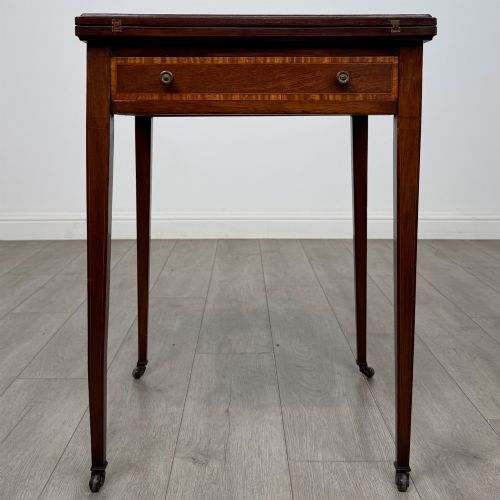
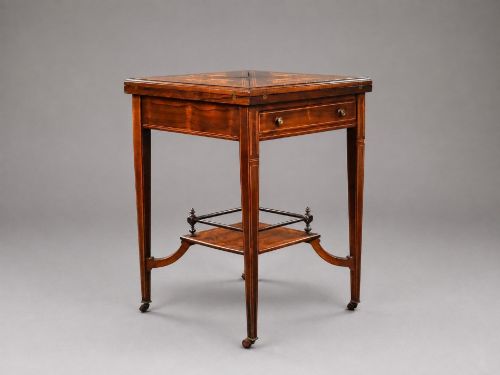
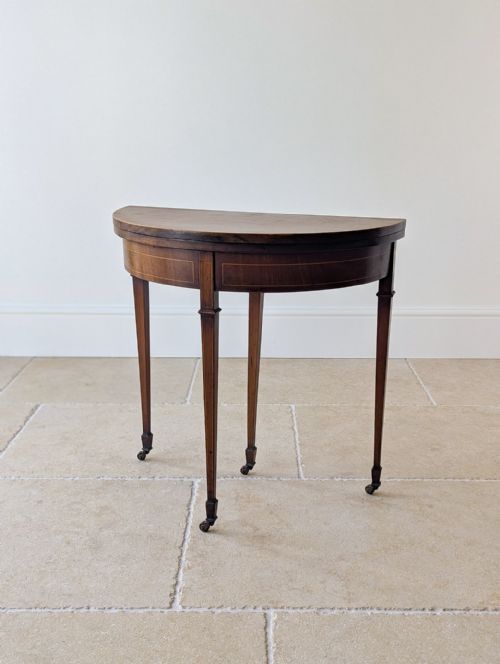
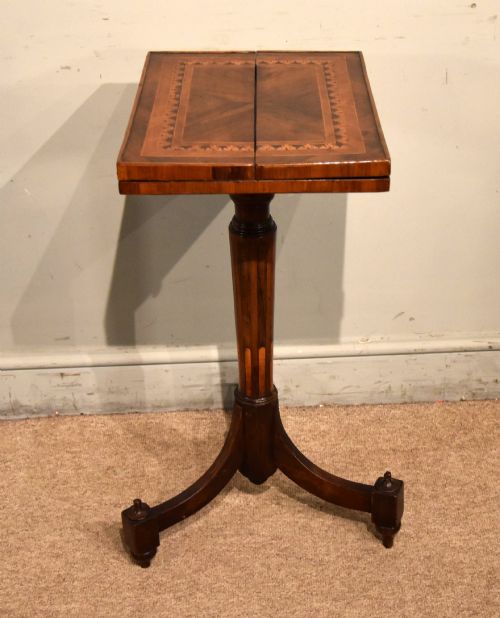
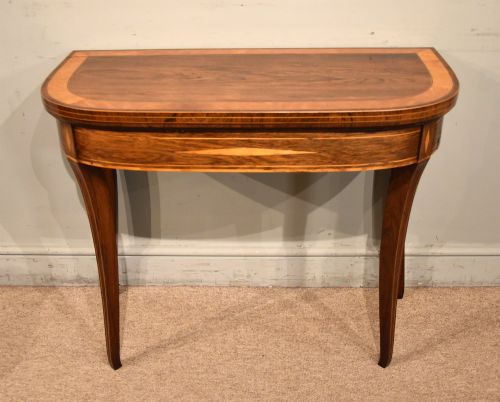
The most common form on this page is the demi-lune or D-shaped table, featuring a fold-over top that pivots or lifts to reveal a baize-lined playing surface. You will also encounter rectangular envelope tables from the Edwardian period, which open by rotating the corner flaps to form a square top.
Many examples combine satinwood veneers with mahogany or rosewood carcases, reflecting the preference for contrasting timbers in eighteenth and nineteenth-century cabinetmaking. They appear across periods from the late eighteenth century through the Edwardian era, spanning George III, Sheraton, and Regency stylistic revivals.
How They Were Made
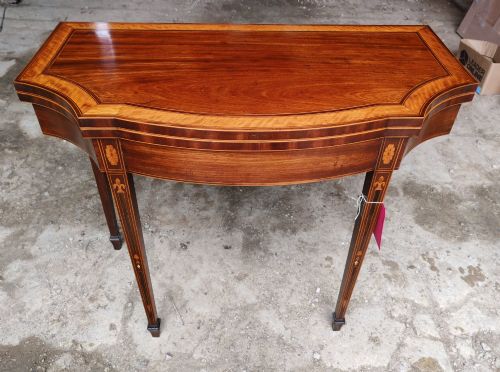
Makers constructed these tables using solid timber carcases faced with figured veneers, principally satinwood, mahogany, and rosewood. Craftsmen applied contrasting stringing and banding in ebony, boxwood, and purpleheart to define the edges of the fold-over tops and aprons.
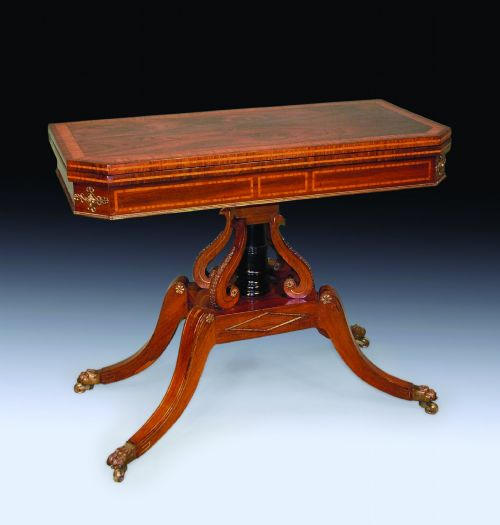
Inlay work relied on marquetry and crossbanding techniques to create geometric patterns, fans, and floral motifs across the satinwood ground. Structural stability depended on delicate tapered legs or central pillar pedestals, sometimes supported on scroll bases fitted with brass accents.
Satinwood Inlaid Card Table Retail Price Guide 2026
Typical asking prices for satinwood inlaid card table among the pieces listed under this phrase on Sellingantiques today, from the lower quarter to the upper quarter. They describe what is for sale here now, not the wider market.
Several tables include hidden compartments beneath the folding tops, once utilised for secretly stashing counters, guineas, and winning hands.
What Varies in Quality
The distinction between ordinary and exceptional pieces rests upon the crispness of the cabinetwork and the selection of the veneers. High-grade examples display finely figured satinwood with minimal fading, paired with precise, tightly fitted boxwood and ebony stringing that shows no gaps.
Proportion and execution define the upper tier of these tables. Superior specimens feature harmonious curves on serpentine or demi-lune tops, matched grain patterns across the folding leaves, and robust hinge mechanisms that allow the top to rest completely flat when opened.
Howard & Son's·Maples of London
The Satinwood Inlaid Card Table Glossary
- Demi-lune
- A half-moon shape used for table tops and consoles designed to stand flush against a wall when closed. When unfolded for play, they form a complete circular or semi-circular surface.
- Crossbanding
- A strip of veneer applied perpendicularly to the grain of the main surface around the border of a table top. This technique frames the satinwood field with a contrasting dark timber such as rosewood or mahogany.
- Envelope table
- A square card table with four triangular flaps that swivel and fold outward to reveal the playing surface. This form gained popularity during the Edwardian period.
- Marquetry
- The art of forming decorative patterns by fitting together small pieces of tinted woods, veneers, and shell. It differs from inlay by assembling the pattern as a complete sheet before gluing it to the carcase.
- Stringing
- Very narrow strips of contrasting wood inlaid into channels cut into the surface of the furniture. Cabinetmakers used boxwood and ebony stringing to trace fine geometric outlines.
Satinwood Inlaid Card Table: Frequently Asked Questions
How do I tell a Georgian table from an Edwardian copy?
Georgian tables generally exhibit hand-cut dovetails, older secondary woods like oak or pine beneath the veneers, and subtle hand-applied patination on the satinwood. Edwardian and Sheraton Revival pieces often display machine-made uniformity in their stringing and lighter interior carcase timbers.
Construction methods inside the pivot mechanism also help distinguish the eras. Earlier examples use straightforward wooden pivot actions or rule joints, while Edwardian models frequently incorporate patent brass hinges and clever swivel mechanisms.
Were these tables used only for playing cards?
While specifically designed for card games like whist or quadrille, these tables functioned as versatile pieces of reception room furniture during the day. When folded shut, they served as side tables, console tables, or lamp stands against a parlour wall.
Many examples feature plain baize interiors rather than inlaid gaming boards, allowing them to double as tea tables or occasional writing surfaces. Their multi-use nature made them staples of middle and upper-class British drawing rooms.
Why is satinwood often paired with mahogany?
Cabinetmakers paired satinwood with darker timbers like mahogany and rosewood to create sharp visual contrast and accentuate the golden glow of the satinwood veneer. This pairing defined the refined aesthetic of the late eighteenth century and later revival periods.
Darker woods provided durable framing materials for the borders, legs, and crossbanding, while the pale satinwood served as the primary canvas for delicate marquetry and floral inlays.
How should I care for a satinwood veneer surface?
Satinwood is sensitive to direct sunlight, which can bleach its characteristic golden colour and cause the delicate marquetry inlays to fade unevenly. Position these tables away from windows and direct heat sources to preserve the timber.
Dust them regularly with a soft, dry cloth and apply a quality beeswax sparingly when the wood appears dry. Avoid modern liquid polishes containing silicones, which can penetrate hairline cracks in old French polish.