


Satinwood Console Cabinet
A satinwood console cabinet brings warm, light grain and classical painted panels into a room, offering elegant surface space and fitted storage.
Satinwood Console Cabinet
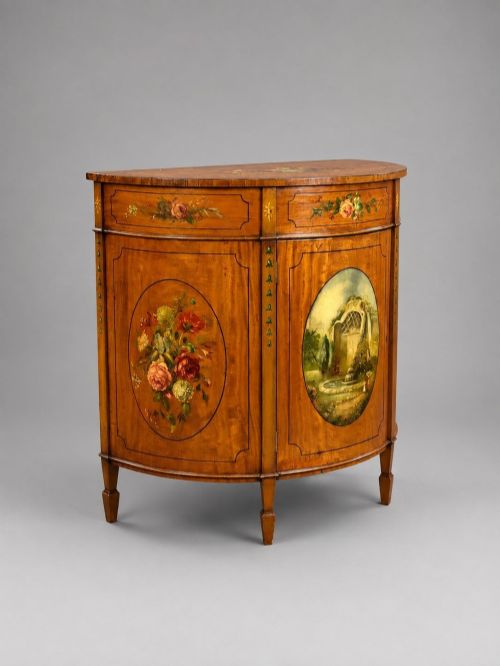
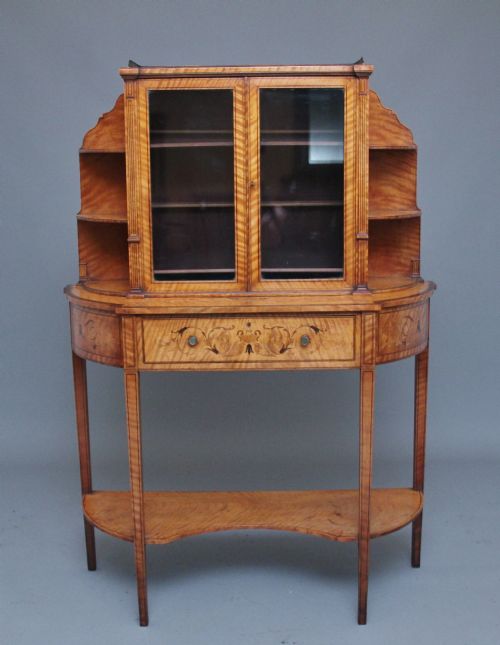
A satinwood console cabinet encompasses forms such as demi-lune commodes, side cabinets, and display pieces originating from the 18th century through to the Edwardian period and the 1930s. Buyers frequently encounter demi-lune and half-round shapes featuring painted classical panels or delicate marquetry.
The styles span Sheraton Revival, Edwardian Neoclassical Revival, Georgian Revival, and Louis XVI, reflecting an enduring taste for lighter neoclassical furniture forms. These items function practically as side cabinets, writing desks, and small display units whilst serving as decorative focal points.
Origins stretch across the 19th century and Edwardian decades, capturing both genuine 18th-century Sheraton period pieces and later revival interpretations. The construction adapts standard cabinet and commode forms to narrower footprints suitable for halls and reception rooms.
What varies in quality
The finesse of the hand-painted classical panels and the precision of the wood inlay, parquetry, and marquetry set the visual standard across these cabinets. Finer pieces demonstrate crisp detail in the painted motifs and seamless alignment of contrasting veneers.
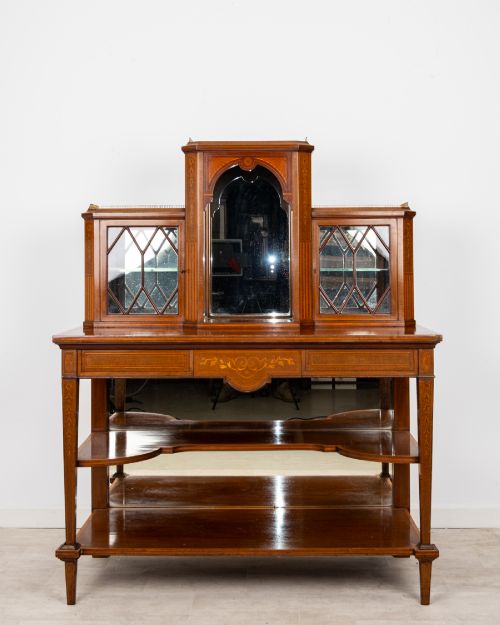
Selection of the underlying timber and the crispness of mouldings distinguish workshop output, from restrained 18th-century proportions to ornate Edwardian revival interpretations. The integrity of the satinwood grain and the harmony of added brass or glass elements complete the hierarchy of manufacture.
Listings feature satinwood combined with mahogany, satinbirch, and rosewood across Victorian, Edwardian, and Regency periods.
The Satinwood Console Cabinet Glossary
- Demi-Lune
- Half-moon shape in furniture design. This profile is especially common among satinwood commodes and console cabinets designed to sit flat against a wall.
- Marquetry
- Decorative patterns formed by fitting together contrasting pieces of veneer. Craftsmen apply this technique to create pictorial or geometric designs across cabinet doors and tops.
- Sheraton Revival
- A late 19th- and early 20th-century design movement inspired by the lightness and neoclassical motifs of 18th-century designer Thomas Sheraton.
- Parquetry
- Geometric mosaic woodwork used for floors and cabinet surfaces. It relies on regular repeating shapes such as cubes or squares.
- Bonheur Du Jour
- A light lady's writing desk featuring a small cabinet or set of drawers on top. These desks often showcase fine satinwood veneers and inlay.
Satinwood Console Cabinet: Frequently Asked Questions
Where do I put a console cabinet?
These cabinets suit hallways, drawing rooms, and landings where floor space is limited. Their shallow profiles allow them to sit neatly against walls without obstructing walkways.
Pairing a demi-lune shape with a matching mirror or placing a lamp upon the surface enhances both function and display in a reception space.
How do I care for satinwood?
Satinwood benefits from gentle dusting with a dry, soft cloth and protection from direct sunlight. Excessive light can alter the pale, golden tone of the timber over time.
Avoid placing damp items or modern plastic protectors directly on the polished surface to preserve the historical finish.
What is the difference between an original and a revival piece?
Original 18th-century pieces, such as those from the Sheraton period, exhibit period-specific construction methods and authentic patina accumulated over centuries. Revival pieces from the Edwardian era or the 1930s reinterpret these earlier neoclassical styles using the tools and tastes of their own time.
Both categories offer distinct craftsmanship, with revivals often featuring exuberant painted panels and detailed marquetry.