

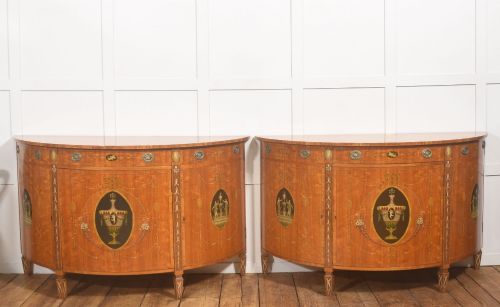
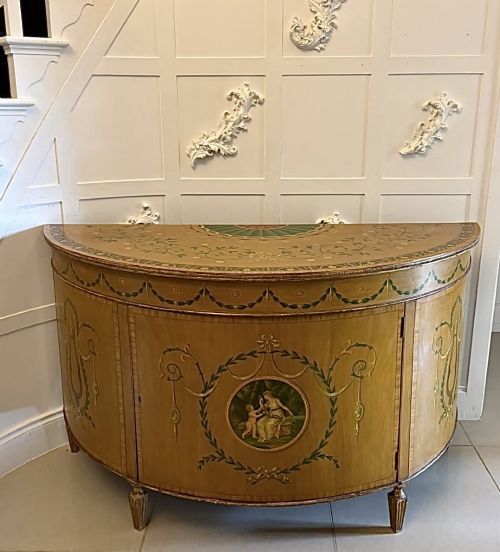
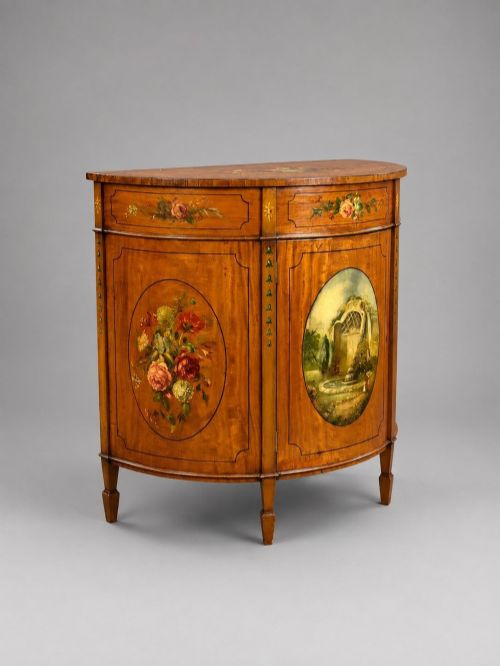


Satinwood Demi Lune Sideboard
These satinwood demi lune sideboard pieces offer curved fronts and refined timber surfaces, making them sought-after centrepieces for sophisticated interiors.
Satinwood Demi Lune Sideboard
A satinwood demi lune sideboard combines a distinctive half-moon footprint with striking light timber veneers, designed to fit snugly against a dining room or hallway wall. The pieces appearing here span the eighteenth century, the Victorian era, and the Edwardian period, with numerous examples drawing on Sheraton Revival and Neoclassical design principles.
Buyers will most frequently encounter compact commodes, side cabinets, and decorated sideboards rather than massive dining buffets. These items often feature flat tops above curving cupboard doors, providing surface display space while concealing practical storage within.
How they were made
Cabinet makers utilised satinwood veneers laid over a secondary timber carcase, taking advantage of the wood's natural shimmering grain to create luminous exterior surfaces. Boxwood and rosewood were frequently employed for stringing and contrasting borders, framing the primary curved panels with precise geometric lines.
Many examples incorporate hand-painted details and classical panels directly onto the timber, applying pigment beneath a protective polish. Marquetry and wood inlay techniques also appear across the periods, building intricate decorative motifs from contrasting woods.
Satinwood Demi Lune Sideboard Retail Price Guide 2026
Typical asking prices for satinwood demi lune sideboard among the pieces listed under this phrase on Sellingantiques today, from the lower quarter to the upper quarter. They describe what is for sale here now, not the wider market.
Cabinet makers sometimes hid secret drawers behind curved cupboard doors, keeping clandestine love letters safe from prying eyes.
What varies in quality
The sophistication of the painted panels and inlay work largely determines the standing of an individual piece. Finer examples display crisp botanical or classical motifs executed with considerable brush control, whereas simpler items rely solely on plain wood veneers.
Construction fidelity in the curved drawers and doors distinguishes superior cabinet making from more ordinary production. The tightness of the mitres, the selection of the timber figures, and the integration of secondary woods like mahogany all reflect the maker's original investment of time and skill.
The Satinwood Demi Lune Sideboard Glossary
- Demi-lune
- A half-moon shape characteristic of tables and cabinets designed to stand flush against a wall. This profile became particularly fashionable during the eighteenth century and saw renewed popularity in later revival periods.
- Satinwood
- A lustrous tropical timber known for its golden colour and reflective, satiny grain. It serves as the primary visual element in these cabinets.
- Marquetry
- The art of applying pieces of veneer to a structure to form decorative patterns and pictures. Craftsmen select contrasting timbers to achieve tonal shading.
- Stringing
- Thin inlay lines of contrasting wood used to outline drawers, panels, and borders. This technique defines the architectural geometry of the furniture.
Satinwood Demi Lune Sideboard: Frequently Asked Questions
Where should I place a demi lune cabinet?
These half-moon cabinets suit narrow hallways, landings, or dining rooms where a full rectangular piece would obstruct movement. Their curved profile softens room corners while offering useful surface space.
Because they sit flush against the wall, they function effectively beneath mirrors or paintings without protruding too far into the floor plan.
How do I identify a Sheraton Revival piece?
Sheraton Revival furniture from the late nineteenth or early twentieth century often imitates eighteenth-century neoclassical elegance through painted satinwood and classical urn motifs. The secondary timbers and interior construction methods usually reveal a later date upon closer inspection.
Cabinet makers of this later era utilised machine-cut veneers and distinct hardware that differentiate their work from genuine Georgian pieces.
What is the difference between a commode and a sideboard?
In this context, a commode generally refers to a lower, decorative storage cabinet with drawers or doors, often featuring high-status painted or inlaid surfaces. Sideboards tend to be longer and were traditionally developed for dining room service.
Both forms share the characteristic curved front when built to a demi-lune design, though commodes lean toward decorative reception room use.
How do I care for satinwood surfaces?
Satinwood benefits from minimal intervention, requiring only a soft, dry cloth for regular dusting. Avoid placing these items in direct sunlight or near heat sources to prevent the veneers from drying out.
Application of traditional beeswax polish helps maintain the lustre of the timber without building up heavy chemical layers over time.