


Vintage Half Moon Credenza
A vintage half moon credenza brings graceful semi-circular curves and classic storage to a room.
Vintage Half Moon Credenza
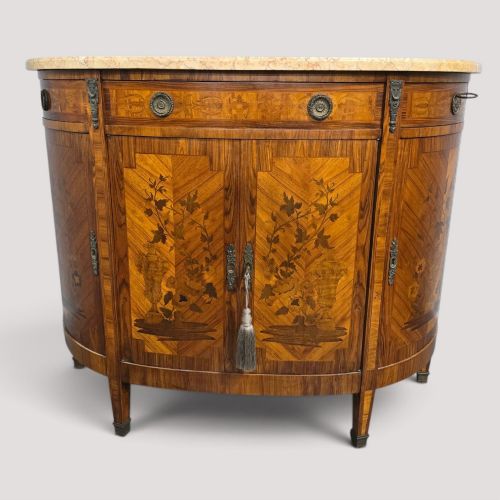
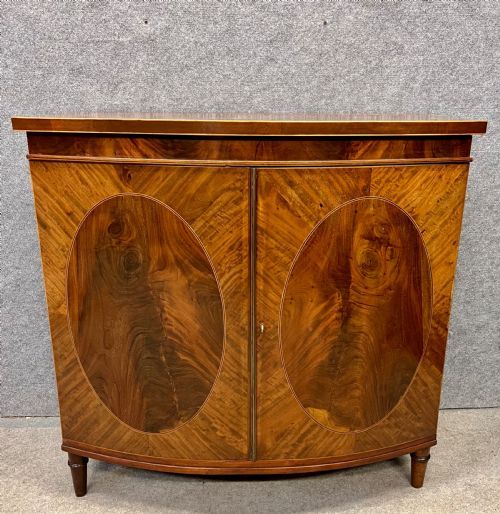
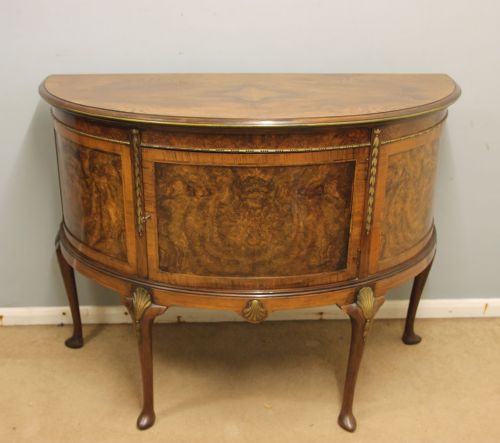
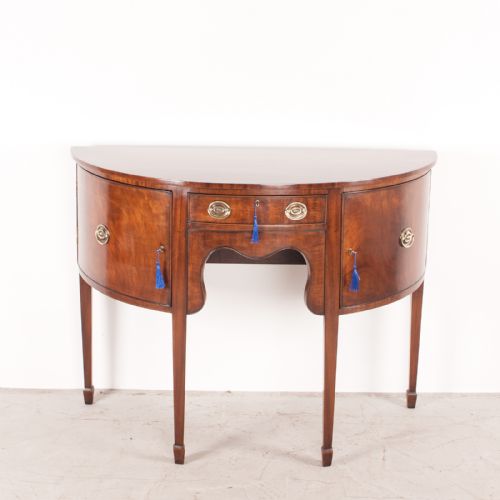
A vintage half moon credenza appears as a semi-circular or demi-lune cabinet designed to sit flush against a wall while offering surface display and concealed storage. These pieces emerge in styles ranging from Edwardian and Queen Anne to French Louis XVI and Sheraton Revival.
The most frequent form encountered on this page is the freestanding side cabinet or sideboard featuring a curved front. Makers from the nineteenth century through the nineteen-thirties utilised this shape for domestic interiors requiring compact yet elegant furniture.
Examples span the Edwardian period, nineteen-ten, nineteen-twenty, nineteen-thirty, and the nineteenth century. Woods such as mahogany, walnut, satinwood, and kingwood dominate the construction.
Materials and construction methods
Craftsmen built these curved carcasses using solid timbers and applied veneers of mahogany, walnut, and satinwood. Many pieces incorporate intricate marquetry and satinwood inlay to decorate the semi-circular top and doors.
Metal mounts in brass and ormolu frequently accent the corners, feet, and key escutcheons. Marble tops appear on specific French variants, adding weight and a contrasting surface texture.
Materials recorded across the selection include mahogany, walnut, satinwood, kingwood, marble, and ormolu.
Judging the quality of a demi-lune cabinet
The sophistication of the timber veneers and the precision of the inlay set the finer examples apart from simpler pieces. Hand-painted decoration by named artists elevates a cabinet above standard production.
The integration of cast brass or ormolu mounts and the smoothness of the curved door hinges indicate the level of workshop care. Subtle distinctions in the neoclassical or Sheraton revival detailing separate ordinary cabinets from superior ones.
Kaufman
The Vintage Half Moon Credenza Glossary
- Demi-lune
- A half-moon or semi-circular shape characteristic of these cabinets and console tables. This geometry allows the furniture to project minimally into a hallway or reception room.
- Marquetry
- The art of applying pieces of veneer to a structure to form decorative patterns and pictures. Craftsmen used various coloured woods to create floral or geometric motifs.
- Ormolu
- Gilt bronze mounted onto furniture for decorative effect. This technique was favoured in French styles to highlight corners and framing edges.
- Satinwood
- A durable timber with a satin-like sheen, often used as a veneer or for inlay work. It provides a pale, reflective surface that contrasts with darker woods like mahogany.
- Sheraton Revival
- An English furniture style drawing on eighteenth-century neoclassical designs. Pieces typically feature delicate proportions, satinwood inlay, and tapered legs.
Vintage Half Moon Credenza: Frequently Asked Questions
What is a demi lune cabinet?
A demi-lune cabinet is a semi-circular piece of furniture designed to fit flat against a wall. It functions primarily as a side cabinet, console, or compact sideboard.
The curved front provides storage space while maintaining a shallow depth, making these cabinets suitable for entrance halls and dining rooms.
How do I date a vintage credenza?
Dating relies on identifying stylistic markers, timber choices, and construction techniques. Pieces from the nineteenth century often show heavier proportions and distinct carving.
Edwardian and nineteen-twenties examples tend to feature lighter satinwood inlay, neoclassical revival motifs, and refined marquetry.
Where should I place a half moon cabinet?
These cabinets suit narrow spaces like hallways, landings, or dining room walls where a rectangular sideboard would project too far into the room.
The flat back sits securely against the wall while the curved front softens room angles and provides a surface for lamps or decorative objects.
What woods were used for these cabinets?
Cabinetmakers utilised a range of fine timbers including mahogany, walnut, satinwood, and kingwood. Veneers allowed them to create curved surfaces with striking grain patterns.
Inlays in contrasting woods and decorative painting frequently embellished the primary timber.