
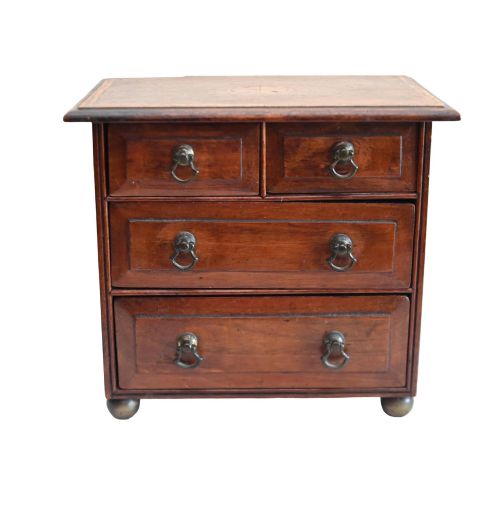
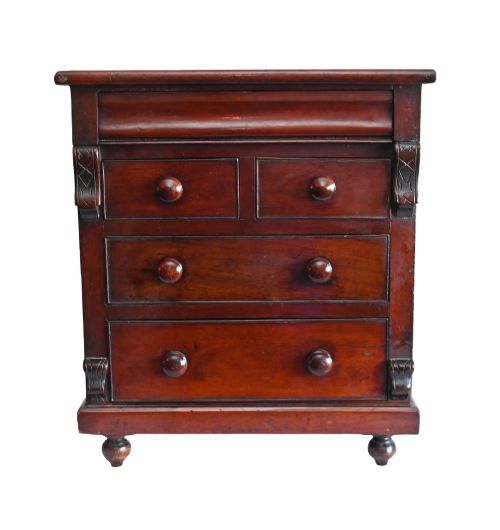
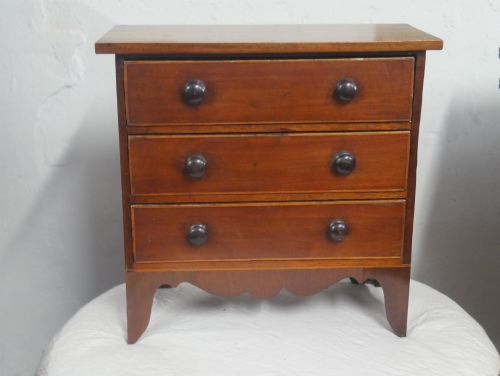
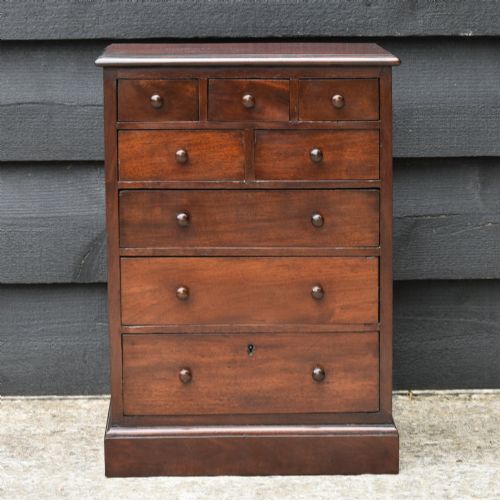
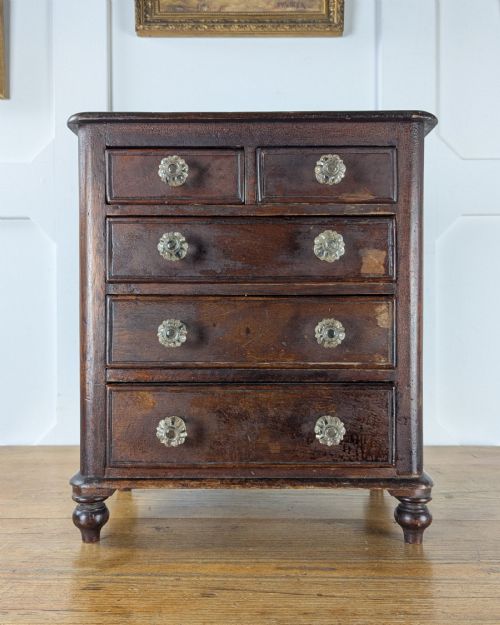
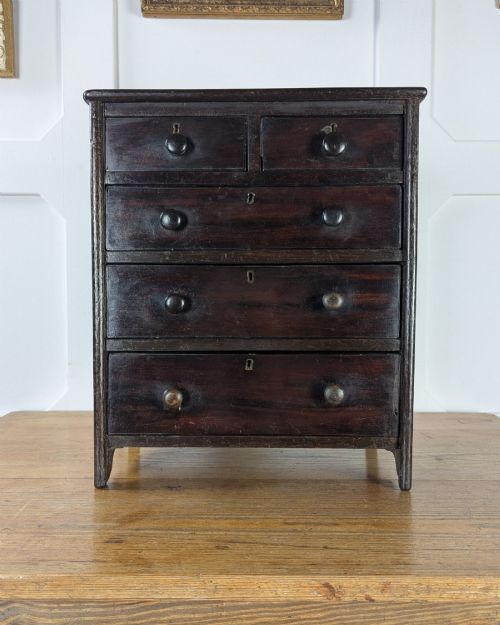
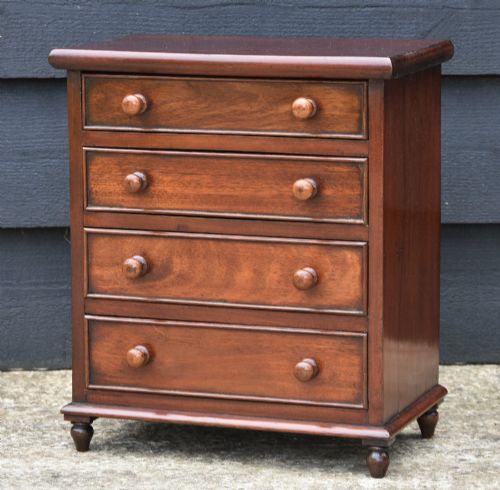
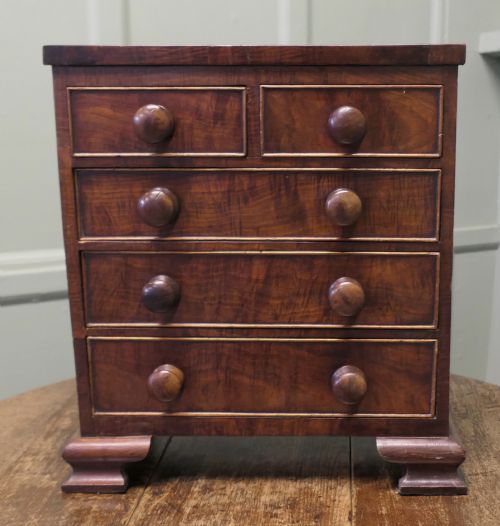



Salesman Sample Drawers
Salesman sample drawers are small-scale pieces created by makers to demonstrate skill or travel with designs, offering compact storage and traditional cabinetmaking on a diminutive scale.
Salesman Sample Drawers
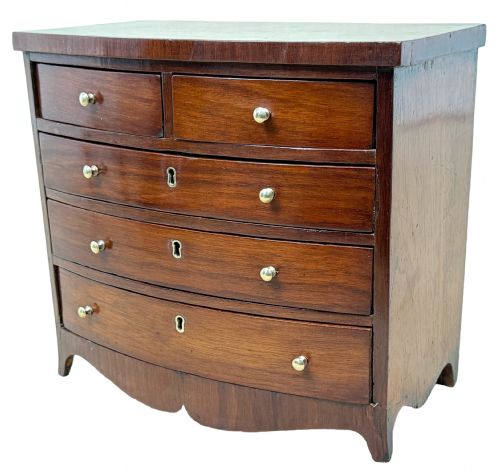
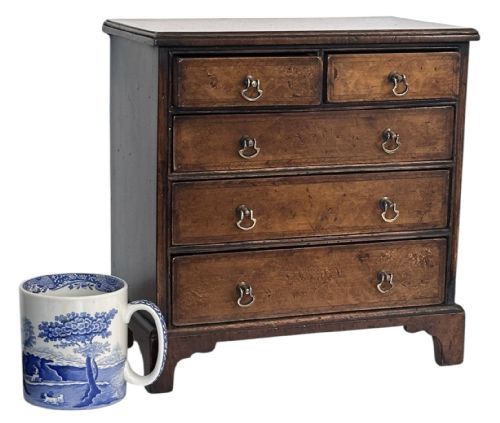
Salesman sample drawers present themselves primarily as miniature chests of drawers, apprentice pieces, and small commodes. The pieces span periods from the 18th century through the Victorian era, alongside Georgian and Regency examples.
Most items on this page are miniature chests of drawers in mahogany, oak, or walnut. Makers produced these small items using the same methods as full-sized furniture, resulting in functional scaled-down storage.
Materials and construction methods
Cabinetmakers constructed these miniature pieces using dense hardwoods like mahogany, oak, walnut, and pine, often applying veneers such as burr yew, kingwood, and tulipwood. They incorporated secondary elements in brass, bone, and marble.
Joinery mirrored standard workshop practice of the period, utilising dovetailed drawer construction and turned feet. Individual pieces integrate moulded details and secret drawers executed to a precise scale.
Materials recorded across the archive include bone, marble, and brass alongside diverse hardwoods and fruitwood veneers.
Judging the quality of miniature furniture
Quality rests on the fidelity of the proportions and the precision of the miniature joinery. Superior examples maintain exact scale relationships between drawers, mouldings, and hardware.
The choice of timber grain and the complexity of the veneer work dictate distinction. Fine execution shows in tight dovetails and smoothly operating small drawers.
The Salesman Sample Drawers Glossary
- Apprentice piece
- A small item made by a trainee to demonstrate mastery of a trade to a guild. These objects typically display exceptional attention to detail.
- Bowfront
- A convex curved front profile common on small chests. This shape requires skilled carpentry to shape timber accurately.
- Commode
- A low French chest of drawers or cabinet. These often incorporate decorative veneers and marble tops.
- Secret drawer
- A hidden compartment built into the carcass of a chest. Makers concealed these behind removable mouldings or false backs.
- Veneer
- A thin layer of figured wood applied to a secondary timber base. This technique creates decorative patterned surfaces on drawer fronts.
Salesman Sample Drawers: Frequently Asked Questions
What are salesman sample drawers?
Salesman sample drawers are miniature chests created by makers to show prospective clients furniture designs without transporting full-sized items. They replicate every functional aspect of standard furniture on a small scale.
These pieces also served as apprentice qualification works or intricate jewellery chests. Their compact size allowed travellers to carry varied styles easily.
How were apprentice pieces used?
Apprentice pieces functioned as tangible proof of a young craftsman's skill before certification. Guilds required trainees to build a complex miniature item successfully.
After completion, these objects often remained in workshops or passed into domestic use. Families kept them on tabletops to store small valuables.
What woods appear in these chests?
Makers relied heavily on mahogany, oak, and walnut for the primary structure of these miniature chests. Pine frequently appears as a secondary wood for drawer linings.
Finer examples feature decorative veneers like burr yew, kingwood, and tulipwood. These figured surfaces enhanced the visual appeal of small-scale display pieces.
How do I date a miniature chest?
Dating relies on identifying period styles, construction methods, and timber choices matching full-sized furniture eras. Georgian pieces show different moulding profiles compared to Victorian examples.
Hardware styles and secondary woods also provide chronological markers. Construction details like hand-cut dovetails help narrow the decade of production.