
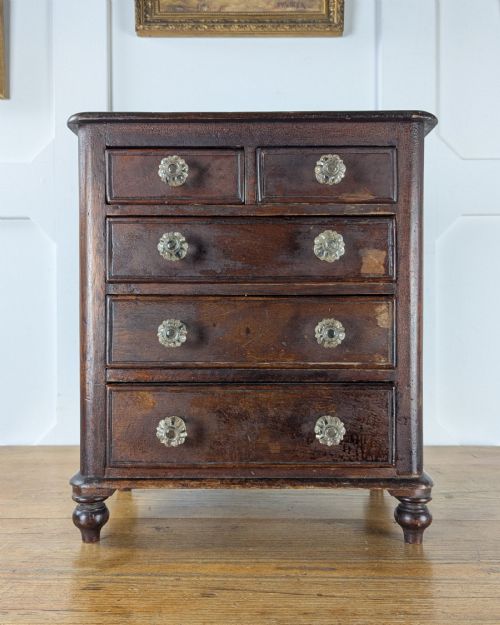
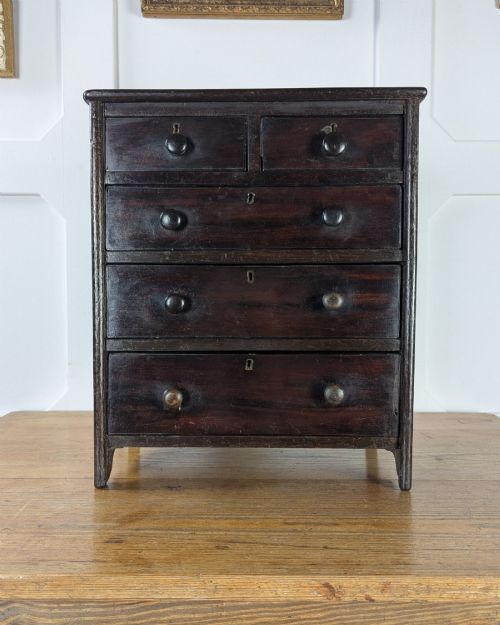
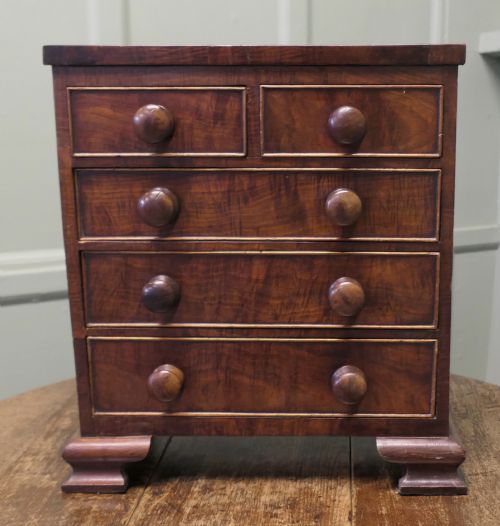
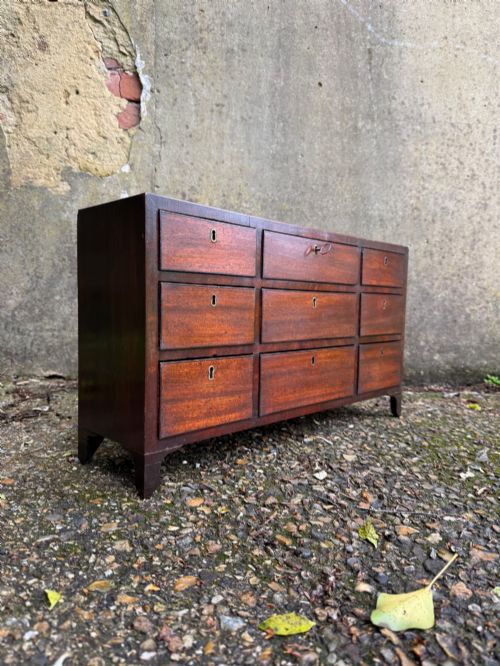


Dark Wood Apprentice Piece
These small-scale dark wood apprentice piece examples offer the precise proportions of full-sized furniture made by cabinetmakers to demonstrate skill.
Dark Wood Apprentice Piece
Makers produced these smaller items as masterworks or demonstration pieces, resulting in miniature desks, bureaus, hall chairs, and tea caddies alongside drawer units.
The objects span the eighteenth and nineteenth centuries, utilising dense timbers such as mahogany, rosewood, and oak to replicate larger domestic furnishings with exact scaling.
Materials and construction methods
Cabinetmakers worked primarily in mahogany, rosewood, and oak, often selecting figured timbers to showcase grain patterns on a reduced scale.
Joinery techniques mirrored those of full-size furniture, employing dovetail joints for drawer construction and turned feet to support miniature carcases.
Secondary elements incorporated brass handles, glass panels, and boxwood stringing to add fine detail to desks, chests, and miniature cabinets.
Current listings feature pieces spanning the Georgian, Regency, and Victorian periods in mahogany, oak, and rosewood.
Distinctions in quality
Proportion and fidelity to full-scale furniture dictate the standard of execution, where superior examples maintain strict architectural accuracy in miniature.
The choice of timber and the precision of dovetail joints separate standard workshop exercises from master cabinetmaker demonstrations.
The Dark Wood Apprentice Piece Glossary
- Apprentice piece
- A small-scale furniture item created by a craftsman to demonstrate technical proficiency. These pieces mirror standard domestic forms in miniature proportions.
- Bowfront
- A curved cabinet front that swells outward in the centre. This shape appears frequently on miniature chests of drawers from the Georgian and Victorian eras.
- Dovetail
- An interlocking joint used in box and drawer construction. Fine examples show tight, precise pins characteristic of skilled cabinetwork.
- Stringing
- Thin inlay work used to outline drawers or panels. It provides decorative contrast against dark timbers like mahogany and rosewood.
Dark Wood Apprentice Piece: Frequently Asked Questions
What is a dark wood apprentice piece?
A dark wood apprentice piece is a small-scale item of furniture made by a craftsman to demonstrate skill. These objects replicate full-sized furniture like chests of drawers and desks.
Craftsmen produced them in mahogany, rosewood, and oak during the Georgian and Victorian periods. They served as trial pieces or display objects rather than toys.
How were apprentice pieces used?
Makers created these miniature items to prove competency before gaining master status in a guild. They also served as travelling samples for cabinetmakers to show clients.
In domestic settings, people used them on larger pieces of furniture for storage or display. Miniature chests often held small valuables or jewellery.
How do I date a miniature chest?
Dating relies on timber choice, construction methods, and stylistic details from specific eras. Georgian examples often feature straight lines or bowfronts in solid mahogany.
Victorian pieces frequently incorporate turned feet and decorative veneers. Examining the drawer dovetails helps confirm the period of manufacture.
How do I style these pieces at home?
These small items fit easily onto sideboards, desks, or mantelpieces without dominating a room. Their compact proportions allow them to sit alongside larger antiques or modern interiors.
Group them with other small wooden objects to highlight their detailed craftsmanship. They provide functional storage for small items while adding period character.