


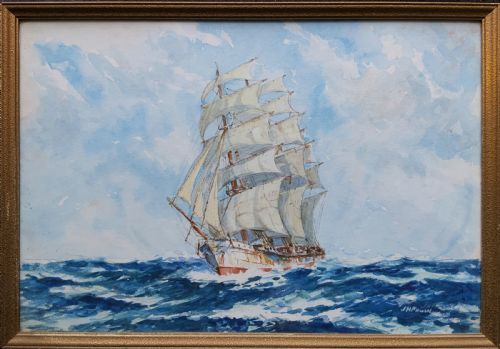
Sailing Vessel Watercolour Artwork
These sailing vessel watercolour artwork pieces capture maritime history on paper, offering buyers authentic depictions of historic ships.
Sailing Vessel Watercolour Artwork
A sailing vessel watercolour artwork brings historic maritime scenes into domestic spaces through delicate pigment application on paper. These paintings capture ships at sea, anchored in harbour, or navigating choppy waters during different daylight conditions.
Buyers encountering this selection will find works originating predominantly from the Victorian period through to the early decades of the twentieth century. The inventory spans straightforward watercolours on paper to finished paintings framed in wood, gilt wood, and glass.
Common subjects include named vessels like barques and clippers alongside unnamed marine scenes. These watercolours represent traditional marine art and Impressionist approaches to coastal and open sea subjects.
Materials and technique
Artists working in this medium apply watercolour pigments directly onto paper supports, occasionally incorporating ink for fine rigging details and linear precision. The application ranges from thin washes for skies and water to opaque bodycolour for highlights on vessel hulls and sails.
Surviving works utilise protective framing incorporating wood mouldings, gilt finishes, and glass panes to shield the delicate paper surfaces from moisture and atmospheric damage. Oak and gilt wood frames are typical for Victorian and early twentieth-century mountings.
Sailing Vessel Watercolour Artwork Retail Price Guide 2026
Typical asking prices for sailing vessel watercolour artwork among the pieces listed under this phrase on Sellingantiques today, from the lower quarter to the upper quarter. They describe what is for sale here now, not the wider market.
Listed materials centre on paper, watercolour, ink, glass, wood, and gold leaf.
Quality and execution
The standard of a sailing vessel watercolour artwork rests upon the artist's technical command of maritime architecture and rigging. Superior examples demonstrate accurate vessel proportions and convincing movement in water.
Condition and provenance further separate works, particularly the preservation of pigment vibrancy against fading and the integrity of the original paper support. Named vessels with documented historical context generally command greater interest than generic coastal sketches.
Charles William Adderton·William Frederick Settle·Samuel Owen·Frank Wood·Fred Mayor·William Boyce·Samuel John Milton Brown·Thomas Bush Hardy
The Sailing Vessel Watercolour Artwork Glossary
- Watercolour
- A painting method where the paints are made of pigments suspended in a water-soluble vehicle. This medium allows for translucent washes of colour on paper.
- Barque
- A sailing vessel with three or more masts having the fore- and mainmasts square-rigged and the mizzenmast fore-and-aft rigged. This rig appears frequently in maritime art.
- Gilt wood
- Wood decorated with gold leaf or gold paint applied to the surface. It provides a reflective border for framed maritime paintings.
- Impressionism
- A style of painting focusing on the visual impression of the moment, particularly regarding shifting light and atmosphere. Several marine works reflect these painterly qualities.
- Clipper
- A very fast sailing ship of the nineteenth century with three masts and a square rig. These vessels are celebrated for their speed and elegant lines.
Sailing Vessel Watercolour Artwork: Frequently Asked Questions
How old are these watercolours?
The works span from the nineteenth century into the early decades of the twentieth century, covering Victorian, Edwardian, and mid-century periods. Dates are established through artist signatures, framing styles, and subject matter.
Specific decades like the 1930s and 1940s appear alongside Victorian pieces, reflecting changing artistic approaches to maritime subjects over time.
How should I display them?
Display these watercolours away from direct sunlight to prevent the pigments and paper from fading. Keep them in rooms with stable humidity levels to protect both the paper and the wooden frames.
Glazing with glass helps shield the delicate watercolour surface from dust and atmospheric pollutants in the home.
What ships are depicted?
The subjects include named vessels such as four-masted barques, steel hull ships, and specific barques like the Garthpool. Other works portray unnamed fishing boats, moored vessels, and ships navigating choppy waters.
Coastal scenes and harbour approaches like Portsmouth Harbour and Lyme Bay provide recognizable geographical settings for the shipping.
How do I identify periods?
Period identification relies on costume, vessel design, framing materials, and artist active dates. Victorian works often feature heavy gilt frames and detailed academic rendering of rigging.
Later pieces from the twentieth century sometimes adopt looser brushwork associated with Impressionism or early modern movements.