
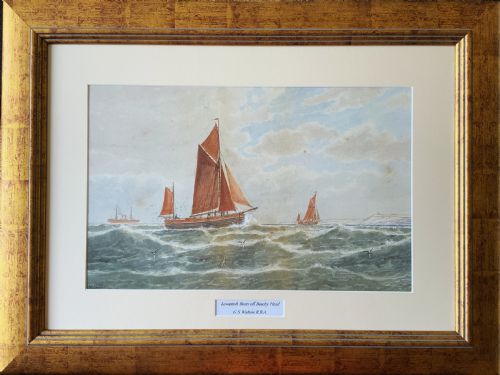


Sailing Boat Watercolour
When you search for a sailing boat watercolour, you are looking at original marine art created on paper using water-soluble pigments.
Sailing Boat Watercolour
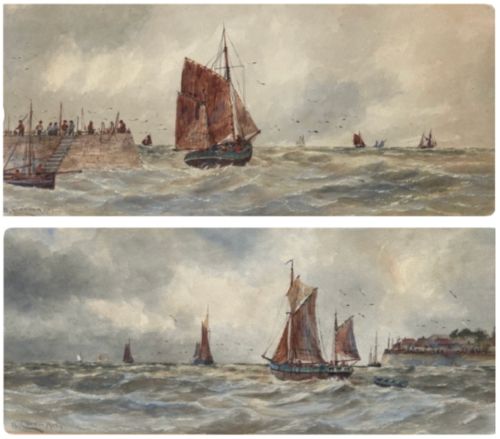
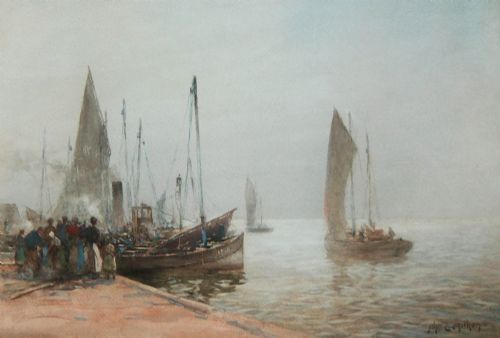
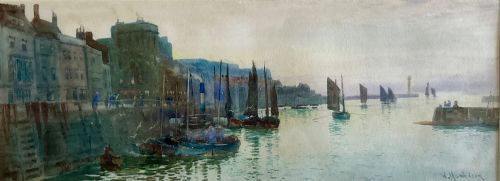
A sailing boat watercolour captures maritime scenes, coastal harbours, and open seas across the nineteenth and early twentieth centuries.
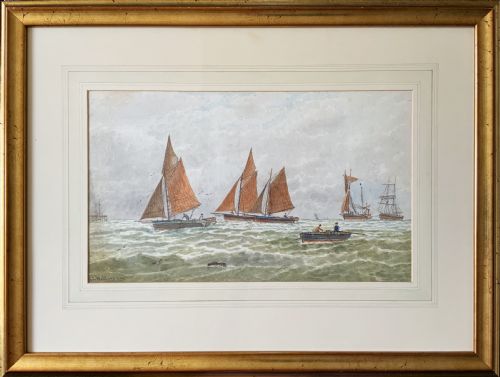
You will most commonly encounter Victorian and Edwardian works on paper, framed under glass in wood or gilt wood frames.
The subjects range from bustling British fishing ports and Venetian canals to masted ships in choppy waters and quiet beach scenes.
Materials and techniques
Artists painted primarily with watercolour pigment on paper, occasionally incorporating bodycolour or highlights of gold leaf.
Finished works were mounted behind glass and housed in wooden or gilt wood frames to protect the delicate paper surface from moisture and light.
Artists braved freezing Yorkshire coasts and choppy seas just to capture a single drifting fishing boat.
What separates the best pieces
Quality rests upon the artist's ability to render light, movement, and atmospheric conditions in maritime environments.
Works by recognised marine artists command greater attention through their confident brushwork and accurate depiction of rigging and hull forms.
William Cannon·James E. Aitken·William Matthison·George Stanfield Walters·Thomas Bush Hardy·Fred Waugh·Frank H. Mason·Clara Montalba·Ernest F. Hill·Fred Mayor·Thomas Clavering Alder·Walter Sweet·Lennard Lewis·Robert Anderson·Harry Wanless·Frederick William Booty·GM de L'Aubiniere·Frank Wasley·J Syer·Charles Edward Wilson·Edward Aubrey Hunt·Edward Wesson·J W Carey·H Magenis
The Sailing Boat Watercolour Glossary
- Watercolour pigment
- Colouring matter finely ground and mixed with a water-soluble binder, applied to paper. It allows for transparent washes and fine linear details.
- Gilt wood
- Wood decorated with a thin layer of gold leaf or metallic gilt. It provides a traditional decorative border for framing fine art.
- Marine art
- Artistic representation of maritime subjects, including ships, coastal views, and harbours. It encompasses both naval engagements and everyday fishing scenes.
- Bodycolour
- Watercolour paint mixed with a white pigment to render it opaque. Artists utilise it to create highlights and solid areas of colour.
Sailing Boat Watercolour: Frequently Asked Questions
How should I display a sailing boat watercolour?
Keep these works behind glass out of direct sunlight to prevent the watercolour pigments from fading over time.
Ensure they hang in rooms with stable humidity levels to protect the underlying paper and original wooden or gilt frames.
Are these paintings original works?
The pieces recorded here are original hand-painted works on paper rather than mass-produced prints.
Artists applied pigments directly to the surface, making each maritime scene a unique creation.
How do I date a maritime watercolour?
Look to the clothing of figures, the type of vessels shown, and framing styles for initial clues.
Signatures, dates inscribed by the artist, and period framing materials help narrow down the decade of creation.
What subjects appear in these paintings?
Common subjects include bustling harbour scenes, fishing drifters, and sailing vessels navigating choppy coastal waters.
Locations range from Yorkshire ports and Cornish harbours to international waters and Venetian canals.