
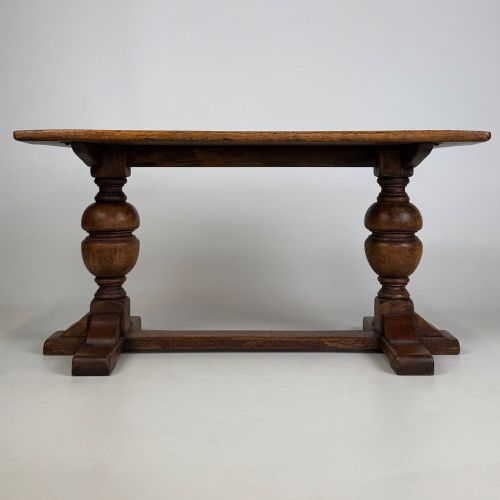
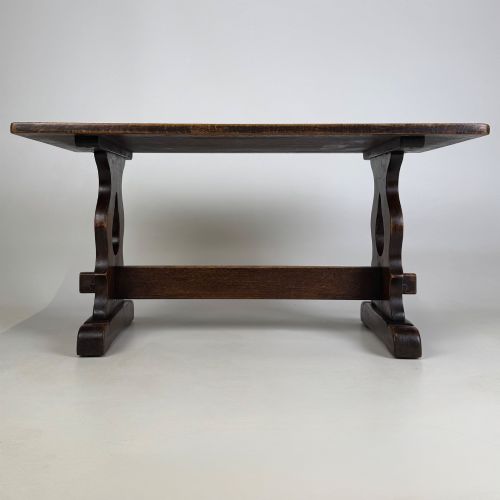
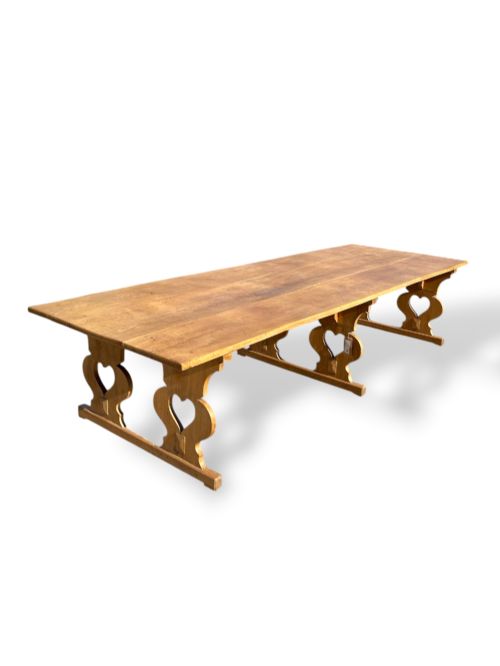


Rustic Trestle Coffee Table
A rustic trestle coffee table brings honest timber and sturdy vernacular lines right to the centre of a sitting room.
Rustic Trestle Coffee Table
When you search for a rustic trestle coffee table, you look for low timber surfaces rooted in utilitarian country traditions. The selection spans the eighteenth, nineteenth, and early twentieth centuries, drawing on English, French, Austrian, and Spanish provincial styles.
You will encounter repurposed benches, low tables, and shortened trestle forms made from native hardwoods. Oak, elm, sycamore, and fruitwood dominate the offerings, often showing scrubbed surfaces or historic paint finishes.
The typical piece balances robust joinery with a low profile suited to modern living rooms. Whether adapted from an eighteenth-century trestle table or an eighteen-nineties pig bench, each object carries distinct signs of its working past.
How they were made
Maker-joiners utilised solid native timbers like oak, elm, and walnut, selecting boards for strength and distinct grain patterns. Tables were constructed using traditional pegged mortise and tenon joints designed to withstand heavy daily use in farmhouses and workshops.
Surfaces often show the marks of hand planes, scrub brushes, and centuries of wear rather than factory-finished veneers. Wrought iron bracing occasionally reinforces the trestle bases, while painted pine and fruitwood exhibit simple, robust construction methods.
Listings feature timbers including oak, elm, sycamore, walnut, pine, and fruitwood across the eighteenth, nineteenth, and early twentieth centuries.
What varies in quality
Quality rests in the integrity of the timber and the honesty of the conversion from larger furniture or benches. Tables retaining their original scrubbed patination and untouched structural timber stand apart from those heavily sanded or altered in recent decades.
Proportion and balance define the superior examples, where the low height feels intentional rather than compromised. The heft of a solid oak or elm top paired with well-proportioned trestle ends separates fine country carpentry from utilitarian utility items.
The Rustic Trestle Coffee Table Glossary
- Trestle
- A structural support consisting of a horizontal beam fixed to two splayed legs. This design provides ample legroom and stability.
- Scrubbed
- A finish achieved by vigorous washing and scouring of wooden tabletops to remove grease and dirt, leaving a pale, clean grain.
- Gateleg
- A table with hinged drop leaves supported by legs that swing out like a gate. It offers flexibility in floor space.
- Pig bench
- A low, sturdy bench historically used in rural butchery and farm work. These benches now function well as narrow coffee tables.
Rustic Trestle Coffee Table: Frequently Asked Questions
What is a rustic trestle coffee table?
It is a low wooden table featuring trestle supports, often adapted from historic country workbenches, dining tables, or utility furniture.
These pieces showcase traditional craftsmanship, solid native timbers like oak and elm, and surfaces shaped by decades of rural use.
How were these tables used originally?
Many began as full-sized trestle dining tables, low work benches, or agricultural utility pieces before being cut down to coffee table height.
Others served specific rural purposes, such as workshop tasks or domestic chores in farmhouses across Britain and continental Europe.
How do I care for a scrubbed timber top?
Scrubbed wood benefits from minimal interference and gentle cleaning with dry or slightly damp cloths rather than harsh chemical polishes.
Applying natural beeswax sparingly helps protect the porous grain while preserving the dry, historic texture of the surface.
How can I tell an older table from a later reproduction?
Examine the timber for authentic tool marks, natural wear patterns, and the colour shifts that only come from age and exposure.
Hand-cut pegs, traditional jointing methods, and genuine patination on oak, elm, or fruitwood provide clear indicators of period authenticity.