
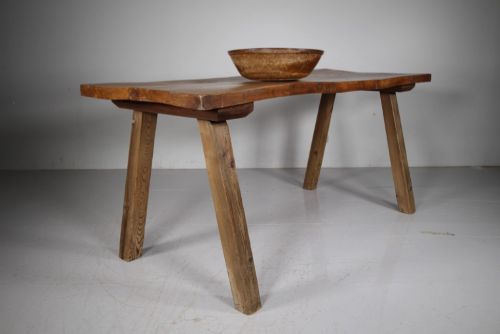
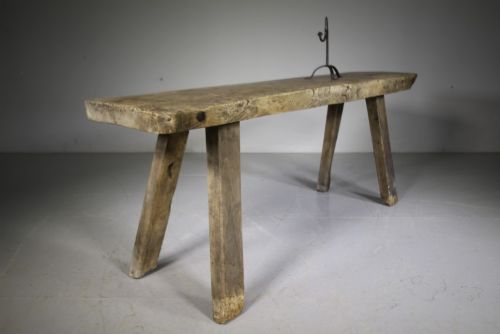
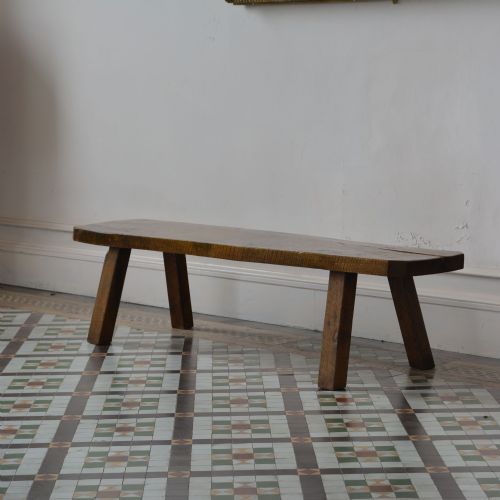


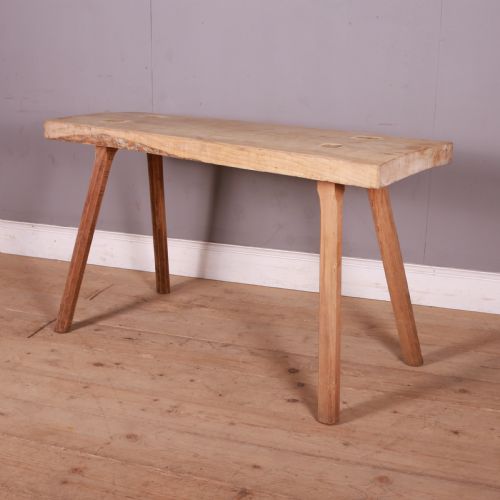

Rustic Splayed Leg Table
A rustic splayed leg table brings honest vernacular character and sturdy everyday utility into a modern room.
Rustic Splayed Leg Table
When you search for a rustic splayed leg table, you encounter robust domestic furniture shaped by practical vernacular traditions rather than formal court design. These pieces span the eighteenth, nineteenth, and early twentieth centuries, drawing on English, French, and Georgian country aesthetics.
The form appears across various functional types, including dining tables, low coffee tables adapted from pig benches, occasional surfaces, and trestle structures. Elm, pine, oak, and sycamore provide the primary building timber, often showing the honest marks of daily household use.
You are most likely to meet seventeenth- to nineteenth-century examples fashioned from solid pine, elm, or oak with visible grain and scrubbed surfaces. Their defining feature remains the angled stance of the legs, which offers reliable stability on uneven flagstone floors.
How they were made
Country joiners built these tables using sturdy domestic timbers like pine, elm, oak, and sycamore, selecting each board for strength rather than uniform grain. Tops were frequently scrubbed clean of old finishes, leaving exposed wood that handles daily wear without pretension.
Legs were angled outward and joined firmly to the underside using traditional pegged joints or wedged tenons to prevent wobble on uneven floors. Iron braces or painted pine elements appear on specific regional forms, adding structural support and distinct visual contrast.
This selection spans pine, elm, oak, and sycamore timbers across the eighteenth, nineteenth, and early twentieth centuries.
What varies in quality
The hierarchy of quality rests upon the integrity of the timber and the honesty of the surface patination. Tables that retain their original scrubbed finish or early painted layers command greater appreciation than those stripped down harshly in later decades.
Proportion and stance dictate visual success, separating a well-balanced country piece from a clumsy imitation. The angle of the splayed legs must support the weight harmoniously while maintaining the clean, unpretentious lines expected of vernacular furniture.
The Rustic Splayed Leg Table Glossary
- Vernacular
- Everyday furniture made by regional carpenters for local domestic use rather than following metropolitan court styles. These pieces prioritise practical function and local timber over decorative excess.
- Scrubbed
- A finish achieved by vigorous washing and scouring of wooden tabletops to remove grease and stains. This process leaves the natural grain pale, clean, and pleasingly textured.
- Splayed
- Angled outward from the centre for increased stability and broader footprint support. This stance prevents tipping on uneven stone floors.
- Pig bench
- A low wooden bench traditionally used in agricultural settings, repurposed today as a low coffee table. They display thick timber tops and sturdy legs shaped by heavy daily use.
- Primitive
- An early, unrefined style of construction lacking sophisticated joinery techniques. Makers relied on basic tools and heavy timbers to achieve direct structural solutions.
Rustic Splayed Leg Table: Frequently Asked Questions
What is a rustic splayed leg table?
A rustic splayed leg table is a piece of country furniture featuring outward-angled legs designed for stability on uneven floors. These tables were built from timbers like pine, elm, and oak to serve practical domestic or agricultural roles.
They reflect regional craftsmanship from the eighteenth and nineteenth centuries, offering honest utility and robust construction without formal ornamentation.
How were these tables used originally?
Makers constructed these tables for demanding everyday tasks in farmhouses, workshops, and kitchens. Some served as dining surfaces, while others functioned as low benches or work tables.
Their sturdy build allowed them to withstand heavy daily labour, handling everything from food preparation to trade work in rural settings.
How do I style a rustic table at home?
These tables anchor contemporary and traditional interiors alike by introducing natural texture and historical depth. Pair them with simple seating or let them stand alone as a central coffee or dining surface.
Their neutral wooden tones complement both minimalist spaces and richly layered rooms, celebrating the natural grain of the timber.
How can I tell the age of a country table?
Age is revealed through tool marks, timber shrinkage, and the natural wear patterns accumulated over centuries of use. Hand-cut joinery and authentic surface patination indicate an early date of manufacture.
Comparing the wood species and construction methods against known regional traditions helps determine whether a piece belongs to the Georgian or Victorian era.