


Ruby Glass Vessel
These ruby glass vessel pieces bring deep crimson colour and brilliant cut crystal to a room, offering both decorative presence and historic craftsmanship.

Ruby Glass Vessel
A ruby glass vessel takes several forms across the inventory, ranging from vases and carafes to jars, jugs and decorative baskets. Collectors searching for a ruby glass vessel encounter items spanning the Victorian era, the Edwardian period and the early twentieth century.
How they were made
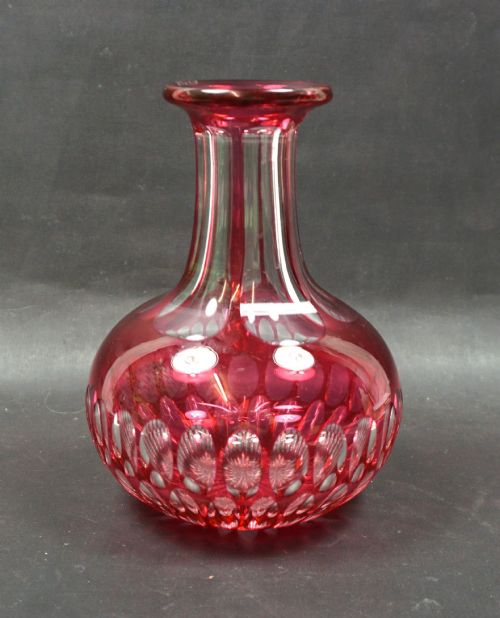
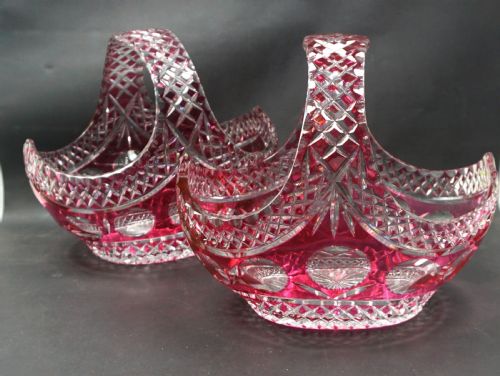
Makers utilised layered techniques, fusing rich ruby or cranberry glass over clear crystal before cutting away portions to reveal the contrasting transparent layer underneath. This overlay method required precise skill in both glassblowing and subsequent wheel cutting.
Surface ornamentation involved hand engraving, such as detailed fruiting vines, alongside delicate white enamel painting seen in Mary Gregory pieces. Artisans also applied gold leaf detailing to enhance the decorative impact of the vessels.
The listings span from the 1860s Victorian era through Edwardian designs to 1930s Art Deco pieces.
What varies in quality
Excellence in a ruby glass vessel rests upon the depth and uniformity of the coloured glass layer and the crispness of the cut crystal facets. Superior pieces display clean, sharp cuts that penetrate precisely through the ruby exterior to the clear glass beneath.
Decoration also dictates distinction, where finely hand-engraved motifs or carefully rendered enamel painting demonstrate higher artistry than standard moulded surfaces. The weight and clarity of the underlying lead crystal further distinguish finer examples.
Val St. Lambert
The Ruby Glass Vessel Glossary
- Cranberry Glass
- A transparent pinkish-red glass produced by adding gold chloride to the molten batch. It became particularly popular during the Victorian period for tableware and decorative items.
- Mary Gregory
- A style of glass decoration featuring white enamel silhouettes of children amidst foliage or pastoral settings. The technique gained prominence in the late nineteenth century.
- Overlay
- A manufacturing method where a layer of coloured glass is cased over a body of clear glass. Craftsmen then cut through the outer layer to create contrasting patterns.
- Bohemian Glass
- Glassware produced in the regions of Bohemia and Silesia, renowned for vibrant colours and intricate cutting techniques. It represents a major tradition in nineteenth-century decorative glass.
Ruby Glass Vessel: Frequently Asked Questions
What is cranberry glass?
Cranberry glass is a distinctive transparent red glass coloured using gold chloride during the melting process. It gained immense popularity throughout the Victorian era.
This glass type forms the basis of many decorative vessels, jugs and jars seen in nineteenth-century collections.
How do I identify Mary Gregory glass?
Mary Gregory pieces are identified by their characteristic white enamel painting depicting children in outdoor scenes. The figures usually appear in silhouette with fine line details.
This specific decorative style appears frequently on cranberry glass vases and jars from the Victorian and Edwardian periods.
What is overlay crystal?
Overlay crystal involves fusing a layer of coloured glass over a colourless crystal base. Artisans then cut away sections of the outer layer to expose the clear glass underneath.
This technique creates striking contrast and highlights the weight and clarity of the crystal vessel.
How should I display these vessels?
These vessels suit placement near natural light sources to illuminate the rich crimson tones and cut crystal facets. Pairing items in matching pairs creates a balanced display on mantelpieces or cabinets.
Care should be taken to place them on stable surfaces away from direct edges due to their delicate material.