

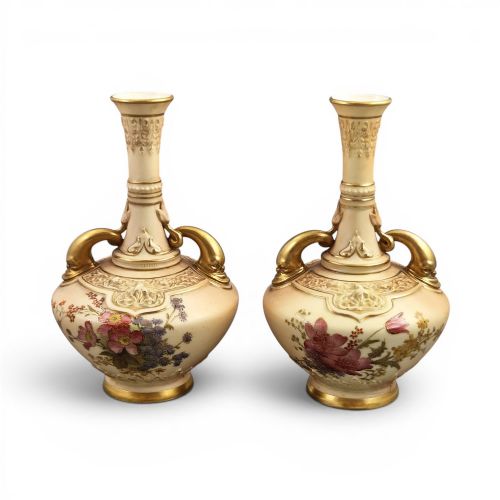
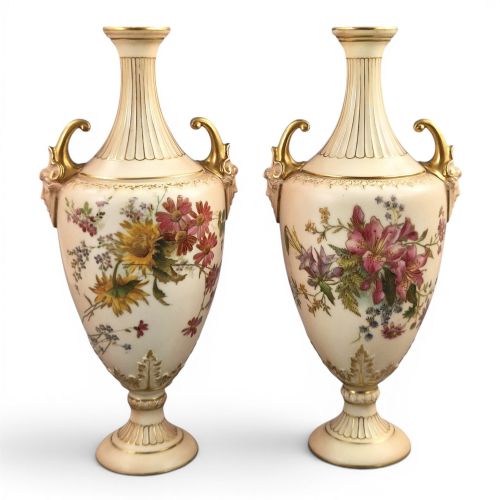


Royal Worcester Urn Pair
These royal worcester urn pair examples bring together fine porcelain, hand-painted decoration and gilt detailing, prized by collectors for their mastery of English ceramic design.
Royal Worcester Urn Pair
A royal worcester urn pair represents the height of British ceramic production, spanning periods from the Regency era through the Edwardian years and into the mid-twentieth century. These decorative vessels take various forms including lidded urns, pedestal vases and ewers, often designed to match symmetrically for display.
The blush ivory ground serves as a common signature of the factory, providing a soft backdrop for hand-painted florals, birds and pastoral scenes. Collectors encounter both miniature pieces and larger covered urns bearing standard factory date ciphers and pattern numbers.
Materials and manufacture
Potters shaped these pieces from fine porcelain, applying smooth glazes to create the characteristic surfaces seen on blush ivory wares. Enamel colours were then hand-painted onto the body, depicting natural subjects such as birds, cattle and floral sprays.
Applied gold leaf and gilding highlight handles, rims and pedestals, often combining with raised enamel work or moulded details like dolphins and swans. Skilled artists signed their work directly onto the ceramic body before a final kiln firing fixed the design.
Royal Worcester Urn Pair Retail Price Guide 2026
Typical asking prices for royal worcester urn pair among the pieces listed under this phrase on Sellingantiques today, from the lower quarter to the upper quarter. They describe what is for sale here now, not the wider market.
Several pairs feature hand-painted highland cattle and swans, proving that nineteenth-century ceramic artists loved birds and beasts as much as flowers.
Judging quality in matching vessels
The distinction between standard production wares and exceptional pieces rests upon the identity and skill of the painter. Signed works by established studio artists command greater interest than unsigned factory decorated counterparts.
The crispness of the moulding, the complexity of the gilt work and the preservation of the delicate enamel colours also define the standing of a pair. Complete sets retaining original matching covers demonstrate superior preservation.
Royal Worcester·Flight Barr & Barr·Chivers·C Baldwyn·William Ricketts·John Smith·James Stinton·Harry Stinton·E Raby
The Royal Worcester Urn Pair Glossary
- Blush ivory
- A matte, cream-coloured porcelain body introduced by the factory in the late nineteenth century. It provides a warm background for floral and animal painting.
- Ewer
- A large jug with a wide spout and scroll handle, often produced as a decorative display piece rather than for practical use. Many examples feature classical forms.
- Pot pourri
- A lidded vessel pierced to allow scent to diffuse from dried herbs and flowers contained within. These often feature intricate pierced ceramic covers.
- Gilding
- The application of gold leaf or gold paint to ceramic surfaces to accent handles, rims and structural details. It ranges from simple bands to heavily chased decoration.
Royal Worcester Urn Pair: Frequently Asked Questions
How do I date a pair?
Dating relies on the factory marks stamped underneath the porcelain base, which changed systematically by year through dot and symbol codes.
Style indicators like Victorian aesthetic motifs or Edwardian blush ivory finishes also help narrow down the decade of production.
Are painted signatures important?
Artists who signed their porcelain, such as the Stinton brothers or Baldwyn, produced work of higher individual artistic merit.
Their specific signatures on the body of the vase usually indicate a bespoke or higher tier factory piece.
What is blush ivory?
Blush ivory refers to the pale, creamy matte porcelain finish developed during the late nineteenth century.
It became a signature ground for floral and avian painting across many Victorian and Edwardian pieces.
How should I display them?
These decorative vessels require stable surfaces away from direct sunlight to protect the hand-painted enamel colours and gilt highlights.
Matching pairs look best when symmetrical placement allows both pieces to be viewed together.