




Royal Vienna Platter
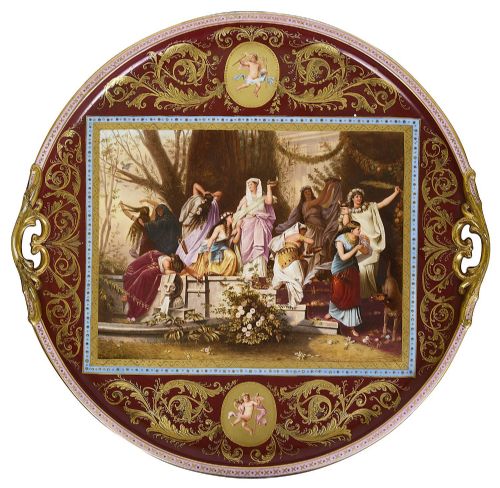
A royal vienna platter brings nineteenth-century neoclassical revival artistry into your room, offering hand-painted mythological scenes framed in rich gilding.
Royal Vienna Platter
A royal vienna platter is a large decorative porcelain piece created in nineteenth-century Vienna style, primarily taking the form of chargers, cabinet plates, and trays. These items function entirely as display objects rather than tableware, often featuring mythological or historical narratives across their surfaces.
The pieces you encounter on this page span the nineteenth century and the year 1890, showing Vienna historicism and neoclassical revival aesthetics. They are dominated by large chargers and decorative trays depicting classical figures like Bacchus, Ariadne, and Adonis.
Collectors seek out these chargers and trays for their ambitious hand-painted pictorial centres and elaborate borders. They represent a specific nineteenth-century European taste for decorative porcelain that mimics earlier classical grandeur through refined artistic execution.
How they were made
These items are fashioned from hard-paste porcelain, providing a smooth, durable white base for detailed miniature painting. Artisans applied cobalt glaze to create deep blue backdrops, establishing a rich contrast against the central figurative artwork.
The decoration relies heavily on polychrome enamel painting combined with applied gold leaf and gilding. Masters painted elaborate scenes such as Calvary or the forge of Vulcan by hand before finishing the rims and borders with intricate gilded ornamentation.
Royal Vienna Platter Retail Price Guide 2026
Typical asking prices for royal vienna platter among the pieces listed under this phrase on Sellingantiques today, from the lower quarter to the upper quarter. They describe what is for sale here now, not the wider market.
Every listing in this selection employs porcelain as the primary material, enriched with gold leaf, gilding, and cobalt glaze.
What varies in quality
Quality in a royal vienna platter rests primarily on the ambition and execution of the hand-painted central scene. Finely rendered figures with expressive faces and detailed drapery elevate a piece far above simple decorative patterns.
The richness of the surrounding ornamentation also dictates the tier of the object. Heavy, precise gilding and complex cobalt glaze work separate standard decorative items from exceptional nineteenth-century Vienna style showpieces.
The Royal Vienna Platter Glossary
- Charger
- A large decorative plate or platter intended solely for display on a wall, cabinet, or sideboard rather than for serving food. These pieces provide a wide canvas for intricate painted narratives.
- Cabinet plate
- A smaller porcelain plate produced specifically for display within a glass-fronted cabinet or on a mantelpiece. They share the detailed artistic decoration found on larger chargers.
- Cobalt glaze
- A deep blue mineral-based colour applied beneath or over the glaze to create intense background tones. It frequently frames the gilt borders on nineteenth-century Vienna porcelain.
- Gilding
- The application of gold leaf or powdered gold paint to the surface of the porcelain. On these trays and chargers, it highlights the neoclassical borders and frames the central paintings.
- Neoclassical revival
- A nineteenth-century artistic movement that drew heavy inspiration from classical Greek and Roman art. The figurative subjects on these plates directly reflect this revivalist enthusiasm.
Royal Vienna Platter: Frequently Asked Questions
What is a royal vienna platter used for?
These pieces were created entirely for visual display rather than practical household use. They add historical elegance and rich colour when placed on a wall or sideboard.
Collectors generally mount them securely or place them on sturdy plate stands. Their detailed painted surfaces make them striking focal points in traditional rooms.
How do I date a vienna porcelain charger?
Dating relies on stylistic clues, nineteenth-century manufacturing traits, and the specific application of cobalt glaze and gilding. Most examples on this page point to the nineteenth century and around 1890.
Examining the depth of the porcelain body and the complexity of the neoclassical revival motifs helps narrow down the production period. Secondary markings on the reverse also offer chronological guidance.
Are these platters meant for serving food?
No, these items are purely decorative cabinet plates, chargers, and trays. Using them for food would risk damaging the delicate hand-painted enamel and gold leaf.
Their value lies in the preserved nineteenth-century artwork depicting classical and mythological scenes. They are fragile objects designed exclusively for aesthetic appreciation.
How do I style a vienna tray at home?
A vienna tray looks best showcased in a well-lit space where its gilded borders and cobalt blue glaze can catch the light. Pair it with dark wooden furniture to contrast against the bright porcelain.
Ensure it rests securely on a dedicated display stand or a secure wall mount. It serves well as a standalone conversation piece in a study or drawing room.