

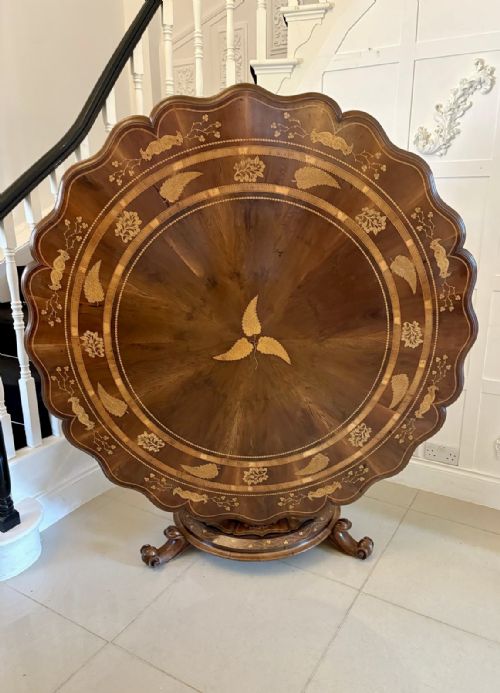
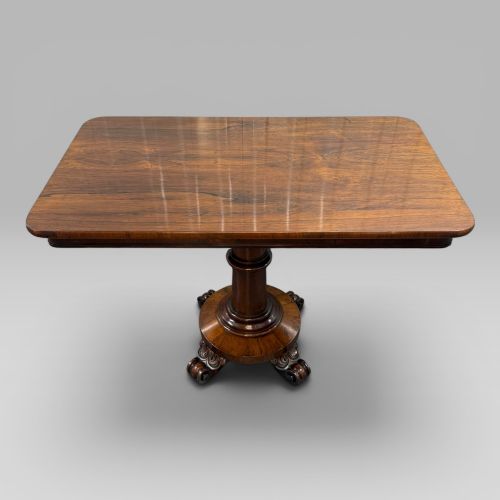


Round Wood Foyer Table
A round wood foyer table anchors a large entrance hall with balanced proportions and a surface for a central floral arrangement.
Round Wood Foyer Table
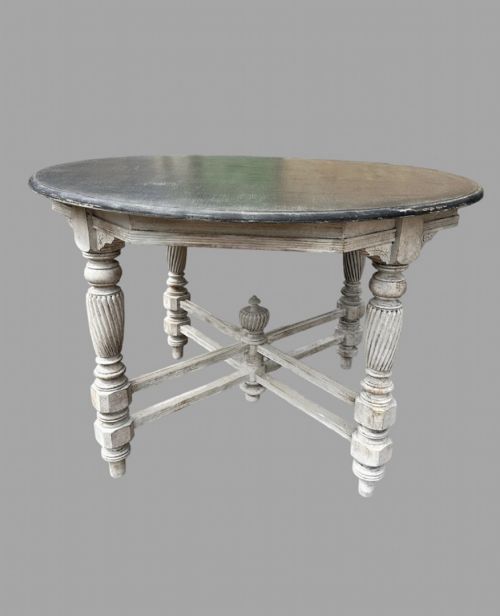
A round wood foyer table functions as a central focal point in an entrance hall, providing a surface that greets visitors upon arrival. These tables often take the form of centre tables, gueridons, or occasional tables adapted from nineteenth-century forms.
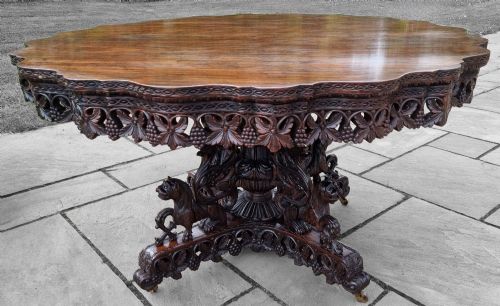
The pieces seen here span periods from the Regency era through the nineteenth century and into the 1920s and 1930s. Regional variations include French, Swedish, Anglo-Indian, and English workshops, with forms ranging from tilt-top breakfast tables to heavy pedestal centre tables.
Materials and construction methods
Cabinet makers utilised dense hardwoods such as mahogany, rosewood, walnut, and padauk, often laid over sturdy secondary timbers. Marquetry inlay, specimen woods, and brass detailing appear frequently across the surfaces and borders.
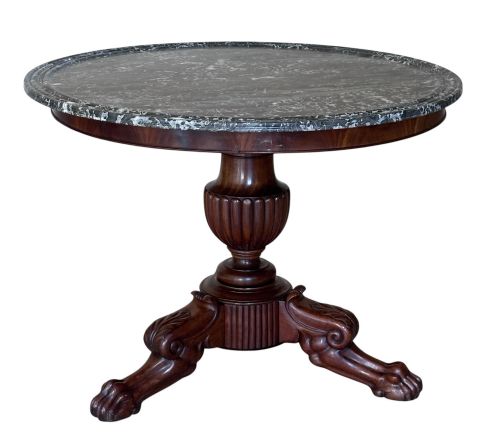
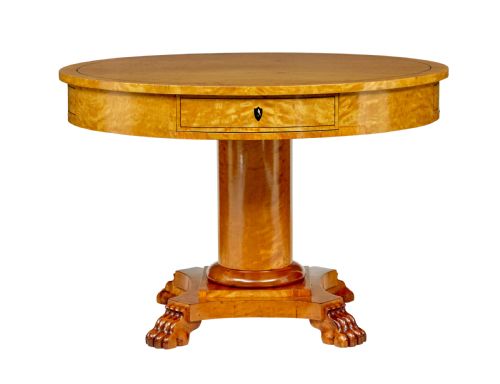
Many examples feature heavy central pedestals resting on tripartite or quadrupartite plinths, while others employ stone tops including white and specimen marble fitted directly to wooden frames.
Some nineteenth-century examples conceal built-in writing slopes beneath their circular tops for clandestine correspondence in the hall.
Evaluating craftsmanship and condition
Quality rests in the precision of the timber selection, such as the choice of burr elm, birdseye maple, or matched rosewood veneers. Finer examples display meticulous hand-cut marquetry and seamless integration of marble or brass elements.
Structural integrity of the central pillar and the stability of the tabletop connection separate standard production from exhibition pieces. The crispness of carved mouldings and the preservation of original polished finishes dictate the standing of an individual table.
Egan Workshop·James Winter of Wardour Street·Whytock and Reid
The Round Wood Foyer Table Glossary
- Gueridon
- A small French round table, typically supported by a central column or figures, used as a stand or decorative centrepiece.
- Marquetry
- Decorative veneer work where pieces of wood, shell, or ivory are fitted into a ground to form geometric or pictorial designs.
- Tilt-top
- A tabletop hinged to a pedestal base so it can be folded vertically and stored against a wall when not in use.
- Pedestal
- A single central support column carrying the weight of the tabletop, frequently resting on scrolled feet or a platform base.
- Specimen wood
- Timbers chosen for their contrasting natural colours and grain patterns, often arranged in geometric panels or sample arrangements.
Round Wood Foyer Table: Frequently Asked Questions
How were these tables used historically?
These tables served as focal points in large entrance halls and reception rooms, providing a surface for decorative objects or lighting.
They also functioned as centre tables where families gathered or displayed collections of books and ceramics.
Can a round wood foyer table hold heavy items?
Most examples rely on heavy central pillars and weighted pedestal bases designed to bear substantial downward pressure without tipping.
Marble-topped variants offer exceptional weight and stability for daily use in busy hallways.
How do I identify a Regency period table?
Regency tables typically feature classical motifs, dark mahogany or rosewood timbers, and often incorporate brass inlay or gilt bronze mounts.
Their architectural lines reflect early nineteenth-century neoclassical design influences.
What is the difference between a gueridon and a centre table?
A gueridon is generally a lighter, French-influenced round table often featuring a marble top and slender supports.
Centre tables tend to be heavier English or continental pieces designed to sit freestanding in the middle of a room.