
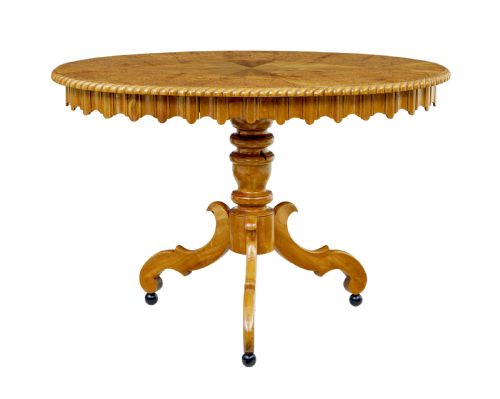
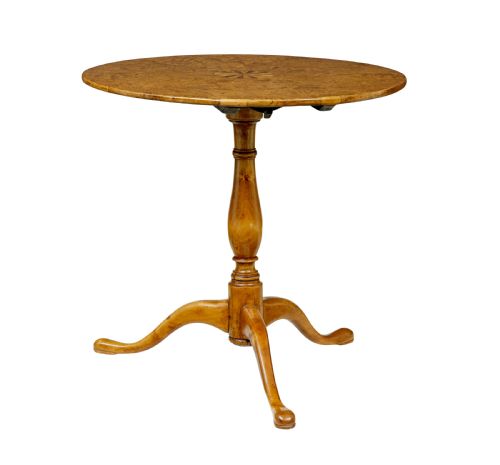
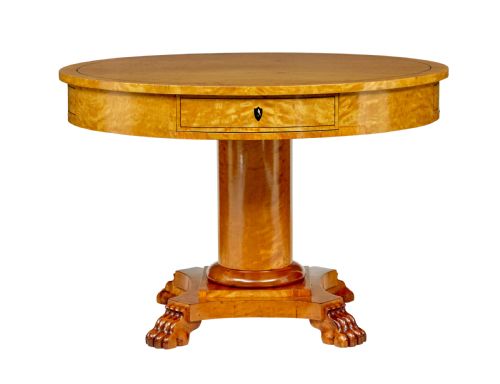


Swedish Birch Round Table
A swedish birch round table brings light wood tones and clean proportions into a room, combining form and utility across multiple design movements.
Swedish Birch Round Table
When you search for a swedish birch round table, you encounter pieces spanning the nineteenth century up through the nineteen-thirties. The selection encompasses centre tables, occasional tables, coffee tables, and lamp tables created in Scandinavian workshops.
Nineteenth-century examples frequently display Biedermeier, Karl Johan, or Swedish Empire influences, often utilising rich figuring like burr or flame timber. Later pieces shift into Scandinavian Art Deco and Swedish Grace aesthetics, demonstrating how makers adapted circular formats across different decades.
Materials and construction
The primary material is birch, worked in various forms including solid timber, satin birch, birch veneer, burr birch, and birch root to create distinct surface patterns. Workshops frequently incorporated contrasting details such as ebony inlay or timber inlay to accentuate the natural grain.
Construction techniques balanced structural stability with decorative surface design, applying figured veneers over sound timber cores. Surfaces received careful polishing to highlight the blonde and golden tones inherent in the birch.
The site listings feature pieces spanning the nineteenth century, nineteen-twenty, and nineteen-thirty, built from birch, satin birch, burr birch, and ebony.
Distinctions in craftsmanship
Quality rests on the selection and matching of the wood veneers, where superior examples exhibit striking, symmetrical grain patterns across the circular top. The choice of secondary elements, such as precise ebony inlay or carved details, elevates the execution.
Proportion and the handling of period styles also define the grade of a piece. Earlier Biedermeier and Karl Johan models rely on monumental simplicity, whereas later Art Deco and Swedish Grace versions depend on geometric restraint and refined surface finishes.
The Swedish Birch Round Table Glossary
- Birch
- A pale hardwood native to northern Europe, prized for its fine grain and ability to take a high polish. It serves as the primary structural and decorative medium for these tables.
- Burr Birch
- A specialised timber cut from tree growths, producing swirling, highly decorative grain patterns. Makers utilised these sections for prominent table tops.
- Centre Table
- A freestanding table designed to be viewed from all sides, placed in the middle of a room rather than against a wall. Nineteenth-century examples often feature substantial circular tops.
- Biedermeier
- A influential Central and Northern European design style spanning the nineteenth century, emphasising utilitarian comfort, clean lines, and polished veneers without excessive ornamentation.
- Inlay
- A decorative technique where contrasting materials like ebony or other timbers are inserted into recessed portions of the base surface to create patterns.
Swedish Birch Round Table: Frequently Asked Questions
What periods do these tables cover?
The available tables span from the nineteenth century through the nineteen-thirties. This includes nineteenth-century pieces alongside nineteen-twenty and nineteen-thirty examples.
Design influences range from early nineteenth-century Biedermeier and Karl Johan styles to later Scandinavian Art Deco and Swedish Grace movements.
How were centre tables used?
Centre tables served as prominent freestanding furniture pieces positioned in the middle of principal rooms. They held lamps, books, or decorative objects while functioning as visual anchors for the interior.
Smaller variants like occasional tables, lamp tables, and coffee tables offered similar versatility for sitting rooms and parlours.
What woods besides birch appear?
While birch forms the foundational material - utilising plain, satin, burr, flame, and root variations - other timbers support the design. Ebony and various contrasting woods appear specifically as inlay details.
Selected pieces also incorporate elm alongside the birch structure to introduce textural contrast.
How do I distinguish Biedermeier from Art Deco?
Biedermeier pieces from the nineteenth century emphasise warm, highly figured burr or flame birch veneers with classical, restrained proportions. They reflect an aesthetic focused on domestic comfort and natural wood grain.
Nineteen-twenties and thirties Scandinavian Art Deco pieces introduce geometric styling, streamlined forms, and contrasting inlay work that reflect twentieth-century modernism.