

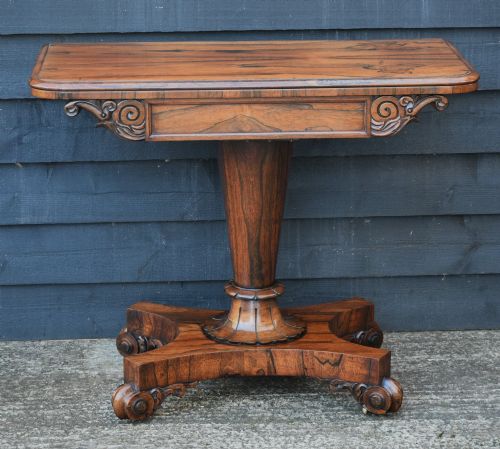
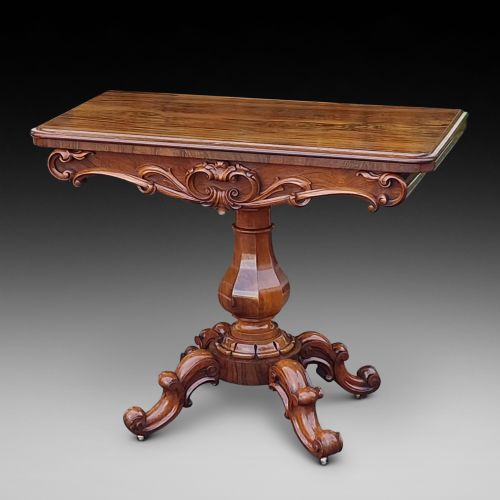
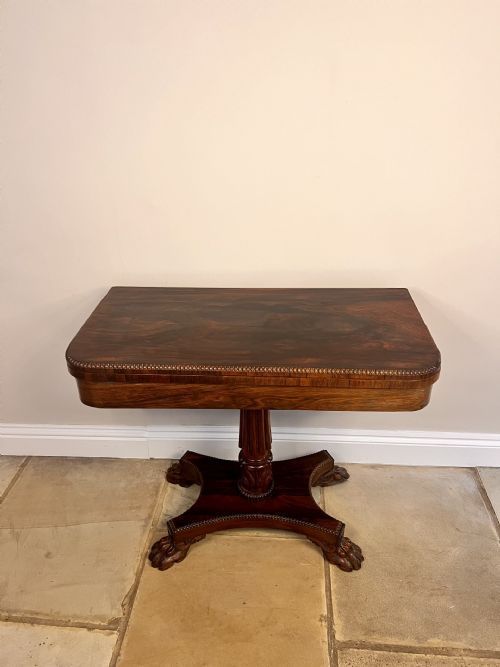


Rosewood Swivel Table
A rosewood swivel table combines dense tropical timber with a pivoting top that conceals games surfaces and storage.
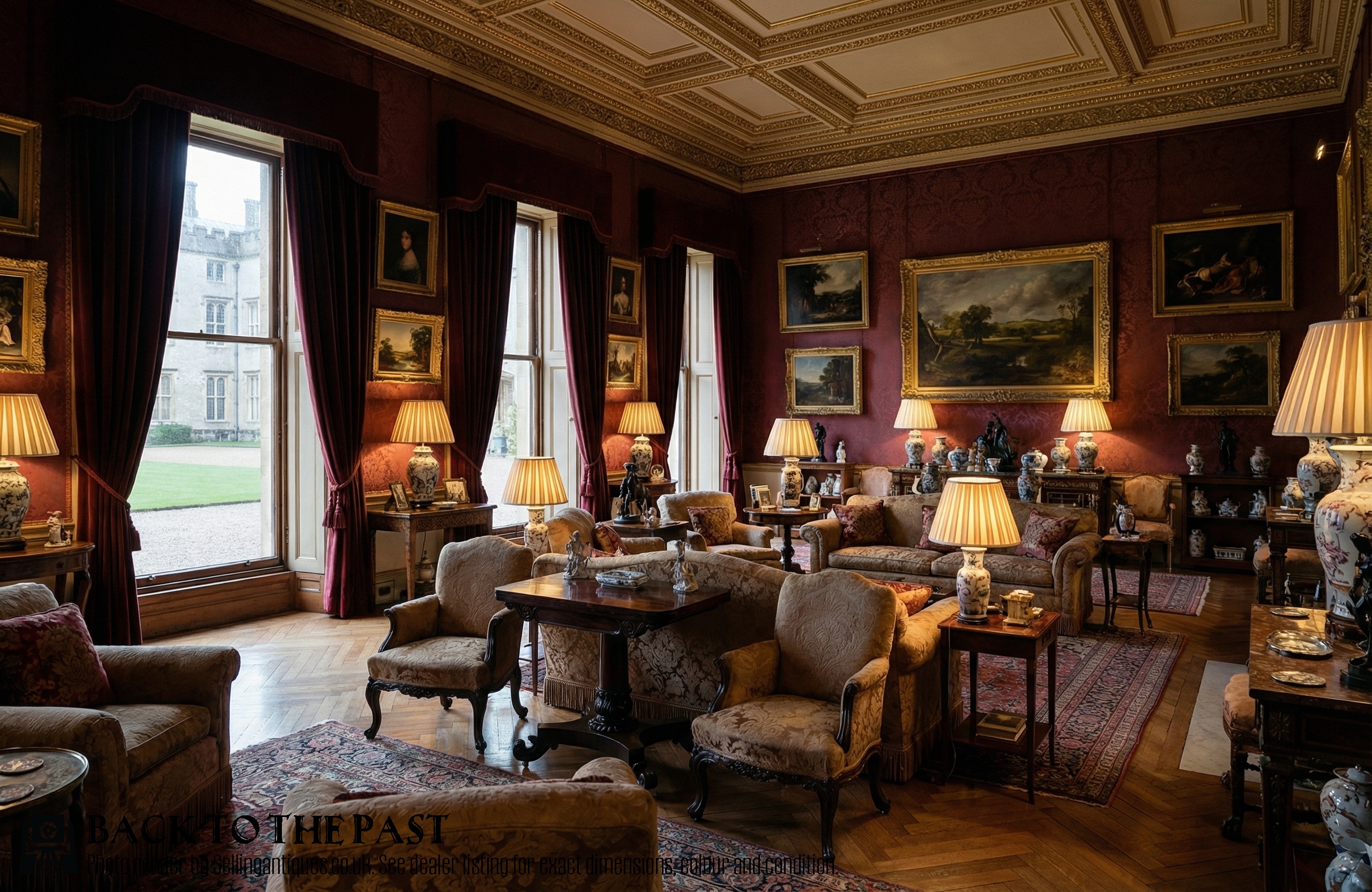
Rosewood Swivel Table
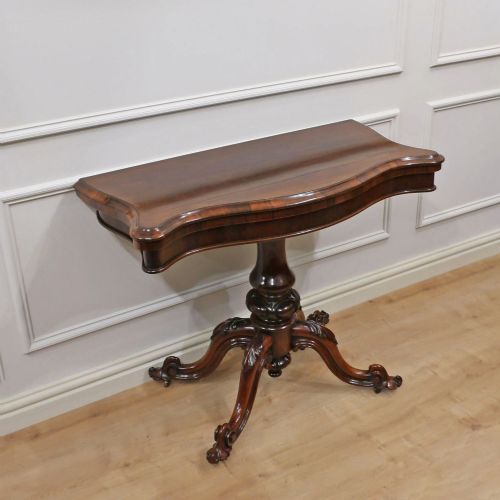
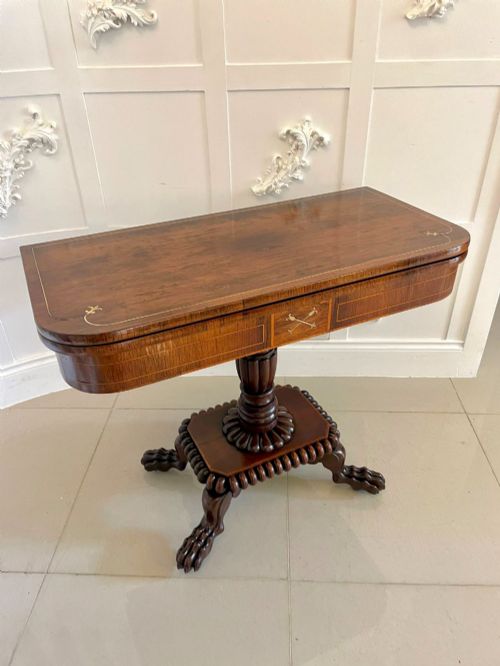
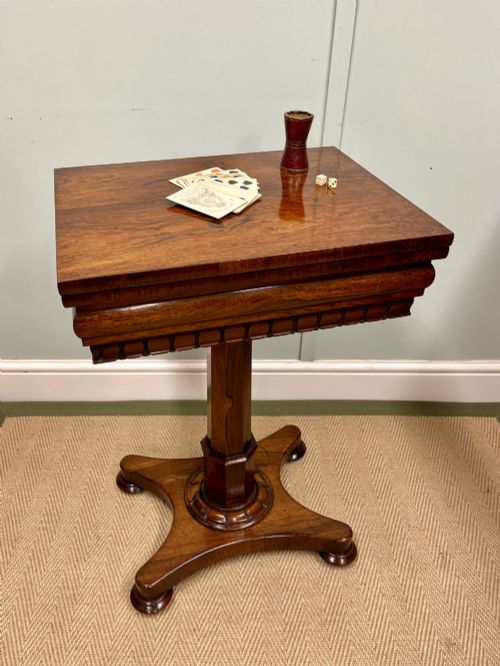
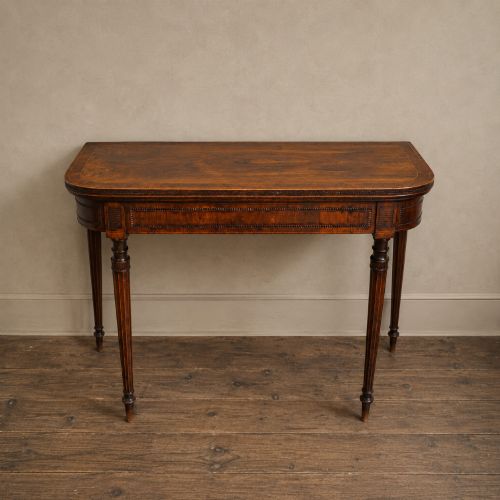
A rosewood swivel table primarily appears as a card, games or tea table with a hinged, pivoting top resting on a central pillar and platform base.
Most examples originate from the Regency, William IV and Victorian periods, spanning the early to late nineteenth century.
Common variants include folding surfaces lined with baize or leather for card games and chess, alongside occasional dressing stools and side tables.
Materials and Construction
Cabinetmakers utilised heavy tropical rosewood, frequently applied as fine veneers over secondary timbers like mahogany and accented with contrasting boxwood stringing.
Brass inlay, intricate carving and burr yew crossbanding appear regularly on Regency and William IV pieces.
The pivoting mechanism relies on robust timber pivots or brass swivels that allow the folding top to rotate ninety degrees and lock parallel to the pedestal base.
Some tables hide compartments so deep you could lose a royal flush and your patience before finding them again.
Quality and Execution
Superior execution shows in the crispness of carved pedestal details, the alignment of figured grain across the fold-over leaves, and the stability of the central pillar.
Lesser pieces exhibit simpler turned columns without carved enrichment and plainer timber selections with less pronounced figuring.
Gillows·T and G Seddon·William Trotter
The Rosewood Swivel Table Glossary
- Crossbanding
- A border of veneer laid perpendicular to the grain of the main surface. This technique frames the top of the table.
- Baize
- A coarse woolen material used to line gaming and card surfaces. It provides a flat, soft texture for playing cards.
- Revolving
- The action of the table top turning on its base to reveal a hidden compartment. This mechanism supports the folding leaves.
- Pedestal
- A central support column rising from a platform base with feet. It bears the weight of the swivelling top.
Rosewood Swivel Table: Frequently Asked Questions
How do I use the swivel top?
Lift the top slightly and rotate it ninety degrees to uncover the concealed well underneath for storing cards and gaming pieces.
Lower the leaf flat once turned so the unfolded surface rests securely on the base.
What games were played on these?
These tables served primarily for card games such as whist, alongside chess and backgammon on specialised inlaid boards.
The baize or leather lining provided a suitable friction surface for handling playing cards.
How do I date a table?
Examine the pedestal carving, leg shapes and secondary timbers to distinguish Regency pieces from later Victorian examples.
Regency models often feature brass inlay and bolder crossbanding, whereas Victorian versions tend toward heavier proportions and carved scroll feet.