
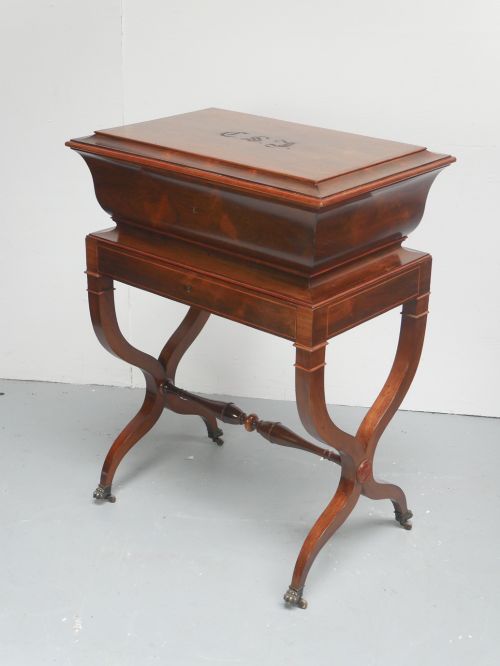


Rosewood Sewing Casket
A rosewood sewing casket is a fitted wooden box for needlework implements that brings rich grain and compartmented storage to a dressing table or desk.
Rosewood Sewing Casket
A rosewood sewing casket is a portable container designed for needlework supplies, featuring internal trays and compartments for threads, needles, and thimbles. When searching for a rosewood sewing casket, buyers encounter variations spanning the Regency, William IV, and Victorian periods.
The pieces on this page appear predominantly as table-top work boxes, alongside occasional sarcophagus shapes and work tables. Most examples date from the nineteenth century, including pieces decorated with Tunbridge Ware or mother-of-pearl inlay.
Makers shaped these caskets into rectangular or sarcophagus forms, often mounting them on bun feet or stands. The interiors typically reveal fitted compartments lined in silk, designed to organise the tools of a Victorian lady's needlework.
Factors that distinguish quality
Quality rests on the precision of the cabinet work, the intricacy of the mother-of-pearl or Tunbridge Ware inlay, and the survival of the original fitted interior. Caskets with intact silk linings and complete internal compartment trays stand apart from altered examples.
The choice of rosewood grain and the crispness of brass stringing or marquetry define the visual standard. Pieces featuring sculptural sarcophagus contours or complex multi-wood mosaics reflect higher workshop skill than plain rectangular boxes.
Listings feature rosewood, mother-of-pearl, boxwood, and bone across Regency and Victorian periods.
Lesage
The Rosewood Sewing Casket Glossary
- Rosewood
- A dense, dark timber with a pronounced grain pattern valued for high-end nineteenth-century cabinet work. It takes a fine polish and forms the primary exterior shell of these caskets.
- Tunbridge Ware
- A type of woodwork featuring minute mosaic decoration made from differently coloured natural woods. It creates pictorial or geometric patterns on box lids and panels.
- Sarcophagus
- A box shape with a domed or stepped lid and sloping sides, resembling an ancient stone coffin. This form became popular for Regency and Victorian work boxes.
- Marquetry
- The art of applying pieces of veneer to a structure to form decorative patterns and pictures. It appears on the lids and bodies of many nineteenth-century boxes.
- Work box
- A portable container fitted with compartments and trays for holding sewing equipment and trinkets. These objects were standard accessories for ladies in the nineteenth century.
Rosewood Sewing Casket: Frequently Asked Questions
How do I date a rosewood sewing casket?
Dating relies on the overall form, inlay materials, and interior fittings. Regency pieces often exhibit classical proportions and brass stringing, while Victorian examples frequently incorporate mother-of-pearl or Tunbridge Ware.
Examination of the secondary woods, hinges, and silk linings also helps narrow the period of manufacture. Sarcophagus shapes tend to span the late Regency to mid-Victorian decades.
Were these caskets only used for sewing?
While primarily designed for needlework implements like bobbins, bodkins, and pins, many served broader purposes. Contemporary descriptions often list them as work and jewellery boxes.
Their fitted interiors accommodated personal trinkets and letters alongside sewing tools. The removable trays allowed owners to reconfigure the storage space as needed.
How should I care for rosewood and silk interiors?
Rosewood requires stable humidity and protection from direct sunlight to prevent the timber and veneers from drying out. Occasional treatment with suitable wax helps maintain the polish.
Original silk linings are fragile and benefit from gentle dusting with a soft brush rather than liquid cleaners. Keeping the boxes away from heat sources preserves both the wood and the interior fabrics.