
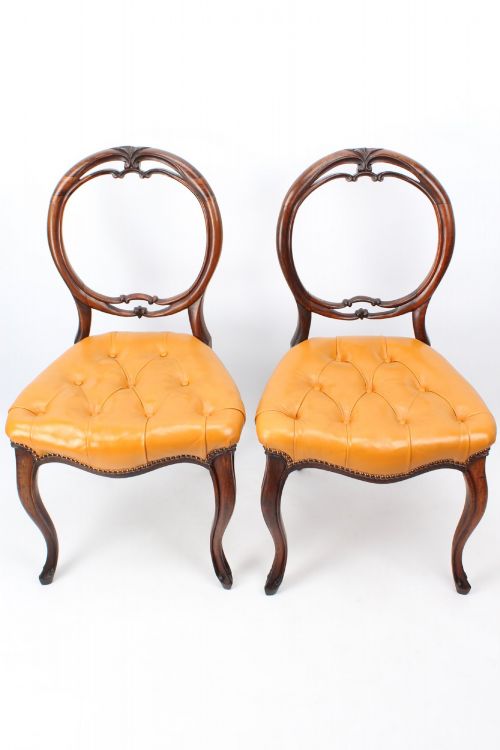
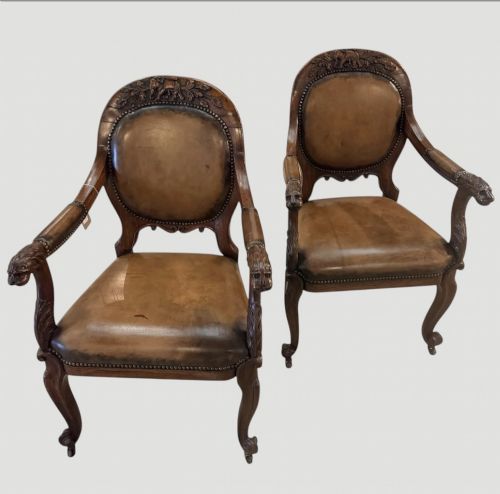


Rosewood Leather Chair
These rosewood leather chair examples bring together rich dark timbers and traditional upholstery, offering substance and period character for a study or library.
Rosewood Leather Chair
A rosewood leather chair combines dense, heavily grained tropical hardwood with leather upholstery, forming seating that ranges from compact side chairs to large library armchairs. These pieces emerge across the Regency, George IV, William IV, and Victorian periods, often taking the form of library armchairs, desk chairs, and dining sets.
The version most commonly met on this page is the Victorian or Regency library armchair, alongside pairs of dining and desk chairs. Makers utilised the distinct grain of rosewood alongside simulated or faux rosewood finishes to create substantial seating.
Origins stretch from English workshops to Anglo-Indian Colonial production and continental workshops like the Louis Philippe style, reflecting broad nineteenth-century design tastes.
Materials and construction
Frames rely upon solid rosewood or simulated rosewood timber, frequently accented with brass inlay or turned and carved wooden details. Cabinetmakers selected these dense woods for structural durability.
Upholstery involves traditional leather, often finished with button-back detailing, stretched over sprung or padded seat foundations. Caning also appears alongside leather on specific bergere forms.
Joinery techniques from the nineteenth century bind the heavy wooden frames, supporting the weight of carved cabriole legs, balloon backs, and reclining mechanisms.
Several chairs feature reclining mechanisms, proving that nineteenth-century readers took their post-lunch relaxation very seriously indeed.
Distinctions in quality
Quality rests upon the depth of the rosewood grain, the crispness of the hand-carving on frames, and the integration of brass elements. Superior examples display harmonious timber selection across structural members.
The execution of the leather upholstery and the preservation of the original wooden frame separate standard production from exceptional cabinetmaking. Maker attributions, when present, elevate the standing of a piece.
Robert Daws·Gillow·Druce and Co
The Rosewood Leather Chair Glossary
- Bergere
- An enclosed upholstered armchair with wooden framing, often featuring cane or leather panels. This French-influenced form appears frequently in Regency library seating.
- Balloon back
- A rounded, oval chair back resembling the shape of a balloon, popular during the Victorian era. It provides both decorative carved detail and ergonomic support.
- Simulated rosewood
- A painted or grained surface finish mimicking the distinctive dark figures of genuine rosewood. Cabinetmakers utilised this technique on alternative timbers during the Regency period.
- Cabriole leg
- A furniture leg featuring a double curve, bowing outward at the knee and tapering inward at the ankle. This form appears on mid-nineteenth-century armchairs.
- Button back
- An upholstery style where buttons are pulled deep into the padding to create a diamond pattern. It secures the leather while offering structured cushioning.
Rosewood Leather Chair: Frequently Asked Questions
How do I identify a Regency period chair?
Regency pieces often display classical architectural influences, crisp reeded legs, and brass inlay set directly into the dark timber.
Look for proportions and joinery typical of the early nineteenth century rather than later Victorian revival adaptations.
How should I care for antique leather?
Maintain antique leather by applying suitable conservation leather balms to prevent drying and cracking over time.
Avoid placing these chairs in direct sunlight or near heat sources that might damage both the hide and the rosewood frame.
Are simulated rosewood frames authentic?
Simulated or faux rosewood is an authentic nineteenth-century technique where secondary woods are painted to imitate expensive tropical hardwoods.
This method allowed makers to achieve a high-status appearance during periods of timber restriction.